1173. Benjamin Robert Haydon to EBB
As published in The Brownings’ Correspondence, 6, 356–358.
| Confidential | London |
March 7. 1843
My dearest Friend,
I can believe that of Caroline Norton, but she met her match here, and was completely floored; what I admired so much was in Mary, her fearless determination to stand up for her own love & rights, and she did it like a Heroine; there was no cause for her uneasiness, but she fancied it; [1] it was fine—the children took Mama’s part, with such fury, that a fine bust I had of her, when I was out, they took down in the Court & beat it all to pieces–
This is entirely confidential—sometimes one longs to tell all sorts of things—and is afraid to open one’s lips– She excited my imagination terrifically & nothing but my devoted love to one dear being saved my brain—but it was a terrific struggle, & I look back on it, with terror——
You must know, I never loved properly but once, and then I married—nor do I believe any one can love with equal intensity, twice–
Caroline Norton’s eyes & air, & talents burdened me, & I suffered agony at times, but the heartlessness of fashion, is its own cure: still, I cannot bear the thought, that even in thought, my allegiance was disturbed—only disturbed–
She had a hankering to disturb families, but she caught a Tartar [2] here—more hereafter—at which you will be highly interested.——
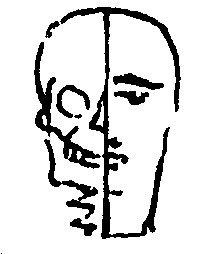
Why you must be convinced I am the quintessence of Vanity!– My own head for Solomon & Curtius!– Ay and Alexander the Great! and Dentatus! dont faint—you must know, you study your own head for Expression, and you will find chalk studies, but it is only as a help– Except in Curtius, for which my head is the best I ever saw, I have never made a Portrait—the sly malice of the Critics is exquisite– They pretended not to know it is myself, call it chubby cheeked, & a want of the heroic, [3] & all sorts of things to reach me as if ignorant–
To illustrate the principle– I will tell you an anecdote– I had an old Servant & model, an old Life guardsman who make the best servants in the World– I always rubbed in my Pictures from him Man, Women and children, using him only to keep me right[.] One day Lord Elgin [4] called when I was out, and walked into the painting room, Salmon attended him, the Picture was the Christ entering Jerusalem, [5] where I had a Penitent Girl, hiding her face, and ushered into Christ[’s] presence by her anxious Mother– The whole was merely Sketched in– Lord Elgin said who sat for that, & who sat for this, & the old Soldier (bolt upright) as if on duty, said to every question I did—My Lord—who sat for the Mother? said Lord Elgin– I did my Lord, said Salmon (6 feet 3 high & heroic in figure)—& who sat for that beautiful Girl[,] I did My Lord, said Salmon at which Lord Elgin burst into a fit of Laughter & said[,] By heavens you are a useful model!– Lord Elgin was fond of a good story, & made the more of this, as you may imagine[.]
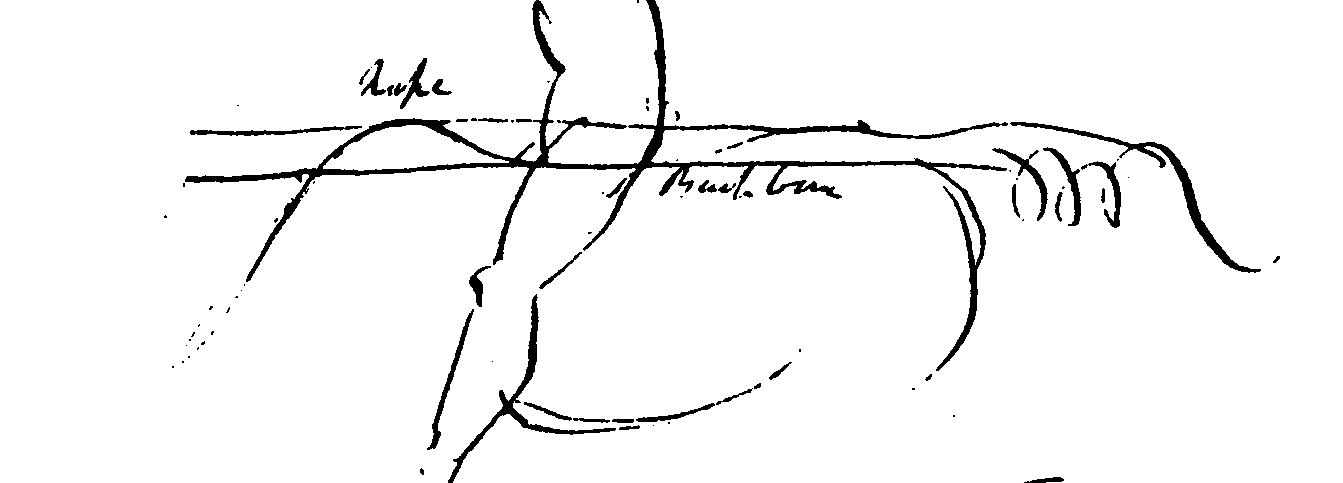
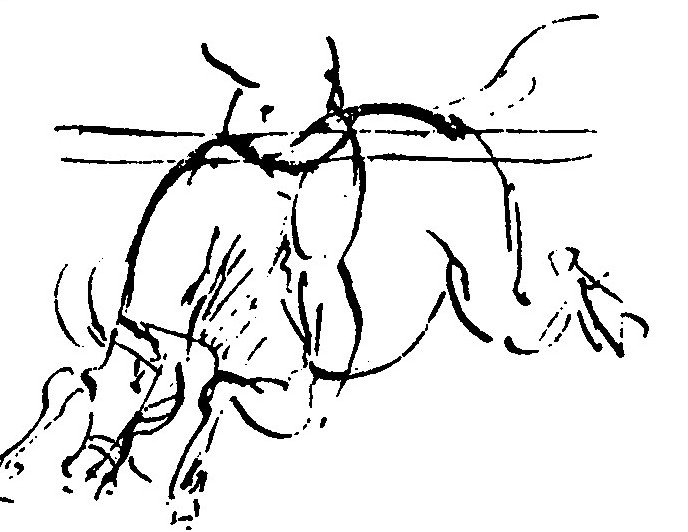
They abuse Curtius as if sitting too low in the Horse [6] —mere trash here is a section– Illus.
Put this in front– Illus.
I have done all but the Fool, which I do today—I mean to make him & John the only grave personages in the Cartoon [7] —The one grave at the uncertainty of Fortune, the [other] grave at the blindness of human Triumph! Illus. as I have seen in an old print—have you read Madam d’Arblay– I hurt my eyes last night reading the article in the Edin[burgh] it is excellent & I suspect Macaulay; have you seen his lays? [8] —or Eyre’s narrative [9] —or Pressnitz on Water– [10] Mary is mad about it, & is drinking cold water like a Fish—which I have done all my life–
Oh you delicate creature does the East Wind touch you? I suppose I shall come to it–
God bless you– I’ll send down two or more folios—as they seem to please you & then return the others– I shall be ever delighted & consider it a duty to relieve by trifles now & then your peculiar state, though your own mind is quite enough for its own solace–
Ever yours
B R Haydon
Miss B. Barrett
Address: Miss B. Barrett, / 50. Wimpole St
Publication: EBB-BRH, pp. 45–48.
Manuscript: University of Vermont.
1. Mary Haydon was indeed distressed by her husband’s infatuation with Caroline Norton. An entry in her commonplace book dated “Sunday, August 1834” noted that “I have passed another night of great suffering.... I ask for redress from the Almighty for the deep, deep misery I have suffered and suffered without cause” (EBB-BRH, p. 47).
2. i.e., met her match.
3. Haydon refers to the article in The Spectator (see letter 1156, note 3).
4. Thomas Bruce, 7th Earl of Elgin (1766–1841), while Ambassador to the Sublime Porte, was responsible for the transfer of more than 80 cases of antiquities from Greece, including the Parthenon sculptures now known as the Elgin Marbles. Haydon was instrumental in persuading the British government to purchase them in 1816.
5. Haydon’s painting of “Christ’s Entry into Jerusalem,” commenced in 1814 and completed in 1820, was exhibited in the Egyptian Hall in 1820.
6. Haydon noted in his diary on 13 March: “The critics say Curtius is too low on his seat—the noodles” (Pope, V, 253), but we have not found this criticism in print.
7. i.e., “The Black Prince Entering London in Triumph.”
8. EBB had commented on this review to Miss Mitford in letter 1164; it was unsigned, and we have not been able to verify Macaulay’s authorship. EBB mentioned his Lays of Ancient Rome in letters 1072 and 1105.
9. Lt. (later Sir) Vincent Eyre (1811–81) was Deputy Commander of Ordnance at Kabul at the time of the Afghan uprising in 1841. Eyre, who was severely wounded, his wife and child were taken as hostages, kept imprisoned, and threatened with being sold into slavery; they were rescued through bribery in September 1842. The diary he kept during this period was published in 1843 as The Military Operations at Cabul … With a Journal of Imprisonment in Affghanistan. It was discussed in The Edinburgh Review, February 1843 (pp. 261–274).
10. Vincenz Priessnitz (1801–51) was a practitioner of the water cure, or hydropathy, currently much in favour. Haydon was probably referring to The Cold Water Cure, its Principles, Theory, and Practice; … With a Full Account of the Wonderful Cures Performed … by the Inventor, V. Priessnitz (1842).
___________________