1209. Benjamin Robert Haydon to EBB
As published in The Brownings’ Correspondence, 7, 66–69.
London
Sat. nite Apr 8 1843
That was not kind of me to say that of dear Wordsworth [1] —burn the letter—I beg—he seems melancholy, at burying Southey, [2] and talks of his best days being over– I enclose you his letter, which pray return with Grace Darling[.]
I have been all day going through the whole of preparing & running lime like the thorough bred old Masters– How Artists can call any thing troublesome in my glorious Art—I know not– I say as Napoleon said; Je ne connais pas le mot—Impossible, [3] so say I of trouble & impatience in Art[;] I love all [that] belongs to it, & have done so from 8 years old– I built up in my father’s Attic a room of pasteboard, with a Window—here I used to hurry home from School, to my darling solitude & Etch—& Sketch—& muse–
When I kept a Man Servant—I used to envy the rascal cleaning my brushes! I have two Tons of Lime 25 miles from Town under ground—going through the process of being mellowed—the Lime I fitted to day is old—& has been 1 year & 8 months in my Cellar– I have made today the regular Biancoe St Giovanni of Cennini [4] —you mix fine lime slaked for a year with water, run it through a Sieve, let it settle, throw off the Water, squeeze the rest in a Cloth, and the residue let dry[,] it is like butter, it is for this design over my Chimney Piece——
You have no idea how very wretched I feel without a great work– I want that between me & adversity– I feel protected before a great Canvas or Wall—experience extasies at the excitement of an Intonaco [5] —& glory, in brushes, oil, lime & Imagination!–
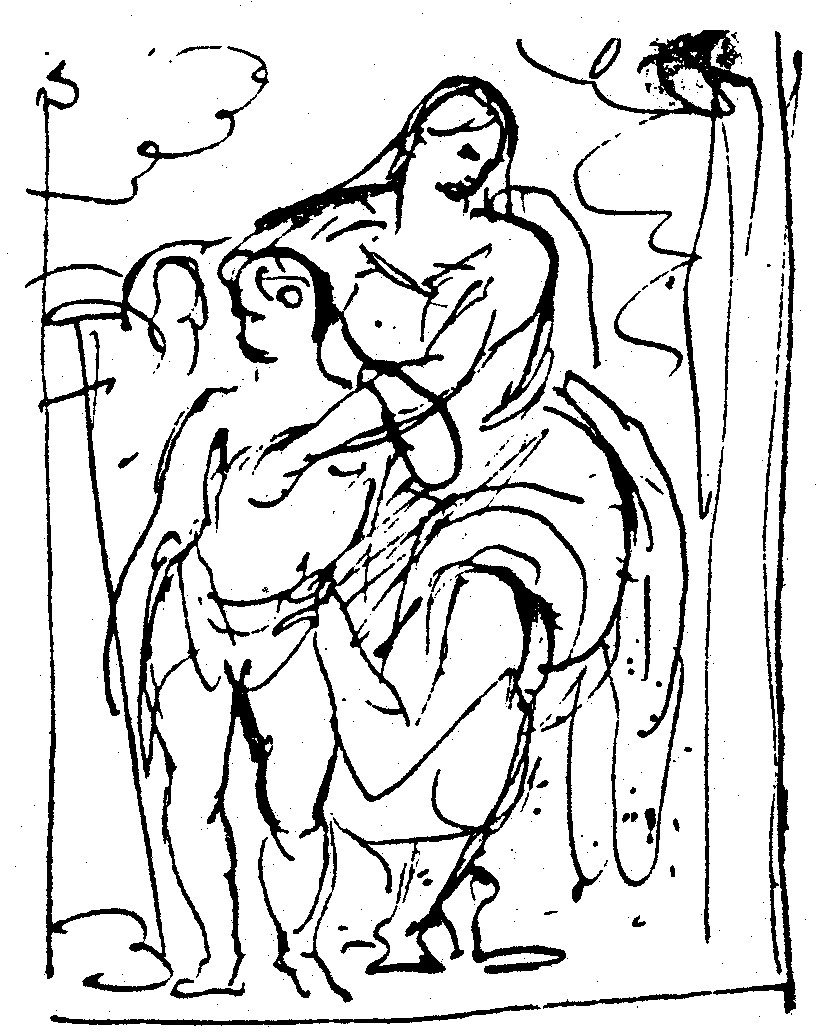
The Virgin & Child– Each side will be two Arch Angels—Uriel & Michel– I’ll tickle ye for a Michel! [6]
I got through my Cartoons March 15[;] ever since that I have been revising & fiddle faddling.
I entered Paris 1814 the very day Josephine died!– [7] Ah Monsieur said a little active Garcon, Josephine est morte!! Sachristi ah Monsieur– Pas de Fortune, pour Napoleon après Divorce— C’est Vrai—Avez vous été Soldat?—said I– Oui Monsieur— Ou?— à la bataille de Rivoli—Ah—Oui!— [8]
Wilkie [9] said to me Haydon give me a Glass—oui Monsieur, said the Waiter, & he brought him a Glace [10] —to Wilkie’s infinite wonder– Wilkie carried a pocket Dictionary & used to look out the Words– Garcon—he used to roar out—oui Monsieur—donnez moi—then he[’]d look out (while I was dying) a spoon– Une cuillere!! Wilkie used to say—dont tell me Haydon—though Paris was full of all the Nations on Earth—the greatest curiosity was David Wilkie! his long battling with Madame who sat enthroned at the Restaurateur’s—about Change—was exquisite!– There he would stay till every sous was correct—battling with her in bad French—she, with all the Grace of a French Woman putting her pretty fingers on his impenetrable arm, as impenetrable as Auld Reekie [11] hersel!– “Mais Monsieur” No, no—Madam—10 minutes have elapsed & he always got the day & then joined me, chuckling at having made her give over his fair change!—— [12] We had a great deal of fun[,] I soon knocked him up[;] he would not go to Rambouillet– I started before he was up and when I came back I found him looking out for me in the streets of Versailles—with an air of Despair like a Man alone in the desert of Zaara[.] [13] Poor Dear Wilkie—the simplicity of his mind was exquisite—his understanding acute but slow—he had beautiful powers of observation—but he never made impression on Woman’s heart—& this broke him at last for that is the real truth—he left England from sheer restlessness & misery of mind, to wear away reflection; how remarkable I wrote his Sister a letter, saying if he go to Syria he will never return– She replied he could not suffer more than he had done in Ireland—but I said remember the Climates– Poor fellow I never saw him after– [14]
B R Haydon
Address: Miss B. Barrett / 50– Wimpole St.
Publication: EBB-BRH, pp. 75–78.
Manuscript: University of Vermont.
2. Southey had died on 21 March and Wordsworth attended the funeral (see letter 1188, note 6).
3. “I do not know the word—Impossible.” In a letter to General Lemarois of 9 July 1813, Napoleon had said: “‘That is not possible’ you write to me: that is not French” (Correspondance de Napoléon Ier, 1858–70, XXV, 478–479). He seems to have been echoing Jean François Collin d’Harleville (1755–1806), who wrote “Impossible est un mot que je ne dis jamais” (“Impossible is a word that I never say”) in Malice Pour Malice (1803, act I, sc. 8).
4. Cennino Cennini (ca. 1370–1440) wrote Il Libro dell’Arte, o Trattato della Pittura, which gave details of ancient techniques and formulæ, including that for bianco sangiovanni (lime-white).
5. The final coating of plaster spread on a wall for a fresco (OED).
6. Cf. I Henry IV, II, 4, 443–444. Haydon began “The Virgin and Child” on 25 March (Pope, V, 597).
7. Josephine died at Malmaison on 24 May 1814. However, Wilkie recorded in his journal that he and Haydon arrived in Paris at 2:30 p.m. on 31 May (The Life of Sir David Wilkie, by Allan Cunningham, 1843, I, 394).
8. “Josephine is dead!! Good Lord, sir—no luck for Napoleon after the divorce. That’s the truth. Were you a soldier? said I. Yes, sir. Where? At the battle of Rivoli—ah, yes!”
9. Sir David Wilkie (1785–1841), who was elected to the Royal Academy in 1811, accompanied Haydon on the visit to France in 1814. His own account of it is included in Cunningham’s Life (I, 394ff.).
10. “Ice-cream.”
11. i.e., Edinburgh, so called from the overhanging cloud of “reek” or smoke.
12. Haydon, in his Autobiography, wrote that “the greatest oddity in [Paris] was unquestionably David Wilkie. His horrible French, his strange, tottering, feeble, pale look … his resolute determination never to leave the restaurants till he got all his change right to a centime; his long disputes about sous and demisous with the dame du comptoir ... her ‘Mais, Monsieur,’ and his Scotch ‘Mais, Madame,’ were worthy of Molière” (Haydon, I, 254).
13. Not positively identified; possibly Zaaram on the east coast of the Red Sea, or Haydon may be misspelling “Sahara.”
14. Haydon’s premonition proved to be true, as Wilkie died suddenly aboard ship on 1 June 1841, while returning from eight months of travel, and was buried at sea. Haydon read of his death in The Morning Chronicle (see Pope, V, 55–56).
___________________