1293. Benjamin Robert Haydon to EBB
As published in The Brownings’ Correspondence, 7, 196–198.
London
June 19. 1843
My dearest Friend /
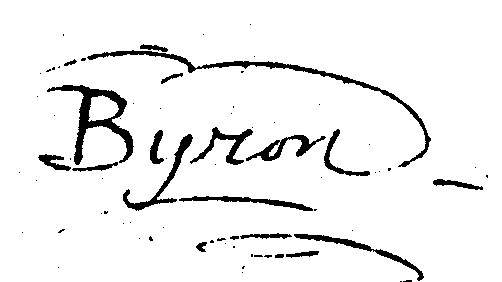
We visited Harrow yesterday, saw his autograph lately discovered in repairing the gallery—& another also—like this Illus. —in pencil—
We stood on the grave of His Allegra [1] —& sat on Peachey’s tomb where he used to lounge [2] —4 more enthusiastic admirers—or 4 more informed & read in his writings, never pilgrimized before[.] —The Day was Unfavorable—but I think of Painting (in his Youth) Byron musing on this Spot– [3] I have an original Water color drawing of Lady C. Lamb of him swimming with Boatswain, [4] left by her at her Lodgings & come to us lineally & regularly & accidentally—you shall see it——
We drew up at a little bye Inn, on a Woody & bye road, & on enquiring if they had a meadow behind, & would grant us chairs & table– They had[—]out we all got—& carrying our provisions into the meadow, Frank (1st prizeman) [5] My dear Daughter & my dear Mary & I—laid the cloth, & dined in Sun shine buried in grass cooled by Shadow, & scenting of Hay, our Coldstream band, [6] were the sweet innocent joyous birds which sang round us, with a fluttering chirrup, that was delightful– In the midst however was the usual Evil– My sweetest Daughter, pathetic, suffering, pale & beautiful face– I never saw her look so handsome, & was not aware how heavenly disease etherialises the human face!– Good God, what a look!—her large dark blue eyes, her exquisite full trembling nose—her pouting, red lips, her oval shaped cheeks, firm forehead, & beautiful chin—her arched brows quivering with suppressed feeling, & her lustrous glance at all of us, as if she thought of leaving us; went to my very hearts core!– I am obliged to suppress my feelings for Her sake. But Mary & I dare not be alone—for with us there is no concealment– Frank is dreadfully touched, & has got quiet, & said he felt giddy, when he saw her– The Howe is expected Home every day [7] & Frederick will break his sailor’s heart when he sees her.
It really is very hard, not to preserve one daughter out of three [8] —but we have been so accustomed to Calamity, and she the love, has seen so little else, but Insult & degradation, to me, & shared them so long, that it is my opinion the dread of the future has brought it on—more than other things–
I hold such eternal intercourse with “Him who is invisible” [9] that nothing in life can shake me more, and as to the Cartoons, My dearest Friend I expect the usual attempt, to lower my rank in the hearts of the people, and its usual success– They do not occupy a thought– I did them as a duty to my Country, & to aid, the opposition to that unnatural party, who have no belief in the Genius of England, & wish to bring in the talented but mistaken Germans—Hess & Kaulbach are now seen at the British Gallery, by the side of Reynolds, they have found as Handlers of the Brush their proper line, two or three such Comparisons, will settle the question—or it is settled already– [10]
I perceive a nasty, envious, malicious feeling, about me, I fear to enquire– There exists a conviction that God Almighty has no right to be guilty of the impertinence of gifting Genius; without a Ministerial Majority of the House, sanctioned by the Lords, signed by the Crown & sealed by the Chancellor!–
The dignity of Aristocracy, is offended!—authority gets stiff!– Already there are hints– The Cartoons are so nearly equal– It will puzzle them– No—they are not puzzled at all!– They have made up their minds!—& under the pretense of equality of talent, shelter their determination to assassinate– We shall see—I expect nothing—to distinguish between what is bad & what is good falls to the lot of many—but to distinguish between what is very good, & what is truly excellent falls to the Lot of few—says Burke [11] —& those few are not likely to be Kings & Princes.
In the mean time I am & shall remain dead quiet—& Trust in God I shall have health, to produce Works enough by Next Year to fling myself with my usual defiance before the World alone & free: that is my element—in association I do not feel at home– “What matter where if I be still the same.” [12] I only hope I shall die at the right time, the time I have made the greatest Impression–
I move Curtius to day, to the usual Dust hole in Dean St [13] where hangs Solomon My first large & now last large Work– Honor to the Patrons of Britain!– I sold it to a poor Devil, who has more taste than money, & wont let it go, till he pays—addio–
Yours affectionately
B R Haydon
Miss B B.
Publication: EBB-BRH, pp. 114–117.
Manuscript: University of Vermont.
1. Clara Allegra Biron (1817–22), Byron’s daughter by Claire Clairmont (d. 1879).
3. Haydon commenced to sketch “Byron Musing on a Distant View of Harrow” in 1845, but never completed it (Pope, V, 465, 477).
4. Byron’s favourite Newfoundland dog, which went mad and died in 1808, aged five. He was buried at Newstead. Caroline Lamb (1785–1828) was at one time romantically involved with Byron.
5. Haydon’s diary entry for 30 May reads: “My dear Boy 1st in Mathematics, 7th in Classics. Dear Frank—this is a fine beginning” (Pope, V, 163).
6. One of the five regiments of Foot Guards, named after Coldstream in Berwickshire where the regiment crossed the border to effect the restoration of Charles II.
7. Frederic Haydon, who was serving in the Royal Navy, “exchanged into the Howe [from the Impregnable], to serve his time out” (Pope, V, 258).
8. His daughter Fanny had died in 1831, aged three, and Georgiana died in 1835, shortly before her second birthday.
9. Hebrews, 11:27.
10. Heinrich Maria von Hess (1798–1863) and Wilhelm von Kaulbach (1805–74). “In the British Gallery is a copy from Hess and an original head by Kaulbach, which will, I trust, settle the pretensions of the British School—or rather the Germans—more feeble, absurd, or ridiculous things never were executed” (Pope, V, 283).
11. Perhaps a paraphrase; Reflections on the Revolution in France (1790) expresses sentiments in this vein, but we have not found this specific quotation.
12. Paradise Lost, I, 256.
13. Possibly no. 3 Dean Street, the premises of William Kebble, frame-maker.
___________________