2670. EBB to Henrietta Moulton-Barrett
As published in The Brownings’ Correspondence, 14, 176–182.
via Delle Belle Donne 4222–
But direct Poste Restante– Firenze– it is safer
[?24–] [30] April [1847] [1]
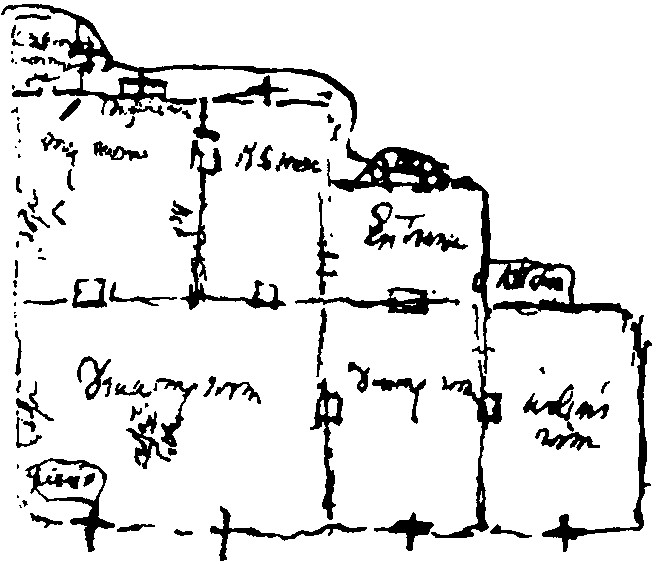
I begin to write in the expectation of having a letter to answer before I have done mine—but I must begin, my ever dearest Henrietta, & thank you for what you wrote last to me, & tell you that we are safely established here in this beautiful Florence in an excellent apartment & that I am gaining strength every day, & that Mrs Jameson & Gerardine are our guests, & that it will be a week before they leave us. We have taken a bedroom for them in our house .. (you know the houses in Italy would be palaces in England ..) & they spend their whole time with us of course—only I dont go out with them, being wise, & resolved on keeping virtuously to the sofa until the weakness is tired out of me—poor me, who in the meanwhile am within a stone’s throw of the Raphaels & the Michael Angelos & can see nothing at all. But Dr Cook in giving consent for me to travel, exacted a profession of intending to be “very quiet indeed” for a little time after the arrival: and I find from experience that absolute rest does such infinite good, it is worth persisting in through every sort of temptation. And then Robert says “Dont be drawn into going out, Ba, I beseech you”—and it seems better to wait now in order to enjoy perfectly hereafter, & escape the risk of adding more painful anxiety to what he has already endured about me. He is so dreadfully nervous when I am in the least unwell, that not to be in the least so acquires an undue sort of consequence in my eyes, observe– Otherwise, & if I thought only of myself (and have I not to think of you besides of him?) I shd not mind being thrown back a week or two for the sake of a degree of delightful imprudence– As it is, the jurisprudence carries it. The coupè we took in the diligence, did very well, but was by no means equal to a coupè in a French diligence, & though I lay half the time or more across Robert’s knees, the shaking made itself felt, & we regretted the private carriage which was nearly engaged when the Diligence people siezed on us. Still, it did very well, & the country with vine-festooned plains & breaks of valley & hill .. ridges of mountain & sweeps of river, .. was far more beautiful than I expected between Pisa & Florence– As to Florence I could see it only in our rapid passage to our hotel, across one of the bridges of our old dear yellow Arno—and when Robert had carried me into the Hotel du Nord [2] & laid me down on the sofa, I could only wait for coffee & dream of being in the city of the Medici– The next day he went out to hunt for apartments, & the day after, we were settled in our present one—of which I send you a plan Illus. .. the cross + expressing windows and the square □ doors—& for which we pay about four pounds a month, having ‘engaged’ it for two months. It is curious that Robert fluctuated between this apartment & one just left by the Garrows [3] & inhabited by them for eight months—but though we pay rather more for the one we decided for, it appeared to him worth the difference of price. I should have thought that the Garrows would have required more rooms– They are re-settled close by us, but are to leave Italy we hear, in May, altogether; & I hope to escape them in as complete a totality. As soon as we had fixed ourselves I persuaded Robert to get a piano—and we have a good one, a grand one[,] a German one, including the hire of music, for about ten shillings a month. Then with a trattoria, hard by, we have an agreement for dinner at three, at the rate of 2s– 8d a day, .. covering the whole, observe! and they send us soup & three dishes, besides vegetables & pudding or tart. Everything hot, & well cooked—& there are three of us. Wine, we have separately—and Robert pays three pence or four pence a bottle for what he drinks. My port, he never will touch, let me ask him ever so. Our payment for the apartment includes everything, linen, plate, china &c .. and this time, everything is in order—we have real cups instead of the famous mugs of Pisa, & a complement of spoons & knives & forks, nay, we have decanters & champagne glasses … we have come to the remote extreme of civilization. As Wilson says succinctly, “it is something like”. Moreover there is a spring sofa, the most delightful of possible sofas, and a spring chair, and I resume my habits of lolling, with extraordinary pleasure. At Pisa, Robert hired a chair for me, at five shillings a month; so that before we were done with it we had paid the full price– And this, besides the additional one pound six a month for the rooms—one pound six more than we pay here, where everything is infinitely superior—the drawingroom for instance so much better & more comfortably furnished, & of more than twice the size– Oh, we subscribe to the proverb “Pisani traditori”, [4] though we left poor Pisa without any rupture with our ‘padroni’ of the Collegio– Deeply sorry they were to lose us, and hoped fondly to the last that I might have a relapse, so as not to be able to go. “The signora will be as ill as ever if she does not take care” said the chief matron to Wilson, when she saw me preparing for our journey by going out in the carriage—and if Wilson ever said that I was not so well, one of these affectionate friends looked unto another, with an expression of unmistakeable & most flattering pleasure. So of course we were altogether grateful, both for the honesty & the kind sympathy, though not “unconsoleable” perhaps for having got away. Robert declares that if we had staid on there much longer, we should have fallen fixed into barbaric habits, & that on returning to civilized life we should with difficulty have extricated ourselves & been apt to cry out unawares, “Lady Londonderry, shall I give you a mug of coffee?” or “Will your Ladyship be good enough to thump with your fist on that door”?—(Because at Pisa, there was not a bell in our rooms, & Wilson was summoned by a knock—it was our only way.)
—(April 31) [5] Well! we are alone again. Dear Mrs Jameson & Gerardine left us this morning, much to our regret––& both of them most affectionate .. & she (Mrs J.) a high minded, true, generous woman. Very much I like, yes, & love her. They went at seven & would not let me get up to breakfast, all I could say .. so I had to let them come into my room & give me a farewell-kiss between sleep & wake on my part. If you should see her, .. if she shd take courage & go to see you in London (but she wont be in England yet for some time,) mind you are kind to her, both of you, & make her feel that I have spoken gratefully of her. She deserves that of me .. & of you. The amusing part of it all is, that she has been charged on all sides with the arrangement of our marriage! You see the coincidence of her being in Paris & receiving us & travelling with us looked so wonderfully suspicious! She says, people write to her who never can be persuaded but that she managed the whole .. “Oh, it is discreet of you to deny it! Of course you would deny it! And yet you need not to me—you never would shake my conviction? And besides, where in the world is there anything to be ashamed of?” Her answer is, “I tell you the truth– If I had had the least thing to do with it, I shd have considered it a very great honour––but I knew nothing .. suspected nothing”. To which people shake their heads incredulously over writing paper of various sizes. She had fixed on last saturday as the day of her arrival at our door, but on friday evening as Robert was playing, to me prostrate on the sofa, Shakespeare’s favorite air (as discovered by poetical antiquaries) a voice said “Upon my word .. here’s domestic harmony!” and lo! Mrs Jameson stood in the room! Both of us leapt up, one from the piano & one from the sofa, & we had our arms round her in a moment, & were listening to all the news from Rome– And it appeared that she had come one day sooner because the thought had struck her of the friday’s being, Shakespeares birthday—so she had brought a bottle of wine from Arezzo in order to do it the due honours in company with “two poets”—to compass which seemed worth an effort. So we had coffee & supper together for the travellers, & a very joyous evening on all sides .. and she cried out as usual “Oh, that inexhaustible man!” meaning Robert, .. to which I rejoined, “And think of the stream running just the same for these six months past, ever since we parted”! And she thought me looking very well considering everything .. and before she went away I looked well without any manner of consideration & allowance. I could not go to the galleries with her, which was a great disappointment, .. but it wd have been foolish, just for the sake of a temptation, to have risked a future prosperity. Now, at the end of the week’s rest, I am quite another person, & move about without showing symptoms of dislocation, .. & the back is getting quite strong again– I am surprisingly well for the time .. for after that journey, I gave myself a fortnight to be fit to resume my activities. Wilson too is drawing health with every breath of this Florentine air. She was much better before, but certain symptoms remained such as the swelling to a degree, .. and an occasional sense of inward heat, & a general languor .. all which symptoms Dr Cook thought of no importance, but which incommoded her of course, poor thing, & made me uncomfortable to observe. From her arrival here however, there has been a complete change, & she feels quite another person, she says, & perceives herself to be better & better every hour. You see, the Pisan air is very soft & relaxing & heavy, and here the air is clear & brisk & bracing, let it be ever so hot—that is, bracing for Italy. Poor Wilson is quite in good spirits, & likes Florence, though her friends of the Creswell establishment are gone, [6] & she has had a great deal to do, with our visitors, of course. I am sure it is very kind in her to speak of the little I could do for her as if it were an obligation– I wish we could have saved her from the necessary suffering– Very painfully we both felt that for our sakes she had incurred it all, and a more honest, true & affectionate heart than Wilson’s cannot be found. Dr Cook repeated to me at our last interview his conviction of the whole evil having proceeded from the sea sickness, & not in any way from climate, and she was quite willing to stay on with us. She was in no sort of danger of life at any time, so that her impression was wrong in that respect. Well! but I was talking of Mrs Jameson. Think of our “doing hospitality” for a week! Was’nt that rather magnificent of us! And the only thing in the world that Robert cant do well, is to carve—and my accomplishments are not very much beyond him even there. Yet we managed .. oh, we managed—& Mrs Jameson was goodnatured as she always is, & had an opportunity of completing her miracles of the saints by our matrimonio miracoloso, [7] with as much love at the end of nearly eight months as at the beginning thereof. I am sure she looked on in utter astonishment, while Robert siezed on the place next me on the sofa, just as if he saw me once in three months at the uttermost. She told me before she went away that every hour of her intercourse with him, from first to last, had raised him higher in her estimation & her affection—dear Mrs Jameson! In July or August she may be in England for the publication of her book of saints & painters, after which her intention is to return to Italy .. to Rome, for subsequent volumes on the Virgin & her painters. [8] Gerardine is a “sweet girl” .. just that .. accomplished & affectionate, but rather childish for her age, which has its attraction also. Now that they are gone, we go back to our old habits .. to the owl’s nest in the hollow tree– Shall I tell you our dinner today .. our dinner for two shillings & eight pence? You like the report of dinners, Henrietta– Vermicelli soup—turkey .. (not a whole turkey but the third of one at least) .. Fish (sturgeon) .. (I should have mentioned the fish before, I think.) Stewed beef .. (done something like fricandeau)—mashed potatoes—cheese cakes. We dont order dinner here, which is delightful. They send us what they like, & everything cooked excellently & well served & hot—as superior as possible to Pisa! Wilson dines after us, & something is always left for supper. When Mrs Jameson was here, we gave about four & sixpence, & were served excellently—green peas, asparagus, everything. Observe the difference of the possibilities, of social life here & in England. No fuss, no need of management or money. When we go to see Arabel in her cottage & you in yours (a thousand thanks to all inviters!) we shall make you spend more I fear, even if you give us mutton chops only & port– And you will never give up the port, you unabstemious people, you! By the way, we expect the Hanfords day by day, as a kind letter from dear Mrs Martin assured us of their being about to approach Florence & that a note from me at Poste Restante wd bring them to us. So I have written, & Robert will do what he can for them in the way of pictures & statues. Now do, both of you, write to me without fear of postage– If you knew what a comfort I draw from your letters, you would. And we shall soon hear from Stormie, surely. Tell me of everyone—oh do! & how George got on on circuit—& of Henry, & Sette & Alfred & Occy & of dearest Papa chiefly. I think of you, pray for you, love you. Does darling Arabel walk out as she ought for love of me? I talk of venturing to get out on monday, being so much much better. Tell me of Arlette’s marriage. When is Susan’s? [9] Love to her & Surtees. Do you see Bevans, Butlers, Hedleys? My very best love to dearest Treppy & tell her that I have a letter begun to her .. but Robert hurries me about the post—bringing me your letter, darling things .. I cant read it before I seal this .. but in a few days you shall hear again, because we just have a notice of the arrival in Leghorn of the parcel & expect it every hour. So you shall hear directly– Mind, I am well. Robert will write.
Your very own
Ba
Love to dear Minny–
Address, on integral page: (To the care of Miss Tripsack.) / Miss Barrett / 5. Upper Montagu Street / Montagu Square.
Publication: Huxley, pp. 19–23 (in part).
Manuscript: British Library.
1. Dated by EBB’s reference to beginning the letter shortly after Mrs. Jameson’s arrival on 23 April, and finishing on the day of her departure, 30 April, despite EBB’s date of “April 31” within the letter.
2. According to Murray’s Hand-Book for Travellers in Northern Italy (1847), this hotel, located “in the handsome Palazzo Bartolini, and in the same Piazza, is a small clean hotel with a good table d’hôte at 5 pauls. It is now (May 1846) kept by a Frenchman, who was cook to Jerome Bonaparte” (p. 474).
3. Joseph Garrow (1789–1857) and his wife, Theodosia (née Abrams, 1766–1849), were living in Via dei Malcontenti in Florence at this time with their two daughters: Theodosia (1816–65) and her elder half-sister Harriet Fisher (1809–48). EBB had been acquainted with Theodosia and Harriet in England in the 1830’s. Theodosia married Thomas Adolphus Trollope in 1848, and together with his mother Frances Trollope, they purchased a house in 1850 in Piazza Maria Antonia (now Piazza dell’Indipendenza), which became known as the “Villino Trollope,” a popular meeting-place for the Anglo-Florentine community.
4. “Treacherous Pisans.” Cf. the proverbial “Fiorentini ciechi, Senesi matti, Pisani traditori, Lucchesi signori.” (“Blind Florentines, mad Sienese, treacherous Pisans, pretentious Luccans.”) EBB’s source for this tradition was probably Murray’s Hand-Book for Travellers in Northern Italy (1847): “It is said that when the Florentines (1117) assisted the Pisans by guarding their city during the expedition which achieved the conquest of Majorca, they were offered their choice between two of the trophies won in the island, certain bronze gates, or two splendid columns of porphyry. The latter being selected, they were duly transmitted to Florence, covered with scarlet cloth: but, when the drapery was removed, they had lost all their beauty, for the rival republicans had spitefully passed the gift through the fire, whence, as it is said, arose the proverb Fiorentini ciechi, Pisani traditori” (pp. 490–491).
5. See note 1 above.
6. We have been unable to trace any additional information or identification for the “Creswells”. The Cresswells were and are (now Baker-Cresswell) an ancient Northumberland County family, and Wilson being from Rothbury might well have known some of the Cresswell servants.
7. “Miraculous marriage.” Doubtless an allusion to the mystical marriage of St. Catherine of Alexandria; see Anna Brownell Jameson’s Sacred and Legendary Art, 1848, II, 95–98.
8. Mrs. Jameson and her niece arrived back in England the following month, but Sacred and Legendary Art was not published until November 1848. Legends of the Madonna was published in December 1852; it contained quotations from the poetry of both RB and EBB (p. xlvi and p. 273, respectively).
9. Susannah (Susan) Cook (1822–61), sister of Surtees Cook; he eventually married EBB’s sister Henrietta. From a letter to Henrietta in early July (see letter 2684, note 5), it seems likely that EBB was confusing Susan Cook with someone else. She married Thomas Bruce Stone (1820?–55) on 9 May 1855.
___________________