2681. EBB to Arabella Moulton-Barrett
As published in The Brownings’ Correspondence, 14, 223–235.
Florence
June 22–23–24–25. [1847] [1]
My own dearest Arabel I am writing what I hope may reach you on a day when I shall think much & tenderly of you [2] .. more than I do everyday, & that is saying a great deal– You will know, whether it reach you or not, that I most think of you .. that no absence could make you less present to me—perhaps you will guess that I shall love you more than ever. May God bless you dearest dearest Arabel, & make you happy according to your choice & His will, recompensing you for all the good & gracious affections which is the debt I owe you forever– To see you & hear you would be the greatest of joy to me—believe it while you believe me– May God bring us together before long .. yet how close to you I feel while I write this—close in heart & in love–
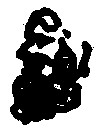
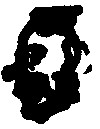
Robert declares to me that I am writing to you now for the third time– To which I answer that I must at any rate, write to you now, for especial reasons, but that assuredly my last letter but one went to dearest Henrietta– Did’nt it? Do tell me. I meant to preserve the perfect symmetry of my correspondence—only there are necessary exceptions as on the present occasion– And I have just had your letter .. went to the post office for it myself. How far can I walk?—farther than Hodgson’s do you ask? Yes, certainly farther than Hodgsons. The post office is in the Piazza Gran Duca, where the Palazzo Vecchio is & the gallery of the Uffizzi. Well, when I got your letter I was on my way to the Gallery .. walked to the doors .. perhaps about as far as to Cavendish Square .. or say, Oxford Street .. then, up stairs, (stairs as high as to my Wimpole Street room,—positively refusing to be carried) & through & through the gallery, sitting down of course at intervals—then, returning by carriage– I was tired, but not too tired for our drive in the evening, and altogether I call it miraculous– If you had but seen me when we came here first! It is only a month, recollect, since I began to go out even in the carriage—and now I am stronger than before the Pisa illness .. oh, infinitely stronger– The air of this Florence vivifies, I think, & yet is not too stimulating: it agrees with all three of us, Robert,—Wilson & myself, and we might perhaps do a foolisher thing than settle here, for next winter & autumn, after our escapade to Vallambrosa– Yet we shant[.] Robert is afraid of the winds for me, and he is cherishing a rather romantic speculation about my being able to escape all shutting up next winter if we go to a warmer place– But even at Pisa you see, there were two months imprisonment for me—only I admit that that winter was unusually cold for Italy, & that we were in a wrong situation—still, a perfectly free winter seems too high an aspiration– Everywhere there will be occasional cold winds and there is a habit of irritability, I suppose, about my throat & chest .. which however are well now to all intents & purposes– I walked up quite a hill in the Boboli Gardens last Thursday & felt no inconvenience—no gasping for breath .. the very place in respect to which Mrs Jameson said to me six weeks ago, “ah Ba, you will never be able to go there– I have no hope for you! You must give it up.” Robert said that she made much more fuss & sighing in the walking there, than I did– Only it is to be admitted that the carriage took me to the gate of the gardens– So beautiful they are. High overarched embower all sorts of trees. You look down green galleries of shade—not a stripe of blue sky visible. Some of these bowery alleys are as long as you can see: you just see a little light at the end. We did not explore the gardens, of course; it wd have been too much; but we saw enough to understand the character & feel the beauty. The cypresses & acacias in this Italy are very beautiful, and so are the evergreen oaks, .. & they strike our English eyes wherever we look. The stone pines too are characteristic—but I like the cypresses. One thing I observe .. the extraordinary luxuriance of the ivy, which enwraps & hangs in festoons on nearly every tree of the Cascine, without appearing to do the harm which ivy in England wd certainly do. The effect is beautiful. Still more beautiful however are the vines, trained everywhere in Tuscany upon trees. The manner in which the tendrils climb & climb, & then throw down floods of leaves, even to the ground, is a thing to see once in a life & never forget afterwards– Ah, people may talk about hops– There’s no comparison I assure you. They might as well talk about peas. People who, having seen both, prefer hops to vines, I am prepared to think very small beer of– I am writing now on the 23d but I thought yesterday of Arlette’s marriage & of poor Bummy, who seems as usual to have embittered to herself this event, as much as possible. Really it is a misfortune to be ridden so by one’s temper .. so kind & affectionate as she is under it all, & so sure to be loved less perhaps than she wd have been if less heart-kind & more gentle of manners– I hope however that Mr Reynolds will remember the fact of her having tried to take the mother’s part towards Arlette—it ought not to be forgotten. Extraordinary, that you shd not be asked to be bridesmaids. So much the better for you of course, but it is not altogether kind, I must be allowed to think, & I wonder how they could make up their minds to venture on the appearance of such a slight– Do tell me all about the ceremony– Poor Arlette .. I do hope she has chosen wisely! That you shd like him better is a better sign– So the mustachios linger, Henrietta says! Talking of mustachios, I cut off Robert’s with my own hand before we left Pisa; it was my last wish on the last night .. and Mrs Jameson reproached me for it, & so did Gerardine, when they arrived, having been used to nothing but mustachios & beards at Rome. But I was right I know. Robert let it be as I liked, & I accepted the full responsibility. He looks much better so– Not that I have changed my mind about beards– I am as little a misopogonist [3] as ever– Only what gives character to common faces, is a detriment to his, I think– The mouth was quite materialized by the mustachio– So I cut it off with a pair of scissors & my own right hand .. “myself I did it” .. & I dont repent the least in the world. Otherwise, everywhere you see superfluities of hair; nothing is less singular than a beard of three or four inches, Illus. & very picturesque these beards are, black, brown, & white I assure you– The majority of English gentlemen even, has the moustache; Illus. so perhaps Mr Reynolds’s looks towards Italy. How I laughed, & so did Robert, at Bummy[’]s successful readings from my letter– So she just made out that I was going to retire with “some artist to Vallambrosa”. Well!–
<…> [4]
No wonder that she is a little shy of the subject of me. Pray explain that when we do go to Vallambrosa, there will only be fortyfive monks within reach, & not an artist among them .. but we are not gone yet, you see .. & we are entering on our third Florentine month after the greatest uncertainties. Being able to do just what one likes, is not always the smoothest & easiest thing in the world, I observe. Robert quite vexed me last week with his exhortations every half hour, “Now, you must decide, Ba”. At last I said, half in a jest & half in a pet, “Then I wont decide,” … & ran out of the room. The truth is that it was’nt so easy. I wanted to go and I wanted to stay, & what could one do under such difficult circumstances? Then the weather grew suddenly cold & rainy, & people said on everyside “If you go to Vallambrosa so early in the summer, you will be blocked up with snow.” Altogether we talked & talked, & hesitated & hesitated, & the days passed & found us here still: yet we may not stay to quite the 22d of July: if the heat shd be intense, we shall probably persuade M. Centofanti into letting us go & return in the cool of the year to serve out our time. Meanwhile, here is the grand festa of San Giovanni, the patron saint of Florence, the grandest festa of the year [5] —and there are to be chariot races in the piazza close to us, & horse races (without riders) somewhere else—games in the manner of the ancients—also fireworks at night– We had intended to have hidden our sublime faces from these things—but after all, I suppose we shall not—it seems foolish not to see what is so characteristic of the people when we have only to open our eyes—so we have ordered the carriage as usual at six, & I will tell you the result. The fireworks I certainly shall like to see: for I like fireworks, & Robert says that Italy is famous for them. Altogether it will cost us a few pauls & two headaches, perhaps. Now you will never guess where I was, last night .... Drinking tea with the ex consul of Venice & his family, Mr & Mrs Hoppner [6] .. the Hoppners mentioned & written to in Lord Byron’s letters & I think Shelley’s. Mr Kenyon sent us a letter of introduction to Mr Hoppner; & on Robert’s returning his visit, so much was said so kindly about our going there in the evening to hear all about Venice & Rome, that I could see Robert wished me to go, .. & went accordingly at half past eight & returned at ten. I was dreadfully nervous, but got over it all pretty well– Everybody in morning gowns up to the throat, & everything to “sans façon” [7] as was promised to Robert in the first place—only a Mrs Collyer who is a friend of Miss Dowglass’s & lives at Rome, and a Mr Freeman, an artist, and a Frenchman who spoke in an undervoice, & Mrs Hoppner’s daughter & niece– [8] She (the mother) is French herself, & speaks her very fluent English with an accent, but is one of the frankest & most pleasing women I ever saw .. full of vivacity & intelligence– I remember that Lord Byron praises her in one of his letters. He, Mr Hoppner, appears full of refinement & shrewd sense .. but I like his wife .. she was very cordial to me, & I shd have liked her, I think, even without that. The daughter is rather pretty & very cultivated—and the niece is pretty too, as Robert makes affidavits– There was a table cloth on a table, & tea & bread & butter just as if we were on English ground again, and a good deal of talk about poor Shelley & his wife, & how they passed three weeks, with the Hoppners once at Venice, & how on their arrival they ate nothing except water gruel & boiled cabbages & cherries, because it was a principle of Shelley’s not to touch animal food, & how Mrs Hoppner did, as she said, “seduce” him into taking roast beef & puddings .. “Dear Mr Shelley, you are so thin[”]. (Fancy all this said with a pretty foreign accent.) “Now if you wd take my advice, you would have a very little slice of beef today– You are an Englishman & you ought to like beef– A very little slice of this beef, dear Mr Shelley”– And so, she said, by degrees, he took a little beef & immediately confessed that “he did feel a great deal better”—“Why of course he did. He was so thin”. The news of Venice were anything but as satisfactory. Venice is said to be cold & damp in the winter, & they left it simply on account of the climate– And so, there’s an end of poor Venice!– Yes indeed, what you said of your fears made a great impression on Robert– He said that even if there were no risk but of making you uneasy, it wd be enough to deter him from wishing to go—but Mr Hoppner’s opinion is final for the present; and now our uncertainty is between Florence & Rome—but we shall at any rate stay at Florence until November, to give us a chance of seeing dear Mr Kenyon—who frightens us by threatening not to come at all. Dont misunderstand– We dont mean to stay at Florence from this time to November– We shall go for the summer to Vallambrosa or elsewhere perhaps, & return here for the autumn months. November is excellent travelling time in Italy, & even better than earlier– Or we may stay altogether at Florence—who knows? .. viz—after November. In the meanwhile we must get to Vallambrosa—if we can. We tremble a little, because we have not yet absolutely received a permission, & because Mr Hoppner prophecies that we shall not .. declares that some friend of his was lately refused an entrance there: it appears that there’s a new prior who is an austere man & fears the approximation of unclean beasts– It will be a serious disappointment if we are rejected applicants at last—& the decision will probably reach us tomorrow– Why, notwithstanding your conjecture, even Wilson will be disappointed– She seems to think it an excellent jest to be shut up with fortyfive monks between precipices, and the Centofantes are getting up a laugh about it, she says: “there is not a woman within miles & miles, & we shall have to send five miles to have our washing done– “Oh they wd not let us in on any other pretext but that of bad health”—but as invalids, the chemist is sanguine as to a probability of our being admitted– My darling Arabel, I knew you would like to come with us—I knew it was just the thing for you. And as to the “musty books” dont suppose that we shall have any part or lot in them, except when perfectly tired of the rest—we shall make the most of the grand, wild nature we expect to see. “Like Switzerland”, they say it is. Mrs Collyer last night told me to my surprise, that Miss Dowglas[s] was at the Baths of Lucca .. Think of that! She will however return to Rome. Her health is wonderfully better & she is very fond of the very young wife lately married by her cousin Dr Pollock [9] —married last year, & only eighteen .. “just taken from the nursery”, said Mrs Collyer, “but very intelligent & affectionate.” Rome is said to be not dear, except as to apartments. Dont tell Mr Kenyon anything of our thoughts of Rome, & assure him that we shall be here in October & early in November, even if we dont winter at Florence: because if he fancies that we are going to Rome, he is capable of not coming to see us for fear of keeping us from the journey. Interrupted by Mrs Hoppner—by a visit from her. Charming she really is, from the heart & goodness in her face & manner, and as vivacious as if she were fifteen—and she is not young, as you may suppose of a friend of Lord Byron’s. I am captivated with her & so is Robert .. It is pure sweetness .. that’s the word! but not vapid sweetness– Wine of Cyprus as Mr Boyd has it– She came to tell us that we had very little chance of Vallambrosa, & therefore, but for the charm, we shd have taken her for the most disagreeable woman on earth– “She has enquired this morning; & the opinion is that strangers like us, have no manner of chance of getting the permission, since the only way of processing it is through a monk & on personal grounds.” Still, when we told her of our chemist and of our plea of ill health & of our hold on the physician of the monastery, she thought there was still hope for us, & we hope on. By tomorrow, it will probably be settled.——
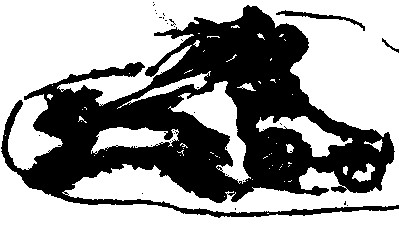
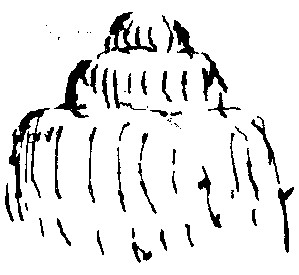
Now I am going to tell you of the chariot races & of much beside– I am out of breath with news. We went (Wilson with us––she took it into her head to be very shy at first & refused to go, because M. Centofanti had assured her that she wd be the only femme de chambre [10] in a carriage, so,—but it was quite right that she shd see it all, it wd have been a shame otherwise) we went to the piazza Santa Maria Novella close to us here, & one of the larger piazzas in Florence though scarcely as large as Montagu Square perhaps: It is not like a square—but open, in the manner of your Trafalgar. On all sides up against the houses, up against the great church, up against the convent walls, seats were raised, one over one, and the people crowded everywhere close as bees, only shining like butterflies, with their pretty dresses & glittering fans– Every seat, every window looked alive. The monks stood at the monastery windows, & we laughed to observe that there was room for just two at each, they were so holely fat. A recess hung with crimson drapes, held the Grand Ducal court & the ambassadors, all in full dress .. the duchesses & princesses with bare shoulders & arms, looking as royal as possible. For the rest, nothing could be more childishly innocent than these “races”, I do assure you. There were bursts of laughter & the waving of fans—but no betting, no gambling, no drinking—the most peac[e]able good humour on every side. The spectacle was brilliant—the houses letting down silken drapperies from window to window, seemed to catch life from the enthusiasm of the people– We drove round the piazza twice or thrice, & then were deposited on seats, up against the church, up high. All this occupied an hour—& straightway the races began after the long, gorgeous preparation & filled just three minutes—that was all. There were four chariots, precisely of the ancient form & device gilt all over .. the charioteer standing upright in a flowing robe, with bare arms. Illus. (My horses are just like dogs I observe, but you must help them with your imagination)– Round the piazza they gallopped about three times, & the people shouted & clapped their hands at the winner— .. & then we looked at one another & laughed to think it possible that that could be all– I did not believe it for some time– While it lasted my attention was dreadfully distracted by two dogs, who wd persist in running in the course of the chariots & whom I expected to see crushed by the wheels every moment. It made me quite sick. Well—but nobody was hurt, not even a dog. The crowd flowed off—in little rivulets, & we got quietly to our carriage about half past eight. The driver drove to the Lung’Arno to take possession of the window at an hotel, provided for us by Mr Centofanti very goodnaturedly, in order to see the fireworks– My reflection as it went, was, that never was a more childish people, amused more innocently– In England we shd at any rate take advantage of the occasion & do something wicked to prove ourselves of mature age– I felt quite tenderly towards a people capable of making so much fuss, from their Grand Duke downwards, about that game of the chariots .. for they have been at work putting up seats in the piazza for weeks & weeks, really. The ambassadors must find it hard work to keep their countenances. Throughout the whole, the spectators were the true spectacle—the whole population was there, .. the very poorest of the peasants in their great uncut Leghorn bonnets nodding over their eyes, and the very richest of the nobles in dresses suitable to their degree. Half a religious ceremony, you see, it is– There are three days of the Feast of St John the Baptist, & yesterday was the vigil–
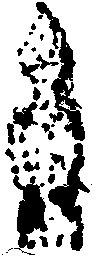
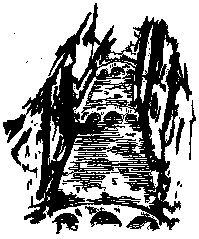
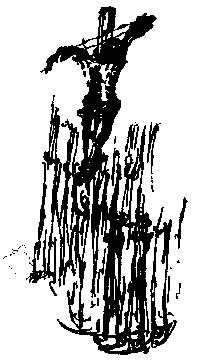
But, now I am going to tell you of the fireworks. We had a window in a little bedroom all to ourselves, in the great hotel opposite to the house in which Alfieri lived & died [11] & it wd have been perfect, we agreed, if we had remembered to bring a bottle of Champagne .. only we did’nt. You know the Arno cleaves the city in two, and the houses (palaces) on each side, press forward into the water– They were illuminated up to their last window .. and the spire of the Campanile Illus. behind was drawn out in light against the sky as black as ink. (I was dreadfully afraid of its beginning to rain & spoiling the fireworks .. nota bene!) Do you see how the river runs between the houses through my scratch? Illus. The three bridges were equally drawn out in light, and little boats with coloured lamps, floated up & down. On the bottom bridge, the fire works were exhibited at about nine oclock & lasted for half an hour without intermission .. and I do say that it was worth while coming to Italy only for that sight– I could’nt help screaming out for pleasure, and surprise– I never had seen any good fireworks, but Robert, who had, declared that nothing ever met his eyes to compare with these .. and then the whole scene, the river, the people, the gardens & characteristic houses[,] contrived to throw one into a fit of ec[s]tasy—it was my turn to be a child, after all my fine reflection of the hour before. Beyond description beautiful, these fireworks were. Great temples, living in light up in the sky, .. fantastic palaces, burning there & going out, fading away, leaving rains of glory, .. fountains of flame rising upward as if to find the stars, & then falling, falling into the river, .. dripping in a regular noiseless splendour which took away your breath! and then entire globes which leapt above the houses, & there broke into a rain of fire or of living fiery serpents which seemed tensing & curling when you looked at them! Illus. I cannot describe to you how marvellously beautiful it was– At last there was a great explosion of Light—& down on both sides of the river & up into our faces & over all the bridges at once broke the trailing fire .. oh, glorious it was! Only, the smoke & smell & noise were rather overcoming! I coughed, & so did Robert– As to Wilson she was in a rapture. Coming home we bought three pence worth of San Giovanni-cakes on the bridge, & poor Flush who had been shut up in the house, was consoled in good time. This was last night & neither of us cd sleep much after it—<though we did’nt go to the ball indeed! .. nor even to the concert!> [12] Robert took out with him one of his worst headaches, which was not of course improved by the smell of gass & gunpowder– It is said that Dante drew some of his ideas of hell from this annual exhibition, some five hundred years ago– How the world goes, yet stands still! This morning we walked to the Duomo, as the air was cool, & saw & heard what impressed me very much .. & Robert was struck too I think. It was the music which was so grand, & the sight of the crowding people, in that dim cathedral—the crucified Christ hanging, with its bent deathly head of marble in the midst of the choir, & a hundred burning candles, three times the height of a man, sending up their smoke about its feet– Illus. I felt quite overcome for a few minutes & could not keep from tears– There! now I have told you the whole, I think– We shant go out to see the lottery & the riderless horses—it is quite enough as it is– Yes, & we met our friend the chemist who cant he says get us a decision from Vallambrosa before two or three days; & therefore I shant be able to mention it in this letter– My dearest beloved Arabel, I am the most ungrateful of women not to have acknowledged the arrival of what you wrote, enclosing Nelly Bordman’s letter– Certainly I received it. I thank you for that, & also for the last dear packet .. oh, how glad it made me. The news of dearest Stormie were worth a thousand thanks, of themselves .. and yet I was a little, little vexed at his talking so of postage, just as if he did’nt mean to write to me. Really I can pay still for letters & my daily bread—& if I carried œconomy out further, it wd be because I was not hungry & did’nt love anybody at a distance. As it is I dont understand this calculating of postages– Well! At any rate Storm might send a note to me through you, & then we might correspond without any postage at all. It will be too hard, now that the others wont write to me, that he shd take up such a motive of another sort. Thank dear Minny for her kind note & tell her that Robert was quite pleased with some of the words—he knows her though he has not seen her yet. I shall write to her on some other day. Give her my love & say so. Nobody tells me if Crow’s youngest child is pretty. [13] And nobody tells me (though I ask & ask) if Mr Bevan is a professed Roman Catholic. I heard lately of a major in the English army taking “office” .. serving .. under the Duke of Tuscany. Ask Surtees the meaning of that, with my love, & whether the change admits of pecuniary advantage. Not that I particularly like this, serving in foreign troops, of an Englishman, .. only these Tuscans here are comparatively enlightened & liberal—they are not altogether like the Austrians .. whisper to Henry. I dont speak of serving in Tuscany for him, by the way: & there wd be no adequate pay for a beginner. It might be otherwise for officers in the army perhaps .. but I know nothing, nor have means of knowing, & only because the thing came into my head, spoke of it. The Pope is perfectly idolized in Italy, & we heard of a riot in <…> the other day because eight hundred people “conspired” .... to cry ‘viva Pio nono’. Of such innoxious childish stuff are Italian conspiracies generally made! People talk or cry aloud like children, & there an end. And when other people get up amusements for them .. gilt chariot races & the like, .. why everything gets right again & smooth. I have just been entreating Robert to go out & be about– Half I am inclined to be out of humour. Exercise is necessary for him & he knows it, yet positively he will only walk as far as I do––except just to the post in the morning– Now this morning because I was with him at the cathedral & confess to feeling tired, he refuses to leave this house any more—yet it is a lovely morning & the whole city being in a state of festa, there is plenty everywhere to see & hear– No, he wont stir. We have been standing up at the window & watching the people go by, & feeling the cool air. Wilson, I think, has gone with Madame Centofanti to see the riderless horses– We stood at the window till I could’nt stand anymore—it is a sight, to see the people. Every human being looks something like a countess or her cousin .. I mean of beings female. Where all the poverty of the world has gone, you would take for a problem– Elegant bonnets & sweeping muslins, & bare throats strung with Roman pearls & gold chains, catch your eye wherever you look. If it were not for the men, who generally forget their gloves—, there wd be no end of the wonder .. & altogether it wd be very pretty, … except for the women’s faces– You smile at my exception .. but Robert & I, having given the deepest investigation to the subject, are really of opinion that the faces are not pretty at all. Robert says that the ugliness indeed is wonderful—and I will answer for it that a like number of Englishmen would give a very different deduction. As to delicate youthful beauty, such a thing is not to be seen. Plenty of red hair & colourless skins instead. Otherwise, great black eyes, & brows rather stern. The quite old women are hags, & all the uglier for their habit of never covering their heads—oh, you would see many a half bald head I assure you, in opposition to your theory, the white lanky hair hanging on each side the bareness.
—Today we had a letter from Mr Chorley—a very affectionate letter—Robert had it, but he spoke of “dear Mrs Browning”. Only, Mr Forster’s letters are the most tender of all—you wd think that he adored us. I cant think where Mrs Jameson is .. she does not write. I did not understand till you told me that Mr Powers’s Eve was in London– Mrs Powers called on me the other day. [14] Not quite Eve! though by no means an ill-looking woman .. we agreed that she looked & talked like a woman who had been battered about among the open ways of the world: ever so many children she has, & her voice has had to keep silence only by crying louder than the loudest, & scolding the maid perhaps– Also she is’nt by any means refined in manner & accent & language—& what, in the man of genius, struck us as a charming simplicity, was another thing in his wife. But I dare say she is an estimable woman, & one ought’nt to be critical on such. Flush is quite well, but very thin, & I dont understand why. I am putting him on a milk diet (besides the meat) to try to fatten him a little like poor Shelley[.] Exercise he has more than ever in his life yet not too much exercise. The other day when we had put him & Wilson out of the carriage at the Cascine, & she had finished holding him (we being out of sight) he set off suddenly & ran like a hare & came up with us panting & gasping & with his eyes stuck out– So delighted he was to be taken into the carriage again– He is in great spirits & as full of caprices as ever .. only thin. Why shd he be thin, I wonder. Wilson thinks it is the change of climate. She is well & liking Italy much better than in the Pisa days. I could not help telling her what Minny says of her so truly– You are imag<…> [15] .. and to trival. But it really <…> have happy results in many ways; but <…> observances I shd want if I I were she,—<…>bulation. Unless she can put away the sense of <…> duty to have a full liberty—not a <…>. I wonder at a man’s expecting to respect <…> her now to suppose that he wd interfere with <…> matter. For my part in it <…> single <…> you blame of such interference. <He> would not <ha>ve it. Oh yes, Arabel! you do right in considering our marriage as exceptionally happy. I tell you openly & truly that if I had expected such a measure of happiness, my own thoughts would have seemed to myself romantic & unreasonable. I did not expect it. Love, trust & sympathy, I expected, because I knew what he was from whom I looked for them; I knew in a degree .. but I had schooled myself from all the traditions of married life, from the experience of life in general, to be satisfied with a modest proportion of even these things, and not to stretch out my hands to the impossible– Yet, you see, the Impossible, or what I took for the impossible, came to me, of itself .. or rather of God’s great mercy—& I never could wish to the dearest, a happier life than mine .. as far as depends on my husband– Never was a more united life led, than this of ours .. never! People say that the married get tired of one another if they live too much together … but when people say this loudest, they must admit the perfection of happiness to be the living together always—& never being tired, if the thing is feasible– Well!– it is feasible to us—& that is saying all– I am certain that we are happier now than at first .. & that he loves me better– I am certain of it—and yet we are constantly in the same room, at the same books, in the same thoughts even .. there is every opportunity of being tired. Thank God for me always dear, dearest Arabel!
You do not tell me a word before of Eliza Giles. Ah, my own Arabel! <…> [16] I think that it wd be wrong in you to give up Mr Stratton’s from the cause in question, & also I believe that if you did so it wd not draw back Papa to a position he has quitted long enough to form a habit. The scene of the toast made me wonder & smile a little. His heart is soft in strange corners– Poor dearest Papa! It is a great blessing to hear of his being well & in good spirits in any case. Your dreadful headaches!– how are they, do you think, on the whole? How is dearest Trippy? You speak of her dining in Wimpole Street which is a good sign, but I want to hear all about her, dear thing– Does she ever go with you to the schools? Tell me of her, & tell her that I love her always .. signed & sealed with a large kiss– I could not believe that anything but a consideration of œconomy wd fasten down the Hedleys at Tours—it was my way of complaining of their taste, observe– As to Bummy’s settling at Leamington, why <…> [17] doubt there is a good deal to say on either side of the subject– If I were she I would go to Tours I think .. to the Hedleys– No wonder that she took Sarianna’s writing for yours—yet your writing is more rapid & flowing & characteristic: but the likeness is extraordinary otherwise. Tell me any little detail about yourself my beloved Arabel. As an example, I have had my new gowns made up with quite plain bodies, notwithstanding my vow against it .. but it was to please Robert who liked Fanny Hanford’s. By the way you shant see the Hanfords I fancy– They were to pass too quickly through London—only if it were possible, Fanny meant to try to see you. Arabel, I wish you had gone to Miss Bayley’s .. not for my sake but yours– You visit the poor & not the rich as dear Minny says. Now I want to know why you shd draw a line between rich & poor– Does God, do you think? Because I have a piece of gold in my purse, am I shut out from your sympathies? Poor me, then.!— Do consider this– I want you to have mental intercourse, which you cant well have with the uneducated– Certain I am that it is wrong & disastrous for you to refuse all equal society .. looking both to the fact & its consequences– My love to George & all of them– My next letter is to dearest Henrietta of whom I think very much. Love me as always, both of you, & let me be known for my own Arabel’s most affected & grateful Ba–
Robert’s best love of course– He was <deligh>ted with H’s note. Ah .. I find from the almanack that the 4th of July is Sunda<y—>& that you cant get this till monday– May God bless you. My regards to the <Stra>ttens– Love to Lizzie. Count that I remember anyone who remembers me, as Henrietta suggested, tell her.
Wilson has made us some knead cakes! [18] R. will be delighted to accept any hospitality of which knead cakes are constituent elements, he likes them so much. Arabella, when you begin “gypseying,” we claim you, remember!–
Our letters will be sent after us to Vallambrosa– The monks get theirs, & medecines &c from Florence—send for them.
Think of Mr Giles [19] & Mr Browning! There’s a combination!– By the way, I call him Mr Browning sometimes, that is, whenever he is impertinent & calls me Miss Barrett.
Love to Mr Boyd. I am very glad about Mr Hunter– Do write, both of you– Here’s an example of a letter!– Does Mrs Orme really go to Naples[?] Dearest Arabel, how dear you are to me!—— May God bless you always.
Oh, you need not keep a secret against dear Mr Kenyon. You may tell him if you have the opportunity that we think of Rome—only you must add that we shall not think of going south until November, whether he comes or not.
Address, on integral page: (To the care of Miss Tr<ipsack> / Miss Ara<bel> Barrett / <5– Montagu Street / Montagu Square / London>.
Publication: None traced.
Manuscript: Berg Collection.
1. Year determined from EBB’s references to residence in Florence after the move from Pisa.
2. i.e., her birthday, 4 July; her 34th.
3. “Beard-hater,” from the title of the 4th-century satire Misopogon by the Emperor Flavius Claudius Julianus.
4. A little more than a line has been obliterated by someone other than EBB.
5. The feast of St. John the Baptist is celebrated on the 24th of June. EBB’s description is similar to Murray’s Hand-Book for Travellers in Northern Italy (1847): “Midsummer-day, or the feast of St. John the Baptist, the ancient protector of Florence, is solemnised by the races of the Cocchi, in the Piazza of Santa Maria Novella. These Cocchi are imitations of Roman cars, but have four wheels, and were invented by Cosmo I … On the vigil of the Saint’s day there are fireworks on the Ponte alla Carraja, and an illumination on the Lungarno. On the morning of the festival the Court attends high mass in the cathedral, and afterwards the races in the Piazza di S.M. Novella” (p. 571). The Hand-Book does not elaborate on the “riderless horses” referred to here and below but Giuliana Artom-Treves mentions “the race of riderless hourses (Corsa dei Barberi)” in The Golden Ring: The Anglo-Florentines, 1847–1862 (1956, p. 13), and James Wood Brown observes that “the horses ran, sometimes with riders on their backs, sometimes without, but always across the city from west to east” (Florence Past and Present, 1911, p. 392).
6. Richard Belgrave Hoppner (1786–1872), the son of the artist John Hoppner, married Marie Isabelle May in 1814 at Brussels. He was the British Consulate-General at Venice from 1814–25, the time Byron was there, and was described by the poet as “a good listener” and “a thoroughly good man” (Conversations of Lord Byron with the Countess of Blessington, 1834, p. 153). Shelley called Hoppner and his Swiss wife “the most amiable people I ever knew” (Essays, Letters from Abroad, 1840, II, 136).
7. “Simple,” or “without ceremony.”
8. Mrs. Hoppner’s daughter and niece have not been identified, nor has the “Frenchman,” or Mrs. Collyer (EBB later spells the name “Colyar” in letters 2696 and 2702). Mr. Freeman was James Edwards Freeman (1808–84), an American artist.
9. James Edward Pollock (1819–1910) who practiced medicine in Rome from 1842 to 1849; he became Physician Extraordinary to the Queen in 1899. His marriage to Marianne Malvars on 2 September 1846 at West Derby, near Liverpool, was witnessed by his cousin Frances Dowglass.
10. “Lady’s maid.”
11. Vittorio Alfieri (1749–1803) was a poet and author of nineteen tragedies, of which Saul (1782) is considered the finest. He spent the last ten years of his life in Florence. In his autobiographical Memoirs of the Life and Writings of Victor Alfieri (1810), he wrote: “Towards the end of this year [1793], we found out near the end of the bridge of Santa Trinita a house, which, though small, was admirably adapted for our accommodation, situated on the Arno, and facing south. We took possession of it in November, since which I have uniformly occupied it. I shall here probably close my earthly career, should fate cease to persecute me” (II, 249).
12. Bracketed passage is interpolated above the line.
14. Elizabeth Powers (née Gibson, 1813–94), the eldest of five daughters of James P. Gibson (1791–1862) and his wife Margaret Ann (née Reilley, 1792–1854), was originally of Philadelphia and later Cincinnati, where Powers met her and where they were married on 1 May 1832. At the time of this letter, five of their nine children had been born; however, the eldest child, James, had died in March 1838, only a few months after the Powers family had arrived in Florence.
15. A large portion of the final leaf of the manuscript is missing, causing loss of text from here to the end of the paragraph.
16. Almost one line has been obliterated here, by someone other than EBB.
17. A few words are missing due to loss of manuscript.
18. “These knead cakes have been famous things in the family for many generations, especially do they come forth to conduce to the glories of festa-days—Christmas mornings—birthday-breakfasts &c. The custom comes from Northumberland, we believe. These cakes, flat as pancakes, are made of flower [sic] and milk, with, or without dried currants, and are baked on a fire, on an iron plate or pan, called a girdle—hence they are sometimes called girdle-cakes in the north” (Surtees Cook, in an editorial note with his transcript of EBB’s letters to his wife, Henrietta; ms at ABL/Altham).
19. George Giles, husband of Eliza Giles (née Cliffe); see note 26 in the preceding letter.
___________________