2686. EBB to Arabella Moulton-Barrett
As published in The Brownings’ Correspondence, 14, 252–262.
Florence. Palazzo Guidi. Via Maggio.
July 26– [1847] [1]
My own dearest Arabel,
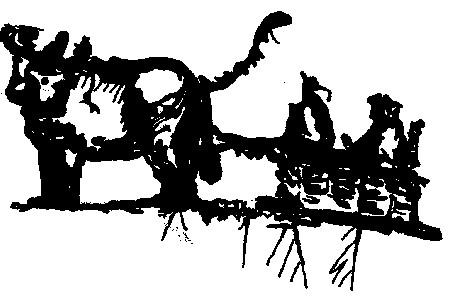
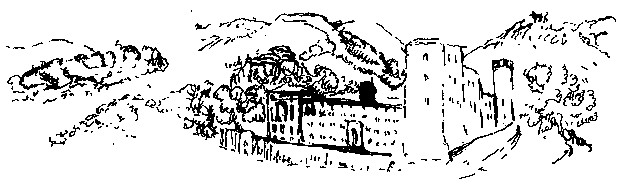
Illus. I had said & promised myself to make up for the lightness of the scale on Henrietta’s side, by writing this present letter to her, but since it must relate to your particular subject of Vallombrosa, where you agreed to go & live with us, you have a right to it I think, & I make over the two next times instead, to the beloved creditor– For we have been to Vallombrosa, Arabel—we have been .. seen & “came away conquered,” [2] excommunicated, thrust out ignominiously by the Father Abbot .. who being a holy man, “cant abide” anything impure & feminine to keep a stinking in his nostrils above three days– Now let me begin from the beginning– We left M. Centofanti’s house on the wednesday of last week .. nearly a week before our time was up, just as we thought the heavens & earth of Florence were about to be dissolved downright, so excessive the heat was. Thermometer at eighty five, and my bedroom growing furnacelike by three in the morning, & the state of the atmosphere rendering the noises of that street (which always were the great evil of the position) scarcely endurable. So we fled before it all, drove round the city at eight or nine in the evening to say goodbye to Mr Powers & the Hoppners, and at four the next morning were swallowing our last Florentine breakfast as it seemed to us, & in the carriage immediately afterwards– Even at that hour the heat was wonderful—we left Florence steeped in a hot vapour, and every mile seemed to throw off a blanket– At a less early hour there wd have been no travelling at all, though we soon were in the mountains & able to breathe– The carriage took us to Pelago, [3] a little mountain-village perched on the rocks where the road for wheels, (the via rotabile) stopped altogether; & so far it was a delightful drive & we were in great spirits, .. the scenery rejoicing our eyes with hill & valley, purple hills & vine-covered vallies, & the river rushing at our right hand as a companion of the road. As the carriage stopped at Pelago, before the door of the little inn, a voice said “Mrs Browning”—and I started as well I might, at being called by my name in that wilderness by any mortal voice. It was Mr Curtis, our American friend, who introduced himself to us by letter as I told you, & had taken coffee with us one evening in Florence, impressing us most agreeably by his refinement & cultivation—quite remarkable in so young a man, for he cant be more than five & twenty I shd think– He is travelling with his brother & two or three other American young men, and their plans had drawn some three of them to Vallombrosa where they meant to sleep, he said, & leave the place on the following day. [3.5] We heard all about it in the little inn while our conveyances were being prepared– The Americans very considerately wd not intrude on us, & went forwards on horseback. Robert too rode,—only keeping by me of course: and Wilson and I took our places as my illustration shows, in what they call a sledge or treggia, but which is nothing but a common wine-hamper, (you know those brown baskets) with two chairs tied into it by ropes, for us to sit on, and a little hay (disagreeably populous) strewn at the bottom– There is no wheel of any kind; & two white oxen dragged it as if they dragged a plough. A second sledge of the same fashion took our luggage,—and so we set off, with four wild looking men to drive the four white oxen & prevent accidents at the dangerous places—and really you wd have opened your eyes if you could have seen at all the way we were bound for. A more romantic excursion, could scarcely be I think, and when I tell you that we were four hours in travelling five miles, you will have some notion perhaps of the difficulties of the road– Then, the scenery! Precipices striking down from under the feet of our oxen into the deep dark gullies, dark with shade,—rocks above, straining upwards as precipitiously,—& mountains, mountains everywhere, on all sides, as if they caught one from another an aspiration to the Infinite—often I thought of Malvern– Malvern was nearest of all that I had seen to what I saw– But then the wildest and the greatest of Malvern was but as the seed of this grand, developped nature– Where the Malvern hills throw out a single ridge, here are seven times seven of hills– You remember Walm’s Well? [4] Take the remembrance, & multiply it fifty times, & you fall below the sight of what I saw– A sort of paved path, impossible indeed to wheels, threaded up & down the mountain ground—and how we descended without rolling, & ascended at all, is a little wonderful to me when I think of it coldly now– “As steep as a house” may be an exaggeration—but “as steep as the Leaning Tower” scarcely any– I was so frightened about Robert’s horse! Only these horses receive a peculiar education, & wd walk up & down stairs without blinking or stumbling– Well! five hours we spent in climbing, .. & our poor oxen were so fatigued that I moaned in the spirit through sympathy for them, & Wilson & Flush & I got out to let them breathe & sate in the chesnut forest– By the way Flush was very lazy & insisted on sitting in the sledge when rather he might as well have run by the side– The truth however was that Flush was distraught with fright– The whole time he was at Vallombrosa he never recovered his equanimity,—& nothing could be plainer both to Robert, Wilson & me than his manner of protesting against the whole scheme of going out into the wilderness, among the mountains & pines & waterfalls, away from civilization & little dogs. There was a black pine-forest close by the monastery which was his special horror: he would not leave the hem of my petticoat when we walked there– And when Wilson took him up the hills, why, there at the ridge of the steeper places, he used to sit & see her safe to the bottom, & look & pause & muse till he was called “cowardly Flush,” .. with one foot out in the air– He likes fresh fields! .. as many of those as you please!—but for wild solitary nature, ‘no, I thank you’, says Flush .. ‘there’s neither pleasure nor safety in it’. He wd as soon trust himself in a den of cats as near a convent of monks– But I was telling you of our ascent to them– Up from Pelago, .. straight up we went, along a thread of mountain-path which wrapt round & round & still up & up those savage eminences– The first mountains, skirted with grey olives & vineyards which seemed to creep upward painfully as far as they could & then let go– Beyond the mountains were mountains & presently we had to drop down into the gorge to the right & cross the torrent & pass into the chesnut forest & climbing[,] climb there more than ever– At the end of four hours, we had arrived– The monastery stood vast & blank before us, on a strip of tableland, flanked with pine woods– Arched with the mountains– To the left, was an open stretch of Prospect .. a great sea of Appenines .. I counted a fold of eight mountain ridges, all wild & purple. The nearest were clung to by the woods—beach woods, chesnut woods, pine woods– The monks may cut with a thousand axes, but those woods are too strong for them still– Now look at the monastery Illus. Something like it, only the mountains are higher, & I cant throw out the grey island of rock where the chapel stands with any expression. There is another rock-island opposite, on which is the hermitage– The “house of strangers” [5] where we were received, faces the tower of the monastery, & is after this fashion containing simply a few rooms on the ground floor. Illus. Here the women-guests go, and their husbands or fathers—otherwise all male strangers betake themselves to the monastery itself. The Americans dined with us, & we had dinner on our arrival– I was dreadfully tired as you may imagine, & the magnificent scenery could scarcely do more than make me feel that I had a soul somewhere, if I could but get at it. Then Father Egidio had come to assure Robert that we were most welcome for three days, but that no power in Heaven or earth, except the Pope’s or Archbishop of Tuscany’s could induce his Abbot to admit of our staying longer– What we had called .. a “permission,” was merely a “recommendation”, & inefficient in the case. Robert poured floods of eloquent amiability against the iron of this resolve—no, nothing would achieve anything– Afterwards he was half vexed & swore that he never had been so “subservient” in his life before, & that he “only did it for me & that I shd not be disappointed”—“those idiots of monks”! (relieving himself from the pressure of his own compliments, in an aside!) So provoking it was, after we had brought the whole of our possessions & a dozen of port up to that eagle’s nest in the clouds, .. to be pecked out by the eagle! I was lying on the sofa perfectly exhausted, for my part, & failed in power to protest even against Robert’s desperate crisis of appeal in my behalf, as having written about & translated from the Greek Fathers! Yes, he was driven to that, I assure you. “She is’nt frivolous like women in general, though she looks young enough still .. as you, padre reverendissimo, [6] may see”. The reverend father smiled benignantly, but evidently thought that no woman in the world young or old-looking could be called otherwise than frivolous except by an heretical device– As to the Gregories & Chrysostoms, he never had heard of them at all, I fancy, unless in some dim, indefinite way, as more modern saints than St Joseph perhaps. He said that our American friends (very goodnatured of them) had spoken highly of us both, as literary persons &c &c .. and when Robert assured him in conclusion, by way of producing a final, thrilling effect, that we never ate anything nor caused any sort of trouble, he could say beside only that he would do what he could for us, & procure us two more days if possible,–– Beyond the five days, was no possibility. So there we had to yield, the Lord divo [7] being obdurate. We stayed from wednesday to monday, & it was all. On thursday morning I did not feel well & looked worse, and Robert fell into despair & declared that he never saw such a difference in anyone, from three days before, … until it was discovered that the confusion had caused Wilson & me to forget my medecine both at night & in the morning;!! which, added to the fatigue, had produced the evil of course. I set myself right in an hour, & was very well indeed afterwards, so well, that we had a little talk about an extravagant project of plunging deeper into the mountains & extending our pilgrimage to the more distant convents of Laverna & Camaldoli [8] .. only it wd have involved thirty miles of either riding on mule back or sledge-driving, and there might be imprudence, … we thought, … though we went ever so slowly. Some day we may return & attempt it—oh, we dont give it up for ever. Because there are intermediate villages––and if we travelled only four miles a day in the glorious mountain-wilderness, it wd be a peopling of one’s dreams for the whole of a life– For the rest, it was probably a less evil than first appeared, that we shd have been restrained from our intended two months retreat at Vallombrosa. With all drawbacks, I shd have liked it, mind—still there were drawbacks. In the first place, we were there as mere guests & dependents. What we paid (though our payment was more than sufficient to cover our expenses) was to be considered as a pure gift to the convent;—& what we received, as the purest hospitality .. for which we were to return ever so much pure gratitude over & above. In this position, we could make no request for little matters necessary to our comfort– If waiting an hour for breakfast, (between the hot water & dry toast) & having the coffee altogether forgotten at night, struck us as an inconvenience, we had to look in one another’s face & be “contentissimi”, perfectly satisfied. We were never sure of strangers not being thrust into the midst of us, never– There was not a woman within reach of service, of course; & the beds were made by a young ‘secular’, who attended to other details of the same class– Then as for food, .. you know I profess to care for nothing, if I can have good bread & eggs .. & coffee for a luxury––and in going to Vallombrosa, Robert meant to live upon milk & cheese & fruit, & I on curds & whey, .. fixing on the simplest things. Now these were precisely the things, we could not attain to by any means– Plenty of beef & veal & fish, steeped in floods of oil, .. & the wine—excellent & copious supplies, we had—but we never saw fruit nor vegetables, nor cheese, nor whey .. and the milk was mere city-milk for waterishness, & such as it was, hard to procure—& the butter came & went once in two days like a very apparition .. and the hens of the convent thought it improper to lay more than one egg all the time we stayed. What they called coffee, I take to have been the emptyings of the holy water-vase at the monastery door, with the taste & colour of the crossing finger of every holy monk communicating by it some perpetual benediction. Worst of all, the bread was– To call it sour wd be flattery– Neither was it only bitter: Nasty resumes everything. Robert swears that it had in it the “flavour of corruption”– But perhaps it was only made out of sawdust from the firs, & kept with the beef .. which combination will account for a good deal. These things I call drawbacks, and if we had stayed as we wished, certainly we shd have been thinner by force of them– Still .. we did wish to stay. The glorious scenery .. the black, breathless silence of pine-forests, .. the sweep of the infinite mountains, the sound of water breaking on & gurgling down among the rocks .. these were greater things than a mere care for bodily comforts could counterbalance. I thought, while Robert & I & Father Egidio were walking together in the forest of pines, how strange it was, & how I shd have started to have seen myself so in a vision, some three years since. I thought too of you, my own Arabel, & how strange it wd seem to you & Henrietta if you caught a sudden glance at us from England– I walked out two or three times a day every day we spent there, & sate out of doors in the woods & enjoyed it as much as I could; but Robert & I falling into a sudden panic or prudence, I did not as we had planned, take a mule & ride out farther– We may go again, without the panic perhaps—we shall see. Father Egidio led him to the more salient places & showed him all the sights hidden from my eyes .. for of course they would’nt permit an unclean beast like me to pass the threshold of monastery or chapel .. oh no!– Out of spite however, when nobody was looking, I put my foot through the gateway & stamped on the gravel of their courtyard—(see the gate in my drawing)– There, was profanation for them, poor men! The little Abbot will have had a visitation of Satan through it, by this time, after the manner of St Anthony. [9] If it had’nt been for Robert who wdnt let me, I should have run in & opened the way for a troop of devils, so provoked I was– These monks are Benedictines & said to be for the most part wholly noble & originally rich– They have each an apartment & food supplied, and from four to six pounds for a yearly income of pocket money[.] Father Egidio is the only one who had intercourse with us, it being his peculiar province to attend to the guests (he is likely to be Abbot some day!),—and a goodnatured, narrow-minded uneducated host we found him, .. gently insinuating at the close, that although he was forbidden by the Rule to receive money, his hands were free toward other gifts, & that several strangers had presented him with snuffboxes, coffee pots & the like– In reply to which, we really could’nt give him Trippy’s coffee pot—and, having no snuffbox in either pocket, we had to delay our generosity to another occasion– [10]
—Well—so we passed the time till monday, .. reading the Life of San Gualberto [11] (who established the monastery) & learning from that only book within our reach, how spiritual holiness & benediction float in the air of the place & purge the waters thereof, & how no mortal soul can approach the mountain, without partaking the sanctifying advantage. Certainly we lost there the very memory almost of the heat of Florence– The change of temperature was extraordinary– Wilson & I had to put on our flannel petticoats as soon as we cd unpack them, and even then we were rather too cool– Once or twice somebody talked of “shivering with cold”—& somebody else said “Do shut that window”– But on monday morning it all ended; & in order to escape the dreadful Heat which waited to catch us up again in the valley, it was agreed that we shd set off at four. At three, we were up, & having hoarded the dry toast of the previous evening (which was’nt much harder than a slice of fir tree) we soaked it in the glass of port wine Wilson had provided for me, & so she & Robert & I broke fast for the day, & then set out on our travels– Sledges as before—and the descent rather alarming, I assure you. But oh, how grand the mountains were, rending the clouds & feeling through them for the sun! Never shall I forget the glory of that morning’s spectacle. We came down so much faster than we went up, that we reached Florence at nine oclock, and it was very much like going into the fire. But, Arabel, where could we go? There seemed no choice, no alternative. We had missed Vallambrosa after considerable expense of both strength & money, & were not rich enough to begin a hunt after cool places—and all we had to do was to make the best of our disappointment & take Florence at its shadiest side.
<…> [12]
So back we came to Florence, & home to M. Centofanti’s .. a day or two of our time remaining there. Annunziata, [13] the servant who had served us & was still in the house, rushed down stairs in an ecstasy, & after rapturously kissing both my hands threw herself into Wilson’s arms. It was really a scene—and to tell you a secret to boot, Robert & I were the happiest of disappointed people when we found ourselves on the old sofa & the breakfast table drawn close to it– We laughed & talked exultingly over the coffee & bread & butter, & praised them up to the height of the Ideal of coffee & bread & butter, .. we never had seen coffee & bread & butter before, you wd have thought certainly–!. Still, the coffee passed away & the heat remained .. a blind smothering heat. Night would come, & how was I to sleep in my bedroom? Fitter that room was, to bake rolls in– So after breakfast I lay stretched on the sofa & Robert went out (poor dearest Robert) to try to get cooler rooms, .. the coolest rooms he cd get in Florence– Two or three times he came back in despair, looking white with exhaustion, .. but at last the grand success befel us .. at last .. the next day .. and we have been in our new apartment now these five or six days. Such fortunate people we are: it is extraordinary I think– We thought at Pisa that we did well in an apartment, .. but at M. Centofanti’s we did so much better that we took to scorning Pisa altogether—and here is best, best of all—you wd be rather surprised if you saw what an apartment we have in this Palazzo Guidi, a few steps from the Grand Duke’s palace & in the situation of Florence & close too to the Boboli Gardens to which we are to have daily access in right of our position, and on the first floor besides. [14] Of course, we could not achieve such rooms except now in the dead part of the season, but with every consideration, it is cheap & happy & I wonder to find myself here as successor to a Russian Prince, & suite with satin couches & arm chairs “à discretion”– And we pay precisely what we paid M. Centofanti .. a guinea a week .. with an additional nine shillings the month to the porter who is a necessary part of the grandeur it appears, & lights the staircase & brings water & so on– The rooms, that is the drawingroom diningroom & my bedroom are very large, very much larger than any room in Wimpole Street, & furnished & overfurnished as I told you, .. marble consoles, carved & gilt arm chairs, all in crimson & white satin, noble mirrors, & instead of the memorable Pisan spoons (or spoon, was it?) such splendours fit for the entertainment of the court of Tuscany, that we grow a little nervous for fear of being ruined to the end of our days by the chipping of a teacup.
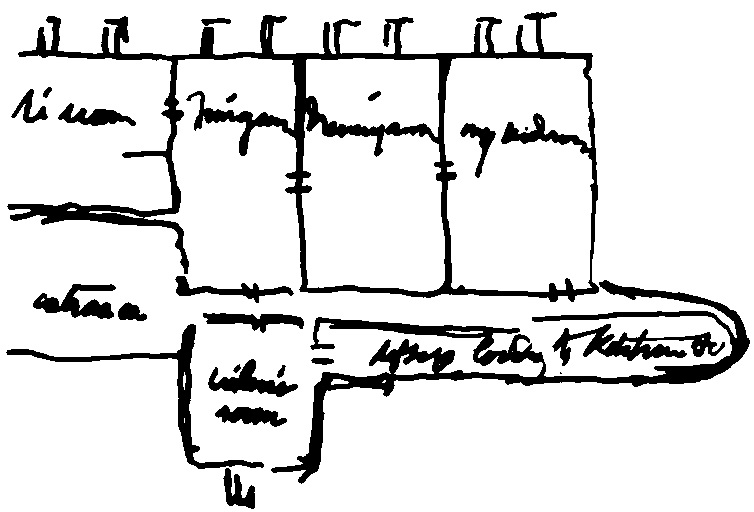
Illus. There’s the plan of the apartment! The eight windows which are very large, opening from ceiling to floor, open on a sort of balcony-terrace .. not quite a terrace, yet no ordinary balcony neither .. which is built out from the house, giving it an antique & picturesque appearance to the exterior– And you may suppose what a pleasure it is to have such a place to walk up & down in, when we are not inclined to go into the streets. Opposite is the grey wall of a church, San Felice, [15] and we walk on the balcony listening to the organ & choir– Nothing can be much more delightful after all—so let the monks keep their Vallombrosa– Robert was unwell with pain in his head, all the time we were there, the consequence he thought, of a slight smell of paint in the House of Strangers, but just as attributable to the food, perhaps .. whereas here at Florence we are all well, it agrees with us all three, let us burn through it ever so– As for coolness we are cooler than at M. Centofanti’s considerably—at night particularly. I can sleep, & the oppression loses itself in these large rooms, where the sun never comes except for a side-glance. Still, every place in Florence must be hot, & you would be rather amused to see the costume I appear in day by day–
<…> [16]
You know I have my mantilla—and besides Robert insists on it that I look just as well without any, .. & seriously he proposed to me the other morning that I never shd put them on again. And the white gowns he particularly admires,––Oh, I assure you there never was a less critical husband in the world. As long as I eat enough, & have my hair in tolerable curl & wear clean gloves, all the rest pleases however it be—and the eating enough is the chief thing. We have taken our apartment for two months certain, & may have it perhaps for a third month—after which the world is all before us where to wander, [17] & I cant tell you what our plans are, they shift so, and are so dependent on circumstances independent of us– Also, we have agreed, seeing how an excess of scheming defeats itself, to leave the future alone a little .. God takes the best care of us and events fall into their places without our meddling over much– It is curious how Robert gets his wishes! Since we have been in Florence, walking carelessly past this palace & admiring the architecture, he has wished two or three times to live here … just as you might in a fancy wish to live .. where shall I say? .. at Northumberland House or Chiswick! He did not suppose even that appartments were to be let here— … yet here, lo! we are! The next thing may be that the Grand Duke may invite us to occupy the left wing of the Pitti .. I dont know what’s to come next. What nonsense I write to you, to be sure! We have taken Anunziata with us in our <place> of residence– Flush likes it much better, he <…> than he liked the mountains– At about eight in the evening we walk in the comparative cool .. stand on the bridge of Santa Trinita, [18] & go eat an ice at Dony’s .. then return to supper, & dont sit up three m<inutes> afterwards– Think of our taking a dozen of port wine up to Vallombrosa! That was Robert’s insisting for thought for me & he will make me hold to the port wine, though it is quite unnecessary, so well I am––none the worse for the fatigue– Which surprises me– We did not expect an opportunity of such bold adventure, and in the midst of it, when it was too late to go back, I certainly feared that I might suffer in some way—but you see———— Give my love to dear Mr Boyd & thank him very much for his kind letter which I will answer soon– It is delightful to me, tell him, to be remembered by him so affectionately .. Always, dear Arabel, let me have the least detail which reaches you about Stormie. Give him my love & pray him to write to me– My love to them all. I had a letter from Mrs Martin while George was with her, & she talks of his ‘success’——is it true? Such kindness too she writes to me of myself, & of her “exulting” sympathy in my happiness– I imagine that the Hanfords have spoken of us to her very kindly .. I mean, of us both– Indeed I could not understand how anyone could see Robert for an hour, & not carry away a pleasant impression—I say that as if in the capacity of the Goddess Justice herself, carved in marble in the Piazza & holding the scales [19] —far on the outside of all affection & intimate knowledge– What he is to me, only God knows. We shall be here to keep our wedding day on the 12th of September, & we mean to do it very jovially—very thankfully, I hope. Neither of us has repented for one half moment what was done on that day—that fountain of blessing for all other days—repented .. oh no! And yet there have been pain & sorrow––only not from him to me .. nor .. I thank God .. even from me to him. It has been for us, a perfect union of two lives & souls, .. happier than anyone can understand from these words of mine, or any like them. Let me hear of Emma .. no more Monro [20] .. do congratulate her from me– It seems to me that the repetition of such a ceremony, must be awkward, to use no sadder word. She must be glad that it’s over. What do you mean about ‘morals’ in relation to Fiesole? I intended to suggest no moral, I am certain, & do’nt remember what you refer to. Tell dearest Trippy that I love her & will write soon to her. Perhaps the Reynoldses will be too charmed with their house to leave it for Rome–
<…> [21]
Always mention him particularly .. poor dearest Papa! Ah, if he knew how I love him through it all!! Kiss Lizzie for me .. Lizzie Barrett. My love to the Cooks—does Surtees get an appointment? Remember me gratefully to Mr & Mrs Stratten .. mind you do– I hope you had a pleasant day. My beloved Arabel take care of yourself for me & be wise, & dont choose a monastic life out of which no good comes– Be certain that no good comes of it ever– See the fruit of it at Vallombrosa! There, be “morals” for you! so be quick & gather them up. How is the school? Tell me everything—as I shall tell you, .. when I have anything to tell. Oh, to compare Vauxhall [22] to Florence! Tell Alfred he is a barbarian. Robert has seen Vauxhall, & Wilson the Surrey Gardens, but the sight here—was the wonder of wonders– Write, write– I love you, both of you .. all of you, .. & am my own Arabel’s
most attached
Ba.
Love to dear Minny– Tell me of Crow–
Robert’s best love to you & dearest Henrietta.
Address, on integral page: (To the care of Miss Tripsack) / Miss Arabel Barrett / 5. Upper Montagu Street / Montagu Square / London.
Publication: None traced.
Manuscript: Berg Collection.
1. Year determined from EBB’s reference to the recent trip to Vallombrosa.
2. Cf. “I came, I saw, I conquered,” (“veni, vidi, vici,” Plutarch, Lives: Caesar, 50).
3. A small village about 14 miles from Florence on the road to Vallombrosa; see Aurora Leigh, I, 111.
3.5. The names of John Frederick Kensett (1816–72), J. Burrill Curtis, and George W. Curtis, dated 15 July 1847, are entered in the Vallombrosa guest register.
4. A spring on the side of a hill near Hope End; see Diary, p.88.
5. Murray’s Hand-Book for Travellers in Northern Italy (1847) identifies “a building called the Forestiera for the reception of strangers, upon whom it is the duty of one of the monks to attend” (p. 584), presumably, in this case, the Father Egidio mentioned below.
6. “Most reverend father.”
7. “Divine,” i.e., the Abbot.
9. St. Anthony (ca. 251–356) whose life of solitude in the desert was beset by temptations, artistic representations of which have taken the form of ugly demons, fantastic creatures, or naked women.
10. Murray’s Hand-Book explains that “Gentlemen are provided with comfortable beds in the convent; but ladies, who are not allowed to enter the convent, have apartments assigned to them in this building [i.e., the Forestiera]. No charge for board or lodging is made upon the traveller: the usual mode of payment, therefore, is, to give the monk who attends upon strangers a sum of money requesting him to distribute it among the servants” (p. 584).
11. Giovanni Gualberto (d. 1073) was canonized in 1193. He joined the monastery of San Miniato in 1013, but when a simoniacal abbot was elected, he chose to remove to the monks of Calmaldoli. From there he retreated to a severer rule of monastic life at Vallombrosa, and eventually formed his own order according to the rules of St. Benedict. The order was approved by Pope Alexander II in 1070. EBB recalls this visit to Vallombrosa and San Gualberto in Casa Guidi Windows, I, 1129–64. There are several accounts of his life in verse, as well as the Historia di San Giovangualberto (Firenze, 1640) by Diego de Franchi.
12. Nearly three lines have been obliterated by someone other than EBB.
13. She was the first of two domestics of this name employed by the Brownings in Florence.
14. The Brownings moved to Palazzo Guidi on 20 July 1847, and, except for the six-and-a-half month period of 19 October 1847 until 9 May 1848, it was their principal residence until EBB’s death in June 1861. Soon after the birth of their son in 1849 the Brownings began calling their apartment Casa Guidi, by which name it is known.
15. This ancient church was largely rebuilt in the 14th and 15th centuries. EBB refers to it in the opening lines of Casa Guidi Windows (I, 1–2).
16. Three lines have been obliterated, by someone other than EBB.
17. Cf. Paradise Lost, XII, 646.
18. According to Murray’s Hand-Book, “this bridge is a favourite evening walk” (p. 481). Murray’s Hand-Book also notes “The café Doney, in the Piazza Sta. Trinita, is the most frequented in Florence. Doney is the Gunter of Florence as regards ices, confectionary, &c.” (p. 474).
19. In the Piazza di Santa Trinità. The porphyry statue by Ferrucci is mounted on a granite column brought from Rome by Cosimo I and erected in 1554 (Murray’s Hand-Book, p. 528).
21. A little more than a line has been obliterated, by someone other than EBB.
___________________