2701. EBB to Arabella & Henrietta Moulton-Barrett
As published in The Brownings’ Correspondence, 14, 300–308.
Florence–
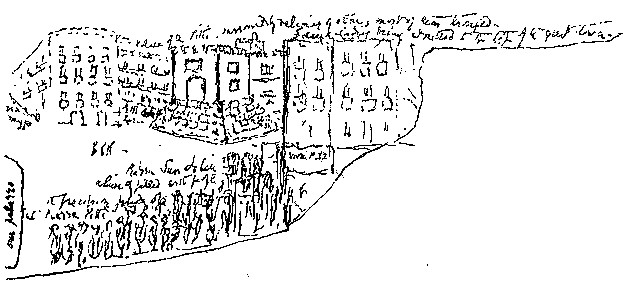
[13 September 1847] [1]
Illus. Love to love my dearest both of you! How else should I thank you adequately for your kindest of letters, which happily came on the wrong day, saturday, inasmuch as if it had come on the twelfth we should have missed it till monday, it being impossible to force one’s way to the postoffice through the crowded streets. [2] Robert expected a letter from home & had to give it up—the thing was impossible. The fact was, that our Italians had resolved to keep our day for us on a most magnificent scale; an intention which we, on our parts, not only graciously appropriated, but permitted in return to perfect the glory by keeping at the same time the establishment of the civic guard & prospect of the liberty of Italy through union– Ah, you should have seen our day! Forty thousand strangers were in Florence .. I mean, inhabitants of the different Tuscan states, deputations and companies of various kinds; and for above three hours the infinite procession filed under our windows with all their various flags & symbols, into the Piazza Pitti where the Duke & his family stood in tears at the window to receive the thanks of his people. Never in the world was a more affecting sight .. nor a grander, if you took it in its full significance– The magistracy came first .. with their flag, & then the priesthood (such as chose) .. and I saw some brown monks there, with the rope girdle, I assure you––and then & then .. class after class .. troops of peasants & nobles, and of soldiers fraternizing with the people .. Then too, came the foreigners, there was a place for them—& there are so many foreign residents here that it was by no means unimportant to admit their sympathy—French, English, Swiss, Greeks (such a noble band of Greeks!) all with their national flags– Meanwhile there was no lack of spectators. The windows dropping down their glittering draperies, seemed to grow larger with the multitude of pretty heads, & of hands which threw out flowers & waved white handkerchiefs– There was not an inch of wall, not alive, if the eye might judge– Clouds of flowers & laurel leaves came fluttering down on the advancing procession—and the clapping of hands, & the frenetic shouting, and the music which came in gushes, & then seemed to go out with too much joy, and the exulting faces, and the kisses given for very exultation between man & man, and the mixing of elegantly dressed women in all that crowd & turbulence with the sort of smile which proved how little cause there was for fear .. all these features of the scene made it peculiar, & memorable & most beautiful to look at & to look back upon. We went to a window in our palazzo which had a full view, and I had a throne of cushions piled up on a chair, but was dreadfully tired before it was all over, in spite of them, as you may suppose from the excitement of such a scene. And then Robert & I waved our handkerchiefs till my wrist ached, I will answer for mine. At night there was an illumination, & we walked just to the Arno to have a sight of it, .. and then, the streets were as crowded as a full route in London might be, only with less pushing probably, & with the soft starry air in change for a stiffling atmosphere– And even then, the people were embracing for joy. It was a state of phrenzy or rapture, extending to the children of two years old, several of whom I heard lisping .. “Vivas,” with their little fat arms clasping their mothers[’] necks. So was’nt our day kept well for us? Yes, and without a single discord to mar the harmony– You never see drunkenness nor brutality in any form in the gladness of these Tuscans. You never see fighting with fists, nor hear blasphemous language. It is the sort of gladness in which women may mingle and be glad too– Our poor English want educating into gladness—they want refining, not in the fire but in the sunshine. How different a thing a crowd is here to an English crowd, you must come here to learn—yet whose is the fault, I wonder? And why should it be so, with all our advantages of a more scriptural instruction and larger constitutional rights? One reason is that our religious teachers in England do not sanctify the relaxations of the people. The narrowness which cuts down literature & refuses to accept Art into the uses of the Christian Life, is more rife with injury & desecration than you see at a first glance– Of this I am more & more sure the more I see & live. It is a worse mistake than marrying on Litany wednesdays, and dining on fast-fridays, .. and we should repent it in the ashes of ash-wednesdays, if people repent deepest really in such ashes. You will say that it was’nt a very perfect keeping of sunday yesterday even though it did perfectly for our anniversary. The whole company of which the procession consisted, went in the first place to the cathedral, observe, the great Duomo, (where nobody unconnected with the ceremony was admitted, for the plain reason that there was no room) & there the banners were blessed, and the ‘Veni Creator’ & Te Deum sung in choral magnificence [3] —and I could not for my part take it for desecration when the next movement brought them to thank their sovereign, & fraternize in hope with one another. Besides their view of the meaning of the “Lord’s Day” is different you know from the general view of it in England, .. whether nearer or farther from the true one, being another question– And now, pray dont take it into your dear imaginations that Italy is in arms, & that I am on the eve of being massacred—you & dearest Trippy may set your hearts at ease, on the contrary, for the safety of my head– The excitement here which certainly exists, & is at its height perhaps in Tuscany just now, is all joyous & good & innocent & preventive of evil. If Italians join hands, Austria may throw in vain her poisoned arrows, .. and the noise we hear is only the clash of the gauntlets as friend meets friend– Every Austrian in Florence was desired to keep the house yesterday, by an order of the police,—& this because it had been discovered that here as lately in Rome, paid Austrians were in league to produce disturbance in the streets, in order to justify the interference of the Austrian government. Is it not hateful & loathsome? Met[t]ernich puts out these fangs, .. trembling in his hole, poor reptile, for his power in Italy. [4] Which may God shiver into dust– Our grand Duke has behaved well– Think!—it was a hard position for him! himself an Austrian, & his family & associations leaning to absolutism naturally. But he sacrifices everything, & does it well & nobly, as if his heart helped him. After all, however, the Pope is the liberator– He is a great man .. I call him great. It is wonderful how a man in such a position, should have his soul free & pure for such a course of action. Liberty seldom originates for a people from the throne, .. and when you consider that it is a Pope’s throne, the wonder grows most wonderful– I think I must go to see him when we go to Rome to express by that act what a man I hold him to be. And it is expected that after the court of the sanctuary, he means to wash the sanctuary itself,—to reform the priesthood (which requires it, as some of the laity know) and to cleanse various practises of the church. [5] A most devout man, he is said to be, and brave and gentle at once—and as the people in Rome adore him, he may attempt very nearly what he pleases without fear of being accused of heresy. He rides about the streets on a mule, they say, & dreams by night & day, of doing good humbly. Think of such a Pope!–
And of such a letter too!—you will be tired of it & of me long & long before this, I am certain, .. you who dont want to hear about Popes & crowds– So let me go on & tell you of our day. The worst of it was that Robert was not well—he had caught cold & felt unwell for several days, & yesterday he was as languid, as languid .. and looked so pale .. and of course it spoiled our good spirits rather, though he made me very happy by saying again & again such things as cant be repeated nor forgotten, besides, that never in his life, from his joyous childhood upwards, had he enjoyed such happiness as he has known with me—— Too happy it makes me to hear such things! Indeed if the perfectest love & sympathy can give any happiness, we both enjoy it– There has not been a cloud, nor a breath. The only difference is from happy to happier, and from being loved to being loved more– When he says he loves me more, I see that it is just so– Every word I say is something right & bright, let it be ever so dull: and if I say nothing, why then, I am sure to be looking right, or pouring out coffee right, or listening divinely to something said to me—so that mine is not a difficult part by any manner of means. We have gone over all our days last year in rather a pleasanter way than we did the original days, which were wretched, to say the best of them——oh, that dreadful day at Hampstead! If you knew how I suffered while I talked word upon word– My darling Arabel was grave, & you looked suspicious, and the life of us all seemed to hang on the suspicion being put away. But in talking lately of these things, I could not help laughing a little, & catching a glimpse of the ridiculous side as they turned into the passing year. Always it does make us laugh, for instance, to think of the official’s (the man with the wand in the church) attitude & gesture of astonishment, as he stood at the churchdoor & saw bride & bridegroom part on the best terms possible & go off in separate flies. Robert was very generous & threw about his gold to clerk, pew openers &c &c in a way to convict us of being in a condition of incognito .. and this particular man with a wand, had hazarded, between two bursts of gratitude, a philosophic sentiment about “marriage being a very serious event in one’s mortal life”, .. this as we left the church– And there he stood in the doorway, his speech scarcely ended on his lips, .. mouth wide open in mute surprise! “Never had he seen anything more remarkable than that, in the whole course of his practice!”—— On our day we gave Wilson a turquoise broach as a memorial of it having chosen it on the jewellers bridge [6] the day before–. If it had not been for Wilson, on the real day, it wd have been worse with me than it was. I assure you she only knew the night before, and, I am sure, had her own share of suffering, .. she who is so timid & easily daunted. She was more glad to make us knead cakes yesterday: & we had them for tea at seven oclock. But now I am going to tell you how a cloud came. Robert, as I said, was not well, & did not take his walk as usual with Flush for company—& therefore, because we hold it necessary for Flush to have daily exercise, we sent him down stairs with Annunciata just for one run– Well– Not only did he run, but he ran away. A little dog passed at the moment, & after the dog he went, & upstairs without him came Annunciata. ‘Oh’ said she .. [“]è niente! Tornerà presto, presto,” [7] —and really I thought he might be back soon .. but hours passed, & no Flush. Was’nt it too bad of him to spoil our wedding day so? As it grew darker & darker the tears could scarcely be kept out of my eyes, .. for Flush has a new collar & I feared that he might be stolen by one of the forty thousand visitors, and so farewell to poor Flush. And so passed the night– The porter left open the gates till twelve oclock .. but not a sign of Flush—and when Wilson came to dress me in the morning no Flush, no Flush! (Robert had gone round to Piazza Pitti in vain, I forgot to say .. but then who could see a dog in that crowd). Well, while I was dressing, in the morning and sighing over all these vicissitudes in the most melancholy of moods, a dash was made against the door of the room which either betokened Flush or the devil .. and of the two you may suppose that it was Flush– Yes! he had come back & laid down at the entrance of our appartment, & a charitable person had let him in—and very guilty he looked & tired, as if he had been roaming about all night. “Quite disgraceful for a respectable dog like him,” as Robert said reproachfully. But I dont doubt that the great crowd & confusion & illumination of the night before had frightened & confounded him, & that he had lost himself completely– In the calm of the morning he had recovered his head a little—poor Flush—and in this way the evil was remedied. Ah, you dearest kindest best Henrietta & Arabel, how I thank you from my heart of hearts for your dear letters & tender words. First I read your letters always to myself, & then Robert sits down by me to hear everything that is not too secret. Well—I read your letter so, to him, yesterday, Henrietta, .. and then I began Arabel’s, without the precaution this time, of reading it to myself first. I managed it all very well until I came to that part where she spoke of praying for me in the place where we used to pray together, and there, I could not get on but burst out crying in the most unforseen way possible, .. which was unfortunate, .. for he hates to see me cry & began to look a little unhappy himself just for company. Yet it grew better by degrees, and at last nothing was left but the brightness of knowing how you both love me who love you back again from the soul of my soul—dearest Things! May we look on one another’s face before long—I long to see you!
We have had a great fair here, and the cheapness of everything has been miraculous. I have bought neck ribbons, five or six or seven of them, very pretty, at three pence a yard—such as you wd give a shilling or fifteen pence for in England. Also a winter’s gown, .. a sort of Orleans cloth, (more like that than anything else) with a silk stripe in it, .. really pretty & fine .. of an invisible green colour .. and I gave for the whole dress 5s–6d It was five pence halfpenny a yard– So much it pleased me that I wanted another in black, (which blackness is convenient at Rome, women being excluded from some of the ceremonies if unclothed in it .. and I have worn out my black silk gown) but it rained the last day of the fair and Wilson missed her opportunity of getting it for me. If I buy at the shops a black French merino, it will be a guinea—and to give a guinea for a dress in this land of cheapness, seems to me rather an extravagance. Yet you would give rather more in England .. would’nt you? Wilson paid three halfpence a yard for the lining of the green gown– Think of that! Such prices only, account for the elegance of the women of all classes, which strikes foreigners so much on the frequent festa-day. Otherwise it wd be a problem to solve. Our baker’s wife is an Englishwoman married to a German, [8] and she said to Wilson .. “Ah, you may talk of England—everybody does that! but when you go back you will cry your eyes out for Italy, just as I did when I thought I would return, and then longed to get out of it all again. England is not the place for the poor. They are treated like dogs there, and never enjoy anything like other human beings– The rich on one side, the poor on another, .. that’s the way in England– Here we are all men & women & can reach to the same pleasures.” Which has a great deal of truth in it– I am jealous for poor England .. Why should not her people be as happy? Why should I pay here only three pence for two large soft spunges, for which in London I shd pay some ten shillings? Wilson has this instant brought them in to my utter astonishment. She says that though the fair is done, she can get things even cheaper, and has brought some more neck-ribbons, three halfpence a yard. We are providing ourselves with everything at Florence, because Rome has a reputation of being dearer & more difficult– And now I am about to tell you of a new visitor we have had. I found a letter on the table from a Miss Boyle, enclosing a note of introduction from Miss Dowglass .. who said by the way, that she knew nothing scarcely of Miss Boyle except that she was in deep anxiety to find us out, having been already introduced to Mr Browning!! &c &c. & intimated that we both shd know in the flash of a thought all about the said Miss Boyle, she being a notorious personage. Well! Robert & I looked into one another’s faces in blank confusion—how could he remember an introduction in London, one of the many? & as for me I had never heard of her, I thought. So I wrote back to Miss Dowglass, beseeching her to send us a key—and I wrote to Miss Boyle, who had invited us to the Carreggi villa (the villa of Lorenzo the Magnificent) in her mother’s name, that I had not been much out lately but would gladly receive her in Florence if she thought it worth while to call on us. 1st Answered Miss Dowglass from the Baths of Lucca .. that Miss Boyle was the daughter of Lady Boyle, sister of the Queen Dowager’s maid of honour, niece to the Earl of Cork, and authoress of certain poems, .. that she had met Robert, whom she excessively admired, at Lady Morgan’s, [9] & had just begun a conversation with him in the hollow of a window when the lady of the house spoilt it all .. that knowing Miss Dowglass slightly she had caught sight of my books on the table & had begun to enquire eagerly “where Mr & Mrs Browning were, whom she had hunted for in vain through Pisa & Florence” .... she had heard of their having gone into Switzerland”. [10] 2d Answered Miss Boyle that she would come .. and she came straightway, at a most unfortunate moment, .. Wilson & Annunciata being both out, & Robert opening the door of our apartment, without the prestige of the cravat .. unanealed, uncravatted! [11] — .. in the merest, wildest state of dishabile. He has the art however of making the best of a situation, & managed to laugh us back into respectability, and to be so cordial to the visitor that she condescended to say “Oh, you ought to see me & my sister in the morning”.– As for me I had been lying prostrate on the sofa & leapt up in horror,—and if really, as he assured me afterward, my hair & appurtenances were ‘quite perfect,’ it was a miracle of the uncommonest. “Here’s Miss Boyle, Ba, come to see you,” did confound me utterly, I must admit– But she seemed after all, good natured, & was clever in conversation & made herself a good place at last. “A little lively aristocrat,” as Robert describes her well .. and somewhat better under and over. He remembered about her in a moment as soon <as> Lady Morgan’s name was mentioned, and says she is the ‘crême de la crême’ in London society, with certain literary pretensions to boot Almacks. [12] Clever <&> original she certainly seemed in her talk, and she sate an hour with us & “hoped to come again.” Lord Holland had lent Lady Boyle the villa Carreggi & they had been there for months without suspecting that we were not in Switzerland, when a chance took Miss Boyle to Lucca Baths & threw her in with Miss Dowglass. Tell Arabel in regard to the latter, that in writing to me she is very reserved about religion, seeming to avoid the subject as much as possible. I imagine, that she unites with the church of England, .. with differences perhaps. She rides out a good deal in “gallops” .. it is her favorite exercise. How much better she must be to admit of this!– As to Mrs Cook, [13] I quite quite agree with you that Bummy shd be defendant rather than plaintiff– The case is obvious. Give my love to Surtees & Susan– How sorry I am about poor dearest Minny! Oh, Holloways pills! [14] What could she be thinking of to be so rash– Keep her in bed as long as you can & mention her particularly– I am sorry too about Crow [15] —mention her when you write– Wilson is better again– You are not to fancy it another illness– It was only a return of unpleasant symptoms– Wisely, as I think, she has thrown away Sir Ch. Herbert’s last medicine– Simple castor oil seems to do more good– It is a case in which diet & exercise are more active & necessary remedial agents than any drug– As to the heat, I do not, nor does she, think that it did the harm– We are all very sorry to leave Florence,—and I assure you Wilson has been invited to go to England for a husband & return with him to settle here. It does’nt seem so bad a plan to her, I fancy, as it would at one time. We are each of us “taken” in a different charm. Yet we go, & go on monday the twentieth—having doubted to the last,—but the winter prices (just double in these rooms) coming in to turn the scale. Also it is better perhaps on all accounts to travel now– We shall be ten days on the road which is usually travelled in five—but probably you shall hear again before we set out. I am perfectly well, only annoyed by a little occasional distress—& the change of air will do me good, I dare say. Dont be afraid of the Austrians, nor Italians either. Tell Arabel it would be impossible to get a passport at this time for Palermo, Naples & Calabria being in actual revolt. The Reynolds’s wont go to Naples we prophesy. In other parts of Italy, where the government gives signs of sympathy with the people, there is no reason to fear for the tranquillity & safety of anyone– Tell my dear dear Treppy that her note shall be answered to herself & that meanwhile I love & kiss her through the air for it. Robert was so gratified, & both of us grateful. Is it possible that Henry will write to me! How happy that will make me– I love him & all of them from the roots of my heart—but it is difficult to believe that they love me as you say, when for my sake they refuse to give up a little of this .. what is it to be called? determination, any wise– Could I have stood aside from one I loved a whole year as they have done from me? Love to them is the uppermost feeling with me after all– Tell them all so– If I and mine have wronged them, why not forgive us legally? And so little thought as there was of wronging them! God bless you–
Your own
Ba–
Robert’s “dearest love,” he says–
Address, on integral page: To the care of Miss Trepsack / (Miss Barrett) / 5– Montagu Street / Montagu Square / London.
Publication: Huxley, pp. 43–51 (in part).
Manuscript: British Library.
1. Dated by EBB’s reference to the celebrations on the day of the Brownings’ first wedding anniversary, and by her reference to their anniversary as “yesterday.”
2. Not easily seen on her sketch, EBB has identified or written the following: “Our palazzo”; “via maggio”; “Pitti Piazza”; “Palace of the Pitti—surrounded by balconies of stone, most of them thronged”; “Foreign ladies being admitted to the top of the great tower”; “The procession ending up at Piazza Pitti”; “Piazza San Felice alive & filled with people”; “Viva P. IX.” EBB’s illustration and description here is echoed in Casa Guidi Windows, I, 446–576.
3. “Te Deum Laudamus” (“We praise Thee, O God”) and “Veni, Creator Spiritus” (“Come, Creator God”) are the opening words of two ancient hymns of praise and thanksgiving.
4. Prince Clemens von Metternich (1773–1859) dominated European diplomacy during his term as Chancellor of Austria (1809–48). In July 1847 he had ordered Austrian troops to occupy the entire city of Ferrara, which was under papal sovereignty, thus violating international law. Pius IX was outraged, and lodged a formal complaint, but his revenge came a few months later when Metternich requested permission for Austrian troops to march across the Papal States to suppress uprisings in the Kingdom of Naples: the pope refused. Metternich’s term as Chancellor ended the following March. EBB refers to him in Casa Guidi Windows, I, 662.
5. Amongst other acts early in his papacy, Pius IX had called for a revival in the religious orders, urging bishops and other clergy to lead the way by example (see letter 2643, note 3); he was himself respected as a model of pastoral leadership.
6. i.e., the Ponte Vecchio; according to Murray’s Hand-Book for Travellers in Northern Italy (1847), “like the Rialto, it is a street of shops, appropriated with few exceptions to jewellers, goldsmiths, and other workers in metal” (p. 481). The Ponte Vecchio is still known for its many jewellery shops.
7. “It’s nothing! He will come back very, very soon.”
8. EBB provides “Miller” as the baker’s name in a letter to Sarianna Browning dated [2 December 1854] (ms at Lilly).
9. Lady Morgan (née Sydney Owenson, bapt. 1783, d. 1859) was an Irish novelist and author of The Wild Irish Girl (1806) and Florence Macarthy (1818). For Miss Boyle, see letter 2698, note 2.
10. Placement of quotation marks is EBB’s.
11. Cf. Hamlet, I, 5, 77.
12. EBB is referring to Almack’s Assembly Rooms in King Street, St. James’s, which had been opened in 1765 by William Almack, a Scotsman. Almack’s soon became a mecca for London society ladies, and was ruled by the patronesses, who alone distributed tickets of admission. Their power to offer or to deny entry made them the undisputed arbiters of fashion and manners.
13. Elizabeth Cook (1783–1862), the mother of Surtees and Susan Cook.
14. One of the “secret remedies” marketed by Thomas Holloway (1800–83), whose ointments and pills were widely advertised. In 1845 he spent £10,000 on advertising (DNB). Holloway was later founder and benefactor of Holloway College.
15. Based on EBB’s comment at the end of letter 2647, we take this to refer to a failed pregnancy.
___________________