2748. EBB to Arabella Moulton-Barrett
As published in The Brownings’ Correspondence, 15, 130–140.
[Florence]
Oct. 7–9–10–11 [1848] [1]
I did mean, my ever dearest Arabel, to write to Henrietta this time, considering that my last letter to her only covered an envelope– But as she has flown away into Herefordshire & as besides you seem to want me to write to you, here I am writing—and it will come to much the same end after all. Her dear letter, with yours, reached me yesterday. Wilson who went to post for it, looking a little disappointed that Minny shd not have answered her note– “Nothing for me [2] !” And now, let me explain to you, that I really wanted some refreshment from your beloved hands, as ever since my letter went to you I have been much less happy than usual, & only within these few days have begun to be easy again– Otherwise I would have written before .. I always meant to write sooner this time, since you were in the country & asked for letters—but see how it has been with me. You remember how I said that I wd not let Robert write that day through his not being well– Little did I think then how it was to be—& that from three weeks from that day he was not to leave the house through illness .. fever & ulcerated sore-throat .. he refusing to let me send for a physician, & I in a continual state of anxiety .. because, you see, fevers in Italy, are really not to be trifled with & he though generally in excellent health, is by no means of a robust habit & constitution. Oh, I wd have sent to Dr Harding without asking him, if it had not been that he never wd do such things to me .. often saying to me that he cd not treat me so, without confidence, whatever his own feelings might be:—and therefore when he appealed to me by his former forbearance on such points towards myself, not to vex him by sending for a physician without his consent, I was paralyzed .. I could not do it!—only Wilson was as nearly as possible doing it without consulting either of us—she had made up her mind, she said, one night, that if he were not better in the morning, she wd send to Dr Harding .. and I shd have been delighted, for my part—so quite wrong it was to be without advice as we were under such circumstances. Such burning hands, so rapid a pulse, & then, when the ulceration of the throat began, such suffering, such impeded articulation. Relief came at last by the breaking of something in the throat, & by nearly a wineglass full of matter coming up, .. so you may suppose what illness must have preceded such a crisis—and he so patient, poor darling, & so dreadfully afraid of giving anybody any trouble. “Oh Ba, it cuts me to the heart to see you doing this for me,” … if I did but carry him a cup of tea—but always he thinks that he is to do everything, & I nothing,—that’s his idea of mutual help! Altogether I shd have been perfectly miserable if it had not been that just as he began to grow obviously weaker & the fever obviously stronger, in came, by God’s providence, no less a person than Father Prout, Mr Mahoney, the celebrated Jesuit– Now, those Jesuits are learned in all arts, & this Jesuit in particular, is alive with talent to the end of his fingers, .. & besides, I must say, most kind & affectionate .. no friend cd have been kinder than he! and he felt the pulse, & pointed out how the fever was getting ahead through exhaustion of the body [3] .. beat up two yokes of eggs in port wine with his own hand, & made Robert take the whole .. (the consequence of which was that he slept & was the better) .. & laughed my anxieties to scorn .. “Had’nt he stood by five six hundred deathbeds, & did’nt he know when an illness was serious or not?—but I was a regular child .. a bambino, my dear .. & now he would take his revenge for my putting that veil down at Leghorn, by having a good stare at me.” [4] A most peculiar person certainly, Father Prout is, full of agreeableness, of apt & various quotation, at once witty & humourous, a scholar & a man of the world, & what beside Heaven knows, .. Carlyle says, .. “of all manner of spiritual wickedness,” & others talk loud of ecclesiastical doubleness & so on .. for my part I shall speak of him as I find, & it is my strong impression that he is a most warm-hearted man, & perhaps a Christian man in the large sense. It is strange, to be sure, to see the priestly vesture, .. (for here he wears the silk gown, & walks about in it on most occasions, as the custom here is, .. though Robert has seen him in London in highly distinguishable waistcoats & gold chains ..) heave with such laughters & jests as seem characteristic of the laity.
We have heard a ‘damn’ and a “devil” too, upon great opportunities .. certain heresies about Solomon’s song & the old testament generally .. (which “now that it has attained its end of pointing to Christ, had better, in his opinion, be burnt!” ..) some curious doctrines about certain popes, and still more curious mockeries on English proselyting Roman Catholics & proselyted Puseyites, (ask Henrietta to forgive me .. I am only talking historically just now) who could see nothing in Christianity but the mark of their own footsteps & called the ground beyond, heresy. Then, as to Rome, he says, it will be a hundred & fifty years before they understand there anything wider than Roman Catholic Christianity, & the present pope, though liberal on most subjects, is as narrow on this, as the narrowest of his predecessors– Strange, to hear a priest talk so—and still stranger the manner!—and observe that not only is he a priest & Jesuit, but that by no means does he disown his order, as you might fancy, but on the contrary .. & he is one of their most active members & in constant employment, .. holding high trusts, it is said, & with his biography already among the “Lives of Modern Jesuits,” published in France. [5] I was asking last night what were the chances for “Henri cinq” there. “Chances! why none at all!– The French will never have him back, whomever else they have. Why, if he came back, he wd bring the catholic clergy; & education is too general in France, even in Brittainy, [6] for the people to endure that.” Well, we have had Father Prout everyday for these three weeks & more, sometimes twice a day, & generally for two hours at a time—he came to doctor (in the first visits) & remained to talk & recite verses .. & now the habit seems to have set in of spending a part of everyday with us during his stay in Florence. When he burst upon our astonished senses by lighting his cigar at the lamp, I could scarcely keep my countenance at the expression in Robert’s eyes .. the Revd Father walking up & down in the room & performing an alternation of expectorations now in the fireplace & now on the carpet– If you knew Robert as I do, you wd be aware of the immense exertion of self restraint, his politeness cost him at that moment– As the cigar ignited he had had the delicacy to say .. “That’s right!—my wife likes the smell of a cigar”—“of course she does,” was the reply—and if she did’nt it wd be the same thing, thought she. We agreed afterwards that his considerate observation was altogether supererogatory .. except as a proof to me how far his sense of courtesy cd go .. his detestation of certain habits far exceeding mine at the utmost of my intolerance. In fact, you know, I do profess to like the cigar per se, when the quality is good, & when the smoker is delicate .. conditions unattainable in this particular position, I confess to you—but he hates the whole business root & branch, [7] & except for a shrinking from the appearance of affectation, would talk much as Henrietta does, I am certain, about “that abominable smell in the coats.” So, little did I ever think to have a smoker, of the extremest order, on our new carpet!– Well—but considering everything, I am delighted that it shd be so—he did good to Robert & brought comfort to me—although I heard of Alessandro’s wringing his hands in an agony & exclaiming “O Inglesi, Inglesi,” [8] at the prescription of port wine & eggs for a fever, which he thought the purest madness of medical hallucination. Alessandro was very attentive & kind, throughout the illness, & kept saying .. “Questo buono signore .. sempre buono, sempre ridente! mi dispiace molto veramente.” [9] He is, as Wilson says, a wonderful talker, & very fond of his own way in all things .. but for the rest, we continue to like him & dont doubt that we shall manage to get on excellently. Oh—and to return to Father Prout, he has been wonderfully affectionate to me! called me “Little dear” in his first visit, and “Dearest” on the second, so that, as I told Robert, I fully expected to be kissed on the third– “But you surely would’nt allow that, Ba”. “Allow it, dear? I shant be asked, depend on it, whether I allow it or not–”. Which made him look rather grave, & murmur about “ungentlemanly familiarities.” But this is all my fun, you know .. say nothing of it—it’s only the way of the man .. not over refined in the way of him, though so highly cultivated in intellectual respects. Then it is a grace in these fathers of the church, to be “fraternal” they think; & notwithstanding the tender beginning, he has never got farther with me than “addio carina” [10] which was his farewell last night.
As for the medical department we are clear of it altogether, the beloved patient being quite himself again, except for being thinner & paler—and I have walked out with him twice, I, in proprià personà—but I dont mean to walk much—it does not answer for me, I believe .. and I am obviously better when keeping quiet on the sofa just now. Perhaps it might be good in a little time, to walk, though—we must try the effect of it by degrees. I am well, quite as well as is admitted of, & when any difficulty occurs, shall appeal to Dr Harding as matter of course—you may depend upon that, Arabel, but a high council of physicians cd do nothing at this moment. <If the sensation of life comes, I shall not be sorry, however satisfactory the whole matter may be settled. It is not time yet, they say. The morphine lasted to the twentieth day, last time, which I told Robert he ought really to blush for!—appetite good, & the regular morning sickness beginning to terminate .. though there is sickness enough now I assure you. Some women (like Arlette) that Wilson tells me of last to the end. It is likely to be mild suffering & very little of it on account of the very illness & tendencies from which I have suffered hitherto. This is in God’s hands like the rest .. but I tell you for the hope’s sake. The chief danger, in my own apprehension, is it not lasting. Still, I never have been in such promising circumstances, in all ways, (for be pleased not to read this aloud, for the benefit of Chapman & company) & Wilson has had the gratification of letting out gowns & stays, at last.> [11] She is well, this dear good Wilson, but has to guard her diet with some strictness still.– Now for Henrietta—Oh Henrietta– How she could venture on such a mad expedition as the one into Herefordshire, moves me with astonishment– [12] The peculiar mode too of preserving an incognita, by going to the parish church, just strikes me as a part of the same madness! Well—I do hold that the whole was not worth the risk– When I dare anything, you know, I like it to be for something. Still, as she has done it, I do hope & trust she did it happily, .. leapt the fence clearly, & left none of her sheep’s wool behind to show which way she went. Most anxious I shall be till I hear the end of it all—and just think, if any servant at the Bartons [13] mentioned it to any tradesman in Ledbury, how Papa might have it in the rebound. [14] He never wd trust anybody out of his sight again—you wd never, any of you, find another Fifield, be sure of it. Now write directly, & let me hear– It’s against my doctrines, I confess, to make an “émeute”, as they do in Leghorn, about a tax on salt [15] .. Rebellion never pays its own cost till it is rebellion on a large scale & for a great cause– Then we call it revolution instead, & have to deal with general officers rather than the police– Which means, that, for a caprice or a pleasure, a mere pleasure, I would not risk the danger of vexing Papa & falling under his anger—it is bad enough to do it when a great happiness & right of life is manifestly at stake. Was’nt I always obedient about little things? Oh, I do trust there has been no catastrophe to the Herefordshire business, & that she enjoyed herself, dear thing, to the point of forgetfulness of the danger.
For my part, nothing shd induce me ever to set foot on that ground—not even to let Robert do it with me .. not even under these altered circumstances .. I could’nt bear to look at that outside gate a moment .. not so much for the sake of the place .. no– But we feel so differently on certain points, that one cant think even, for another, .. & therefore I leave this consideration quite on one side. Write & tell me that everything has passed prosperously– You told me yourself, Arabel, that it was four miles from Fifield to chapel, .. therefore, four back. Four & four make eight or used to do before the late revolutions. At chapel, you cant rest—you have to sit on a bench, & stand up– Altogether I concluded & conclude that it wd be much too fatiguing for you. Always I like you to walk, & firmly, hold that regular exercise of that kind does you good in an obvious way .. but from your own account it did strike me that what you proposed attempting, my own dearest Arabel, would be an excess likely to be injurious, especially as you had a scheme about the afternoon church, & “three miles off” you said that was. Now do be careful & wise, & not headstrong, and use the donkey when it is necessary,—walking only in the prudent degree. Beautiful & delightful your Fifield must be– As to Windsor Forest, the ‘gnats’ wd spoil it a little to me. Our Italian mosquitos are just gnats .. neither more nor less; and I have never been bitten by them as I used to be at Hope End (you remember) where they must have been drawn by the low situation & standing water. At Pisa, & in parts of Florence too they are a plague .. but in this house which is dry & airy we have only a few occasionally & are very little tormented. Poor Wilson cd not go out at Pisa for weeks, her face looking exactly as if she had had the smallpox when we first arrived in Italy. But that state of things has never recurred, & would not have been so bad at the moment, if we had understood better & not used eau de cologne to the parts affected, which produced irritation & inflammation– Oil of lavender will act on the swelling directly on the other hand, & in an hour or two remove the whole evil. Remember it if you are annoyed with gnats in the country—and I assure you I have seen ever so many more in some of the Hope End bedrooms than I have seen in Italy. Once or twice, here, in the earlier part of our residence, I have not been out through the inability to get on gloves .. the hands swelling so: but it never happens now, because one has grown learned in remedies, as I tell you– Dearest Arabel, I do hope & trust that the improved account of Mr Stratten may continue, .. & since the fever has turned, we may be sanguine that God’s mercy will withhold so heavy a stroke from his family & the church. It would indeed be a desolating loss on many sides .. and I should be grieved, not least of all, for yourself who have looked to him so long for instruction & consolation. Of course you will tell me exactly how he is—and if the moment shd come for mentioning one of the many who have felt anxiety about him, mention my name—will you? .. with my grateful regards. I wish you wd give me more particular accounts of my dearest Trippy, as Henrietta talks of a stiffness in the joints, & I want to know exactly what that means– Is it of the same nature of the affection she used to complain of sometimes, or anything worse? If I saw her, should I think she was weaker?—less able to walk? I dreamt of her, dearest Trippy, the whole of the night after Henrietta’s letter came, .. & I was kissing her as she sate in a chair– Give her my best, best love, & a kiss wide-awake, & thank her a hundred times for her thought of me in the slippers & butter-plate– How kind, & very kind! Yes, and now we come to think of it, we have no butter-plate at all—it never entered our heads till this reminded us. The teapot continues to be the most useful & pretty of teapots, & Father Prout admired it the other day just as he ought. Oh, so glad I am that she is with you—it will do her good, & she ought to have come from the beginning– I felt almost sure that my letter wd find her with you– Would that we could share our grapes with her & all of you—she would like them, I am certain– Such grapes nobody in England ever saw or dreamt of, as we have had this year, through the long dry & hot season it is said, & Robert & I scold one another for eating too many, he being always the only one in fault. And dont fancy that people live merely on grapes, in this Florence, & not at all on beef. I have always been wondering at the beef, which struck me as being quite a different thing from “the beef of England,” .. rather like the idea of game in the abstract .. and we attributed these effects to the charcoal cooking, until we heard the other day that there is an actual superiority of flavour & delicacy, through the cows being fed upon vine-leaves– Better than turnips & oil-cake, is’nt it? We have bought a little spit of French construction which is wound up like a watch, & looked quite pretty on the dining room table– Dearest Minny wd think it was meant for a baby house—not much larger than that. My love to her always– Is she able to creep about the shrubberies a little? The sight of the trees & fresh air must in any case be good for her—and the rest from that Wimpole Street staircase.
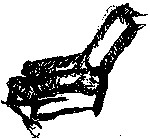
(Oct. 9.) Now I am going to tell you, Arabel, what happened to me last night. Being bewitched by a spirit of foolishness, I knelt down to say my prayers in one of these great chairs .. the one called mine, [16] instead of the common one I was in the habit of using. Observe Illus. .. it slopes in the back—so of course—(I could’nt much expect the laws of gravitation to be reversed for me!) of course, over I went chair & all, head foremost, most happily falling with my whole weight upon the forehead, which prevented the injury to the body which was to be dreaded most– I was stunned for a moment, but unless the shock .. the shaking .. shd have done harm without my knowing it, there was no effect except an hour’s headache .. & you wd not wonder at headache, if you saw me at this moment. The floor (under the carpet) is stone, & the mere force of the fall was such that both the forehead & upper part of the nose bled, besides a most frightful swelling .. which this morning has subsided however, leaving just the marks of excoriation which defigure one without being of the least consequence. I slept at night—the headache went off .. and I have had no other pain of any sort:—therefore Wilson is of opinion that no injury can be done– <Write & ask Nelly Jago, if Mr Jago thinks that injury likely from the fall—it taking place at the end of the fourth month.> [17] There was no fever—the very headache went off in a strangely short time—and the pains which I am sure to have after sitting upright for an hour, or walking for twenty minutes, never touched me at all. After I got into bed there was some internal beating—but so there was the night before, (when I felt it for the first time) & I slept quite as well as usual– In spite of which, & my own impression that the entire force of the fall was broken by my poor broken head, I cant help feeling uneasy, though I dont say so to Robert. It is bad enough for him to be vexed by the fact as it is “written on my brow.” [18] Oh, my stupidity—my unutterable stupidity! May God grant that only I suffer by it!– Here’s the effect of lying on sofas for ever so many months– One falls off a chair & meets one’s fate so!– Not that I myself am in the least the worse, understand,—I shd just laugh at it all if under ordinary circumstances—as you would, or anyone else– In a day or two, the disfigurement will have passed away, & one does’nt care for it in the meanwhile.
The next great news is, that at last, after my being forced to write to Mr Kenyon to ask him to rouse Blackwood (who refused to give sign of life after swallowing all my poems) there is at last an answer for which we have paid nine shillings .. an answer containing a full proof of the ‘meditation’. [19] He calls it a “Grand poem” but past all human understanding,—in consequence of which, the proof must be sent to the poetess to get her to attach notes or something to assist the intelligibility, or he does’nt know what in the world his magazine-readers will do with it. [20] Still, he wd be very loth to refuse the poem on that account! ‘Prometheus’ too is to appear—he had wished me to see a proof of that also– Dear Mr Kenyon seems to do more than agree with Blackwood’s complaints of Ægyptian darkness, & tells me than [sic, for that] nobody will care for my “theologic politics” touching popes & the rest– I cant think, for my part, what people do care for!– The best is that poor Robert had congratulated me on being so “perfectly clear this time!” I shall see what I can do with notes &c,—& am the more inclined to be goodhumoured as Blackwood has sent five & twenty pounds for the poems already accepted, [21] & I think it liberal.
(Oct. 11) The force of gratitude can scarcely much farther go. Meaning, that Father Prout’s disagreeableness is beginning to pass his agree[a]bleness, & that when he sets out to Rome, there will certainly be ‘compensations’– Every evening, now, he plants himself close to my sofa, smokes at leisure two or three cigars, takes one of our Raffael-basins for a spitting convenience, & last night, not for the first time by any means, both Robert & I were fairly sick. As he said, “It was enough to disgust one for ever of the duties of hospitality.” And yet, poor man, he was so goodhumoured & full of jests, that I should have been quite mortified if I had had to run out of the room (a catastrophe as nearly occurring as possible) through an ascend<ing> [22] of the personal incommodity– When he had gone .. between ten & eleve<n ..> windows & doors & relieved ourselves by swearing gently. Since <…> myself to people in general .. (you would’nt, to people in particular <…> my long white dressing-gown, which I had forsworn since the we<…> no visitors .. except this Father Prout– Oh, you will wonder <…> with Father Prout .. but, you see, Robert’s illness & his kindness brought <…> Robert had only known him before by chance interviews—the first time was <…> at Emerson Tennant’s [23] —(now have I written that before to you? I fancy I have in this very <letter.> There’s the effect of writing by fragments in this way!) Then he is goodnatured—bringing us books <…> & ‘Prout-papers,’ & really very clever & amusing– By the time we are done with him <…> I shall be perfectly cured of my tenderness for cigars, .. “I see as from a tower the end of all.” [24] As to the fall .. not from the tower but the chair .. I am cured of that also .. at least I have felt no inconvenience in any frightening way, & shall be fit to be seen perhaps in another day or two, by others than Father Prout. Robert met the Cottrells yesterday & heard from them that the unfortunate Lee-baby expired on the second day of its arrival in England. Quite natural, of course! The Lees were raving mad in their eagerness to throw off Italy .. and the fact of weening [sic] a baby of a few weeks old & putting it on board ship for a long voyage, with a provision of water & biscuits—(for they could not get any sort of milk at sea ..) could only be followed by the other fact of untimely death. Such a fine, healthy baby too! They must reproach themselves, I think. Thank you, thank you, for all your kindness about the boxes– I wish you wd tell me of the expences incurred, to your knowledge, in England; & (for instance) whatever out-of-pocketing there has been, apply to Mr Kenyon to re-imburse. This, without fail or delay, or we will be very much offended. Is it possible that I shall have my dearest Henrietta’s portrait? If this interpretation be right, joyfully welcome it will be. Your’s, my beloved Arabel, is a bright comfort to me, as I turn to it on the table where it always lies. Beloved, think of me as I do of you, with tender thoughts. May God bless you for ever. I wish you cd have gone to Emma Margary .. it wd have been such a pleasure. Did Eliza Giles go back straight to Ireland, or where? Do you hear nothing of Mr Hunter & Mary? Is it possible that they can throw you off so? It seems to me scarcely credible. And any other tiding of Annie Hayes? Tell me when you hear. And Bummy, where is Bummy all this while? Surely not in Ireland still. Arabel, send me the receipt of Sally Lunns as you can make them. Wilson is going to try some orange-marmalade according to a celebrated one at New Cross– Yes, indeed I did laugh at the happy meeting, the influence of stars at Fifield. If both gentlemen were pleased, who shd be displeased, I wonder? [25] Give my love to dearest Henry & ask him what he means by thinking about postage in regard to me? What have I done (if postages were seven shillings instead of 7 pence) that he shd calculate such things? To hear from him, will always delight me of course, .. and he is the only one of them who will think it worth while to consider that, .. so I say so to him– Even Storm never sends me the least word after the few words he sent. While Robert was ill I fell into a paroxysm of most unChristian humour– My whole heart seemed turned into bitterness of a sudden, & I thought within myself (thoughts come like lightning, you know) that if any dreadful affliction struck me & I could’nt die .. as it has been proved that I am not “worthy to die of grief” [26] .. never wd I set foot on English ground again .. never! Not very kind to you, you will say—but say nothing, for people are apt to be unkind when they are unhappy & embittered .. feeling wronged in what they love .. as I did then. Which is all passed .. I mean, the unchristian temper. Dont mention it when you write, & believe that I love you tenderly & gratefully & shall to the end. You are of those who have been better to me than I deserved. God bless you– Write soon!—at once, that is, to
your own
Ba–
Is poor Maria’s husband better?
I suppose Surtees is returned or turned to Somersetshire by this time. Thank you for thinking of us on the 12th. Dear things you are!– I have just heard from Lady M. Cocks[.] Nobody mentions Crow<.> Why<?>
Rem<ember> to t<…> her <…> whe<…> Rob<in> Hed<ley …> lov<e …> even<…>
Too long a letter to enclose to New Cross & admit of another inclosure from Robert, or he wanted much to write to you this time. His affecte love to you both .. and to dear Treppy, tell her. Miss Mitford has been very unwell, I regret to say.
Address, on integral page: Miss Arabel Barrett / Fifield House / Bray / Near Maidenhead.
Publication: EBB-AB, I, 193–203.
Manuscript: Berg Collection.
1. Year provided by postmark.
2. Underscored three times.
3. RB recalled this illness years later in a letter to Julia Wedgwood, dated 17 October 1864: “I had a worse than ever sore-throat and was cured by Father Prout forcing himself into my bedroom and making me drink hot spiced wine … . I could not get sleep for the pain, and my wife took my head in her two little hands, in broad daylight, and I went to sleep at once, and woke better” (ms at ABL).
4. The Brownings had encountered Francis Sylvester Mahony (Father Prout) in Leghorn on their journey from England to Italy. As EBB explained in letter 2678, Mahony had told Mrs. Jameson that he had not been able to see EBB’s face at Leghorn through her black veil.
5. Mahony is mentioned in Les Jésuites Modernes (1826) by the Abbé Martial Marcet de la Roche-Arnaud.
6. Historically, Brittany had been a Catholic, legitimist stronghold since the French Revolution.
7. Cf. Malachi 4:1.
8. “O the English, the English.”
9. “This good gentleman .. always good, always smiling! I’m truly very sorry.”
10. “Goodbye darling.”
11. Passage in angle brackets is reconstructed, having been obliterated after receipt, probably by Arabella. For “Chapman & company,” see the following note.
12. The Barrett household was staying at Fifield House, Bray, near Maidenhead in Berkshire. According to William Surtees Cook, Henrietta travelled with her brother Alfred to Barton Court (see note 13) on Saturday, 23 September 1848, and returned during the night of 25–26 September. “Poor dear Henrietta was much excited she not having seen Hope End since they left it in 1832” (Surtees, 22 September 1848). From EBB’s remarks, and from the context of Surtees’s journal, it is clear that Henrietta went without her father’s knowledge. EBB’s mention of “Chapman & company” refers to Thomas Palmer Chapman (d. 1892, aged 71), Henrietta’s former suitor, and William Surtees Cook who were sharing accommodations in a farmhouse near Fifield. There is no indication that EBB’s father learned of Henrietta’s adventure, but he evidently heard of Chapman’s presence in the vicinity and wrote to Septimus ordering them all to return to London. When Septimus replied that they (the brothers and sisters) had had nothing to do with Chapman being there, they were allowed to remain (Surtees, 28 September 1848).
13. The Bartons, or Barton Court, located 1½ miles E. of Hope End, was the Herefordshire seat of the Peytons.
14. EBB’s father had retained ownership of a considerable acreage (chiefly woodland) from the original Hope End estate and, consequently, still did business in Ledbury, the nearest market town to Hope End.
15. During the summer of 1848, “something like civil war broke out in Tuscany. The trouble centre was Leghorn … . In August it rose in open revolt against rule by Florence. Troops sent to restore order were attacked by the mob and forced to take refuge in the fortress” (Edgar Holt, Risorgimento: The Making of Italy, 1815–1870, 1970, p. 154).
16. The “very low, very languid looking” chair mentioned in letter 2739 (see note 3).
17. Passage in angle brackets is reconstructed, having been obliterated after receipt, probably by Arabella.
18. Byron, The Giaour (1813), line 1057.
20. In the first edition of Casa Guidi Windows, there are ten notes at the end of the poem, as well as notes at the bottom of pp. 37 and 125. When Casa Guidi Windows was collected in the fourth edition of EBB’s Poems (1856), the notes all appeared at the bottom of the relevant pages.
21. i.e., the seven poems published in October 1846 (see letter 2626, note 7) and the eight sonnets published in May and June 1847 (see letter 2655, note 9).
22. About one-sixth of the sheet has been torn away, resulting in loss of text here and below.
23. James Emerson Tennent (1804–69), M.P. for Belfast, became a civil secretary in the Ceylonese colonial government shortly after being knighted in July 1845. Tennent is listed in RB’s earliest extant address book at 25 Duke St., Westminster (AB-2).
24. Cf. Shelley, The Cenci (1819), II, 2, 147.
25. Thomas Palmer Chapman and William Surtees Cook (see the end of note 12 above).
26. We have not located the source of this quotation.
___________________