2774. EBB to Arabella Moulton-Barrett
As published in The Brownings’ Correspondence, 15, 230–236.
[Florence]
March 3d—& a few days later. [1849] [1]
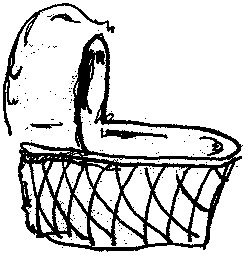
My ever loved Arabel, I thought when I began my last letter to send it away sooner,—but this must go soon .. I cant afford to keep it this time, positively. You are thinking of me a good deal I know, & so am I of you—and I must write to my dearest Henrietta—and I must tell you both that we are neither cut to pieces by adverse armaments nor have come to other harm. Also, I am well still—it may go on to the fifteenth or past it. The cradle is the prettiest I ever saw. Behold Illus. —open-work wicket [sic], lined with pink twilled muslin .. covered with white mull muslin, embroidered .. fragments of our drawing room curtains trimmed with edging—a rosette of pink ribbon & muslin at the opening of the curtains—the pillow, pink, covered with white muslin & frilled round:—little linen sheets done with edging—and a Marseilles quilt. I assure you it is quite elegant, & strikes observers into sudden admirations. Wilson has contrived the whole with surprising art & success. The basket is finished in the same way, with dear Minnys pincushion in the middle—& if the pincushion had been made purposely to suit the rest, it could not look more harmoniously. Oh Arabel—so often, I have thought of your basket for ‘Emma Monro’. We are less magnificent of course, & eight or ten shillings cover the whole expense of cradle & basket together—but really, the effect is far better than you might imagine in an abstraction from white satin & blonde. Only it looks too pretty & frightens me sometimes– Shall I ever see a little living face inside the curtains? God knows—& cares .. & decides best—if we could but say so frankly & not sigh. Now I am going to talk politics by way of change. The other night, or evening rather, there was a sound of guns .. cannons as it appeared to me, while Robert & I sate by the fire. Presently, I said .. “Do you hear?” “Yes, I have been hearing for some minutes—& there’s the Generale”. [2] And there, too, came up the hum of many voices from the street, the noise of many footsteps .. a confused din. Wilson came into the room, “trembling,” she said, “from head to foot!”– Mr Righi was with her, & he thought it was the “cannon from the forts, two fortresses at opposite Gates of Florence, & that of course the Piedmontese army under Laugier [3] was attempting an ingress.” “Now,” cried Robert, “I will run out for one moment & ascertain the truth– I will just run into the street—now, Ba, I give you my honour not to run any risk” .. (for I was about to sieze on him!) .. “why you cant believe that I wd run any risk, & you as you are.”– I let him go in the confusion of the moment & bitterly repented it afterwards when twenty minutes passed without his returning. Not that he would not have avoided danger for my sake, I knew, as he promised, .. but I could’nt help thinking how two or three English gentlemen had been shot accidentally in Naples at the time of the disturbances, through going into the streets from curiosity. So I was frightened till he came back—& Wilson & I went out on the terrace, & saw the streets filled with men, & heard cries of “To arms, to arms” .. & then again, “Viva Leopoldo secondo”!– I didnt wait to put on hat or shawl, I can tell you—there I stood in the night-air. There was a scuffle at the church-door opposite—because one set of men wanted the bells rung, & one would’nt have it so– In the midst, Robert returned– A volley of reproaches in salutation! “But, my dearest, you must’nt wish to make a woman of me! I told you I would’nt expose myself, & I have kept my word, as certainly you could not doubt that I would—but it was quite right to ascertain facts as far as possible—” So then he went on to explain that as far as such ascertaining of facts was possible in such a confusion of conflicting opinions & rumours, there was no army of Piedmontese at all, nor Laugier neither, but some descent of the peasantry from the hills, who having taken into their heads that Leopold was in the neighbourhood, resolved on opening the gates to him & themselves in a burst of triumph. And this proved to be true– People say that some five thousand peasants had congregated .. the poor Grand Duke being adored by the Tuscan peasantry .. & that they very nearly entered the city– As to the firing of guns, that was only out of joy—they have the stupid habit of expressing joy & triumph here by firing into the air .. gunpowder without balls! so stupid!– If the peasantry had entered, there were bodies of brave citizens ready (just waiting for the encouragement) to give up the city & the “provisional government;” but we are such heroes at Florence that we always wait for encouragement. Oh, I was’nt in the least afraid, except about Robert when he was away—and even if the Austrians come, I sha’nt be afraid in the least. In my ordinary state of health I shd have liked to have gone out with him & seen for myself. But God keep the Austrians far from us—farther than they are now, it appears, on the frontiers of Tuscany! Angry as I am with this poor people, who have no strength in either heart or hand, & suffer themselves to be put under the feet of a turbulent minority, with all their affections & sense of gratitude, just because the minority can bawl a little louder & wear nailed shoes .. angry as we feel sometimes, & cant help feeling, .. yet God keep Austria away, we do earnestly desire. The people is so innocent & amiable, so everything except heroical, that one can wish no harsher thing to them than an unpainful experience. For republicanism, I myself being a republican as much as ever, I have no belief in the reality here– Liberty by coercion is not credible .. is it? .. nor is, a republic by a party. They planted a tree of liberty close to the windows of our palazzo the other day, or night rather, by torchlight, & we went to the same window from whence last year we witnessed the triumph of the “constitution” to see the great bare tree, branchless, leafless, fruitless, the merest pole, planted & blessed by a priest in an oration– A striking sight, yet a melancholy. Not a singingbird will ever light upon that tree. Falsely called tree! falsely called liberty!– Poor Florence!—— Everything is calm, too calm .. as calm as death itself. The English, we hear, are going at once, for the most part—& we have taken on our apartment till May twelvemonth in spite of all, & though Robert & I were agreeing the other evening that in the case of some great tax being imposed (the worst thing to be feared) we shd have to move off with our furniture to the south of France somewhere. But the man came about the rent, & we had to signify either an intention of going or of staying, .. & Robert said to me “How do you think of it?” & I said to Robert “Is there danger of this tax? What a pity to move, when we are just settled!” “What a pity!” said he—“& what an expense” said I—“and no danger after all” he added. So we decided & took on the apartment. Nowhere in the world could we have such beautiful rooms at such a price, you know—and we have besides the option of taking another kitchen & two cellars down stairs for some thirty shillings in addition to the actual rent. If we want a ‘nursery’, we shall want the room which Robert now uses for his dressing room, a delightful room with communication through to Wilson’s sittingroom, but inconvenient for him on account of the distance from me,—the only inconvenience of the house. Our present kitchen is close to my bedroom up a sort of ladder staircase (so narrow the steps are) & Alessandro complains of the dimensions altogether– It wd be the very thing for a dressing room—& then Alessandro might have his kitchen down stairs, & I hear it is a lordly one. Still, this is not settled– For the present we shall manage as we are. I had rather planned to get Robert to dress in the little sittingroom at the end of the suite of rooms. In London, you know, gentlemen often use the library as a dressing room, even though on a lower floor—but he is fond of the little sitting room, which is very prettily furnished, & does’nt like to throw coats & waistcoats about in it. Well—we shall see! Everybody admires our rooms & calls them delightful & enviable, & is of opinion that we may let them any day at the holding up of a finger. Not any day of a republican kalend perhaps!
Poor Wilson’s betrothed has gone to Prato to his shop, & certainly she must miss him dreadfully– The guard at the Pitti palace, was dismissed in a body by the “provisional government.” Also, the removal to Prato is, by no means the worst part of the position, she being in great fear that this new conscription to which all young men from eighteen to thirty are liable, may sieze on him even over the counter & send him off against the Austrians. Meanwhile, he is likely to come to Florence every festa day at least, to pay her a visit—it is scarcely a separation, & the Prato business is likely to flourish through everything adverse. Dr Harding has just come .. (he has been to Prato this morning, he says, to see a patient) has come & gone, & except the lifting up of hands & eyes at the diminution of the morphine, has made no sign. “Why,” he observes, “what you take now is only equal to a glass of wine in the comforting effect of it”.– What in July, at the Ancona-journey, lasted twelve days, now lasts seventy-two—think of that, Arabel! A vial of the made up mixture (one draught, that is:) divides into eleven times. How Robert contrives it, I cant make out really, because the truth is that I do not suffer in consequence. Last night I slept as soundly as I well could—& to be able to sleep just now is considered no common advantage. “Very probably,” says Dr H, I “shall go on to the fifteenth”—so the Biondi & he are agreed. It may even be later, he seemed to intimate—so mind you dont think of me till you hear—& he repeated his old opinion that afterwards I am likely to be “reinstated in health & strength”—& that nothing so good for me could possibly happen. Not a single medical suggestion! indeed he would’nt let Robert go out of the room while he spoke to me. Mention Arlette when you write—& do write—& tell me all of all. Have you heard from Mrs Cliffe or of her? Sophia Cottrell brought her child to see me yesterday—a fine, rosy little girl, [4] but too like the “signor conte” [5] to be very pretty. She was very kind, & said that she wd come to see me directly I was taken ill, [6] desiring to be to me some comfort .. “something like one of my sisters.” Very kind—but I am not inclined to take advantage of the kindness, & have already refused a similar offer from Mrs Ogilvy. You know my old way of liking to get into a corner when there is anything to suffer—and I do assure you I would do anything to make Robert go to Fiesole, or somewhere out of sight & hearing, so dreadfully afraid I am for him, poor fellow– Dearest Arabel, dear, dearest Arabel, I just receive your letter through Mr Kenyon. My dearest Arabel, what foolishness of you to be frightened about Florence! Now, believe me—Florence never was quieter than at this moment—there’s the truth. The “republican party” (so called) is satisfied with singing about the streets & planting trees of liberty. The party is in a minority of the smallest, & cant stand, & ought’nt. The majority submit rather than make a disturbance, .. the men hiding their “Leopold buttons” under their over-coats, & the women their tears in their pocket handkerchiefs .. everybody expecting & waiting for an “opportunity”. If the G Duke had not been rather a Florentine than an Austrian (poor Leopold!) he would have kept his ground as he shd have done. He will return, by some quiet turn of the cards—as quiet as all the rest. Why, if the Piedmontese army had arrived the other night, do you think there wd have been fighting? Fighting in Florence? Oh no– So put out of your head these thoughts. I am not, nor have been, the least frightened, I do assure you, <not being one of the “Civic guard”.>– [7] The Biondi says, “questo popolo è tanto buono”, [8] .. which is true as goodness may be predicated of children. This letter shd have gone to you two days ago, but I am sorry to say I grew suddenly lazy through having caught cold, or an influence from the east wind or something very sudden– The chest has been slightly affected, & I fell into a panic lest my baby shd be born ‘with the croup’ .. but I am better again, & Mdme Biondi has been here to assure me that there was nothing to fear on that particular ground. Otherwise, my spirits have kept up surprisingly (if Arlette is to be surprised for such reasons) & I try to persuade Robert that people exaggerate gigantically both “pains & perils”, & I repeat to him what Mrs Cranch the American told me the other day, that “on the whole it was rather pleasant than otherwise” .. which, being a peculiar opinion, I give you, too, the benefit of. Now, dont be uneasy about me– However it may be, God’s will is best, be very sure.– I think that Mrs Jameson is afraid, actually afraid, of going to Wimpole Street. Gerardine said to me .. “Aunt Nina will never dare to go to see your sisters”. But she has never been even to New Cross, where she promised to go & could’nt fear at all about going, .. & Robert is very much vexed at this omission of her’s. You astonish me on the subject of Stormie– Why, how can Papa imagine that he gets on, .. & what embarrassing positions he must be liable to, in a strange country without money? Send him my little note. And send this less note to Mary Hunter—now dont lose it, Arabel. You say nothing of dearest Trippy, & you must always mention her particularly. My love to her between two affectionate kisses. Does Papa take in the Morning Chronicle now? Why it is a “young England” paper [9] —having made a great sweep as to politics. Count Cottrell has the kindness to send me his “Galignani” which includes the “leading articles” of all the best English & French gazettes, & sometimes I wonder at the Morning Chronicle, & Robert is furious about the attack on Milnes. [10] Which of Crow’s children is prettier at this hour? & does she mean to have another? & does William bake his own loaves? You surprise me about the Bevans—and yet the reason is quite plain. Depend on it the expenses at Tunbridge W (said to be one of the most expensive places in England) were too heavy for their income. Why is’nt Mr Bevan a favorite with uncle Hedley & the rest? The “Puseyism” cant be an objection, when they embraced him with it in the earliest period of their connection. I should think Mr Bevan was so very amiable a man, and in many respects an agreeable man, besides. Louisa Carmichael & Arlette are both of them, kind, in enquiring about me– Give my love to both– Love to all—and to dear Minny. Robert writes in the greatest hurry to save the post today. May God bless you my beloveds! My own Arabel, I do love you. Robert’s love. Always love him, Arabel, for he is perfect to me. He will write the first news, if I cant write sooner—only dont expect, too soon.
Your most attached & for ever
attached Ba–
Address, on integral page: Care of Miss Tripsack / (Miss Arabel Barrett) / 12. Upper Gloucester Street / Dorset Square / New Road / London.
Publication: EBB-AB, I, 228–234.
Manuscript: Gordon E. Moulton-Barrett.
1. Year provided by postmark. This letter was concluded on or about the 7th; RB mentions posting it “two days ago” in letter 2776.
2. “A peculiar beat of the drum” to sound an alarm, as explained by EBB in letter 2761; see the beginning of the final paragraph.
3. Cesare de Laugier, Conte di Bellecour (1789–1871) had fought in the Napoleonic wars in Spain and Russia. In February 1849, defying the Tuscan provisional government, he made an abortive attempt to restore Leopold II, but he was unable to find the support he needed from the Austrians. He later joined the Grand Duke at Gaeta.
4. Alice Cottrell.
5. “Lord Count.”
6. i.e., when she went into labour.
7. The bracketed passage is interpolated above the line.
8. “These people are so good.”
9. “Young England,” a faction within the Tory party led by Benjamin Disraeli, was active between 1842 and 1846. Ownership of The Morning Chronicle had, in early 1848, passed from Sir John Easthope, Liberal M.P. for Leicester (1837–47), to a group of new owners, including “the Duke of Newcastle, the Earl of Lincoln, Sidney Herbert, and other influential Peelites” (H.R. Fox Bourne, English Newspapers: Chapters in the History of Journalism, 1887, II, 153).
10. The morning edition of Galignani’s Messenger for 24 February 1849 contained an extract from an article in The Morning Chronicle (22 February 1849), which commented on a pamphlet Richard Monckton Milnes had written in support of Lord Palmerston: “After the levity of Lord Palmerston’s characteristic defence of his own peculiar foreign policy, there was wanting nothing more than a pamphlet in its eulogy from Mr. Monckton Milnes. … Thus, immethodic, absurd, and illogical as is this pamphlet of Mr. Milnes, it is occasionally, and by involuntary glimpses, so unwittingly true, that it is not without a purpose that we propose to gibbet him, in front of every country of which he has written with universal ignorance and omniscient pretensions” (p. 1).
___________________