2878. EBB to Henrietta Cook
As published in The Brownings’ Correspondence, 16, 186–192.
Siena–
September 7–8. [1850] [1]
Thank you for your great kindness in writing again to me, my ever dearest Henrietta: Nothing could be kinder nor more welcome. I had your last letter just as we were coming off to this place—the day before—& we were off in the morning at seven. So delightful it is always to hear of your getting on so admirably & living so happily, that even apart from your dear affectionateness, which is a precious thing, the letters wd be precious. As for me, you will have heard from Arabel of me, & how Dr Harding wd insist on sending me away, .. “leaving all my medecines behind,” as he said: & indeed the heaps of empty bottles & my white face did not prove together much as to the profiting by medecines– Still he did for me admirably .. as well as any one could—but he did not “dare” to give strong tonics, & the change of air was to be more effectual than those he dared. But we missed our villa in the Appennines, Henrietta, near Vallombrosa; & Arabel at least will compassionate that miss. It was taken by somebody else during my illness, for the sake of shooting. Upon which we resolved at once upon Siena, notwithstanding Robert’s unpleasant impressions, .. because Siena is famous at least for its good fresh-air & cheapness, & because what we went for was health after all. This is saturday– At seven in the morning of last saturday, we left Florence by railroad, .. I in a miserably helpless state, though five weeks had gone since the catastrophe; having to be lifted about like a baby, looking ghostly rather than ghastly, & feeling as if it were a most uncongenial effort, & that I wd rather be left in my own chair at Florence. We had to stay at the hotel at Siena till sunday, in spite of Robert’s efforts, .. but on sunday afternoon we were settled in this villa, .. a small house about two miles from the city, built on the “hill of the winds,” as it is called, with windows looking to all points of the compass, & with various & magnificent views on all sides– From one window you have a view of Siena, with its Duomo & campanile, & its Italian colouring over all! From another, you look over the vast sweep of the maremma to the mountains of Rome– From another, the whole country leaps, under the sun, alive with verdure & vineyards– Very beautiful it is indeed– All we want is water. Then our villa stands in the midst of its own extensive grounds, .. its own vineyard & olive-ground, .. not to boast too much of its little square flower garden full of flowers. The walls hold the grapes up in garlands—& we see purple touches of them down through the vistas of the vineyard which is planted up to the door– The house itself is small, consisting of seven rooms .. & a sort of belvidère [sic], (specola, we call it in Italy) at the top, from whence to enjoy the views more absolutely—four bedrooms & a dressingroom, a good sized sitting room, a passage-room which shuts in & makes another place to sit in, a lumber room for boxes up stairs, & a kitchen—for all of which, we pay the sum of eleven shillings and a penny farthing a week. We heard of another villa having twenty rooms, to be let for six shillings & eightpence a week, but it was four miles from the city, & we should have had to leave it at the end of September—& this wd have been doubly inconvenient– For the most splendid villas in the neighbourhood, set in gardens & training avenues, nobody thinks of giving above twenty two shillings a week—that’s the most extravagant price, we hear. Well—so the outlay is not great, you see: and really the air, if it were dearer, wd be worth paying for. Exquisitely fresh it is, like English air for freshness, & like Italian air for elasticity– Wilson wd have it at first that it was a great deal too cold, & that we shd all be ill in consequence,—till I showed her the thermometer standing at seventy! .. Why, who wd have believed it? Certainly I have not been able to sleep with the window open since I came, I, who, since June, have never had my bedroom windows closed. I am famous for sitting & sleeping in a gale of wind (when it’s to be attained) for really I cannot bear the dead heat which is so common in Italian summers. In Florence it has not been as oppressive as usual this year, & we left it much cooler– Still there was room for improvement—oh, Henrietta, our “autumn” by no means begins on the “first of August” I assure you, .. and till half November is over we are scarcely secure of a return of too warm days. Now you will want to hear of me rather than of climates.
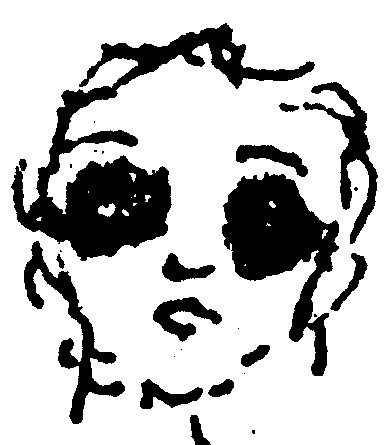
I am considerably better .. essentially better & stronger .. able to move about on my own feet & without anybody’s help, & looking .... why, I cant conscientiously praise my looks much yet, but I may say that they are mending. I dont quite look so. Illus. Eyes swamped in blackness!– The Italians, on our journey, seemed to draw back from me with horror .. (they are such contagionists—) concluding that I was either just recovering from a milliary fever, or not recovering from a phthisical disorder. It is delightful to feel better & stronger again, & now that the strength has set in, it will come faster & faster, I dare say. Indeed I have had a terrible time of it altogether—“three times as bad as a confinement,” said Dr Harding .. and nine times as bad, say I. All for nothing, too!—only God’s wisdom sees something good in it, let my foolishness miscount as it will (& I cant help agreeing with the balia .. “The signora had better have had two or three children”–) After all my prudence, besides! You wont value my counsels much, Henrietta, when I talk about the danger of ponies & the like—though I am none the less pleased that you go in a carriage now, rather than on a poney. For the rest, I never meant to recommend to you “beefstakes by night” & any such excesses—only to suggest, that taking food often & a little at [a] time, was a natural way of assisting the digestion. Fruit & vegetables are excellent of course– It was excess & fantasy in these things, I spoke against. By this time, you will probably have felt the movement, and after it has set in fairly you will be much better, I do not doubt,—and then you will be able to walk, & ought to walk, say the learned, if you can do so without positive suffering. Keeping from excessive fatigue, of course. Exercise is said to diminish the suffering at last—but I could not bear it—my tendencies wd not let me. On the other hand, I never had my breakfast in bed (hear & blush, Henrietta!) the whole time … except once, when I was persuaded into it on account of an east wind & cough which came just before Wiedeman did. With him, I had the morning sickness & vomiting through all the nine months—but this is not very usual, I believe, and it did not in the least interfere with my appetite, and I grew not to mind it. As to the letting out of gowns, you surprise me, I confess .. & Wilson too. Wilson says she never let out mine more than three inches, taking all in all, & from the beginning to the end. But I was unnaturally small; there, is the explanation—and not that I fastened myself in more than you do. In fact, for the first four or five months, it being hot weather, I wore no stays at all; & afterwards I might as well have worn none as far as tightness went. You are perfectly right & sensible in not minding what foolish people say about ‘figures’ &c.– Besides it is intensely foolish– If you have a good nurse, everything will come right again, be certain, & then, will be the time to take care. I am a little uneasy about the small wardrobe, as you mention having had from Arabel the pattern of a cap– Now—if you have begun to make ‘caps’ in spite of my instructions, where will be the place for those I wanted to send you? Perhaps I may not have an opportunity, but I shd have liked you to have waited till the last for the caps, in case I could have sent those by me. They are French cambric, but worth nothing otherwise, except as Wilson’s work– So however it may be, you wont lose much, only I. Here is the list of necessary things—things, I found to be necessary– Six caps—(meaning nightcaps.) Eight shirts. Eight bed gowns—(& twelve might be better.) Four long flannel petticoats. Two square flannels .. (to carry the baby in). Four white petticoats. Two flannel caps .. (to use in the bath). Several pairs of woollen shoes .. socks .. (to keep the little feet warm). A square of flannel to take the child in .. & you can turn it into an apron for the nurse afterwards .. a washing & dressing apron, understand. Flannel bands for the baby, which you must have patterns for—four of those. Two dozens of other necessities—but somebody will instruct you on all these points. For dress caps, I mean day caps, I had only four from first to last, & Wiedeman wore them till he was more than a year old in spite of counsel. I would not have many caps, because a change of trimming is everything in a cap, observe: but you must take care to have the first caps made so as to be easily let out or enlarged. Also, I wd be careful to have the shirts & bedgowns made too large rather than too small, because the little creatures grow as fast as mustard & cress I assure you. We were forced to have two or three sets of baby-shirts the first year through being imprudent in this respect. I made my first little shirts of Scotch cambric instead of French, and it did just as well & looked nearly as pretty, trimmed with narrow edging: But always the night caps should be of French cambric: they are much seen, & do not take much stuff. I strongly advise you to buy no long robes & frocks of that description– The bedgowns are just as pretty & more convenient in every respect—& when the little creature goes into short clothes, which it ought to do at the end of three months, you can have pretty frocks at half the expense. Otherwise you must either buy double, or cut off the tails of the ‘long robes’ through a destructive œconomy. The pattern of the bedgown I liked so much was very simple—body & skirt all in one & sloped: left loose behind: drawn in & sewn neatly like a blouse in front, Illus. with bands at the waist, which crossed behind & tied before. Do you understand? Long sleeves, of course. The baby never looked so neat & pretty in anything, I assure you, as in these,—& you, in England, might so easily find pretty worked frills to trim them with. I wish I cd send you a pattern in time, but I am unreliable, & I could not venture to throw you back, in your work, by asking you to wait for that– You will see how strictly economy is attended to in all my instructions—but you will probably be far more magnificent than I was, & exceed on every side. Only really these things, small as they seem, end in being very expensive. Mrs Ogilvy told me when she was fresh from England—“You may do it handsomely for five & twenty guineas, tolerably well for twenty, & attain to the barely necessary for fifteen.” Now I scarcely spent five—cradle & all.
My dearest dear Henrietta, what fancies you do take vainly into your head about Robert’s being angry. Angry! Why how in the world could he, or was likely? No, indeed. The truth is, Robert is like a child (or perhaps a little like me) in impatience to set everything right– We had been talking about your liberal attribution to me of a grand fortune of five hundred a year, & had agreed to destroy your illusion, lest you shd think it disgraceful of us not to be rich enough to go to England, with our finances in such a golden condition– Then, I was ill,—& Robert, when he wrote that second note, said to me “I think I shall tell Henrietta how wrong she was”. I answered .. “You had better wait till I can do it myself—it makes it of too much importance for you to write about it–” [“]Oh, I might as well,” said he!– The consequence of which is, that you fancied him angry—angry .. of all things in the world—falling into a still deeper mistake than the first. My dearest Henrietta, if you set us down as having five thousand a year, nobody will be angry, be certain—only it’s as well to know the truth, lest you should throw us over as too stingy– Observe, that I had simply six thousand pounds in the bank of England, yielding one hundred & seventy or eighty pounds a year, with the deduction of the income tax. The rest is the most uncertain & unreliable produce of the ship, which every year is likely to grow more uncertain. That was all I had .. except my books. If the six thousand pounds cd have been put into the foreign funds, as always I wished, we shd have escaped the income tax & received nearly double interest: but marriage settlements & the wisdom connected with them, having settled it differently, we must submit to circumstances–
So anxious I am about Arabel & the leaving London, & so provoked that they shd have been disappointed as to Wales. Do you know Henrietta, I think it possible that your suggestion may be the right one, & that there may have been a fear of some wicked plot to meet you somewhere? In any case I do hope & trust they may have decided on some place & have left London long before now. Has the isle of Wight struck anybody? The country is said to be exquisite, you know. I certainly wd not go to such places as Worthing & Ramsgate. Hastings wd be better .. And if I were they & could get leave, I wd prefer a breath of French air & go to Calais or Dieppe—the change wd be completer and more amusing, I think. Most vexed I am that they shd have been disappointed about Wales—poor darling Arabel, who has so few schemes of her own!– And even that was a secondary scheme; as her first, particular, favorite one was the Rhine, dear thing!– What wd I give to have her here, to “let her go” (like a bird) wild & free. As for you, Henrietta & Surtees, I am really astonished at your gaieties which seem to be exhaustless– Pray how do you <go> out to dinner? In an open carriage always? Shall I tell you the truth now, Henrietta? will you promise not to be vexed with me if I do? Well, then, Mrs Martin always has the most delicately and profound good sense, it seems to me, among women, & I know neither man nor woman whose impressions on matters of the world, I wd more implicitly accept. I think her right then on the point of Mrs Heywood [2] —right, right, right. From the first moment of your going to Herefordshire, I anticipated the difficulty of the Heywoods. Mrs Heywood cd not do otherwise than call on you—& you .. the consequences were obvious. My dearest Henrietta, you went of your own will, you know, to Hope End—after which, nobody can be expected to understand the difference to you, between the inside & outside of the house– For my part I see no difference. In fact, the inside is much more changed than the outside can be. Therefore your motive is sure to be mistaken—& I tell you honestly than [sic, for that] I do suspect you of a little mistaking it yourself– Consider your position in Herefordshire—living in social intercourse with everybody except the Heywoods. Explain it as you may, it is a false & wrong position. That is my opinion—take the opinion for what it is worth or not worth, for I dont say it is worth anything.
Tell me what you pay for beef & mutton &c a pound, & what for poultry & butter? Dont forget. Wiedeman was as good as an angel on the journey, & only screamed once for the electric telegraph. “So near, & yet so far,” he thought! He is unnaturally full of life & motion for his age, & we cant keep him off his poor little feet. Still, the child is well & his cheeks are growing rosier. I said to Dr Harding, “And the change will do good to the baby, wont it?” “Why, as to that,” he replied, “the baby wants no good—he cant be better than well, I think–”
Nevertheless I shd like him to look robuster. He is too much like a fairy, quite to satisfy me. Our best love to dear Surtees whom I do love, tell him, for giving you “a happy summer.” God bless you both– Write to me,
ever dearest Henrietta—
to your attached
Ba–
Love to dear Mrs Martin—& Mr Martin.
Sunday.
I must tell you how much better I am feeling this morning after a week here. The wearing, persisting symptoms have ceased, as Dr Harding prophecied, & I am beginning even to look like myself– He told me it was mere debility & the natural effect of what I had suffered, & that change of air wd set me to rights—which it has done, effectually, thank God. Tell Arabel–
Robert’s best love always—& mind you dont fancy him “angry” again .. Angry with you!!
Address, on integral page: Mrs Surtees Cook / The Winnings / Malvern / Worcestershire.
Publication: Huxley, pp. 127–129 (in part).
Manuscript: British Library.
1. Year provided by postmark.
2. Mary Elizabeth Heywood (née Barton, d. 1870). She and her husband, Thomas Heywood (1797–1866), had acquired the Moulton-Barretts’ former residence, Hope End, in 1832. Henrietta and Surtees Cook called on the Heywoods on 23 June 1850, and, apparently, Mrs. Heywood returned the call at the Winnings, where the Cooks remained until 26 November.
___________________