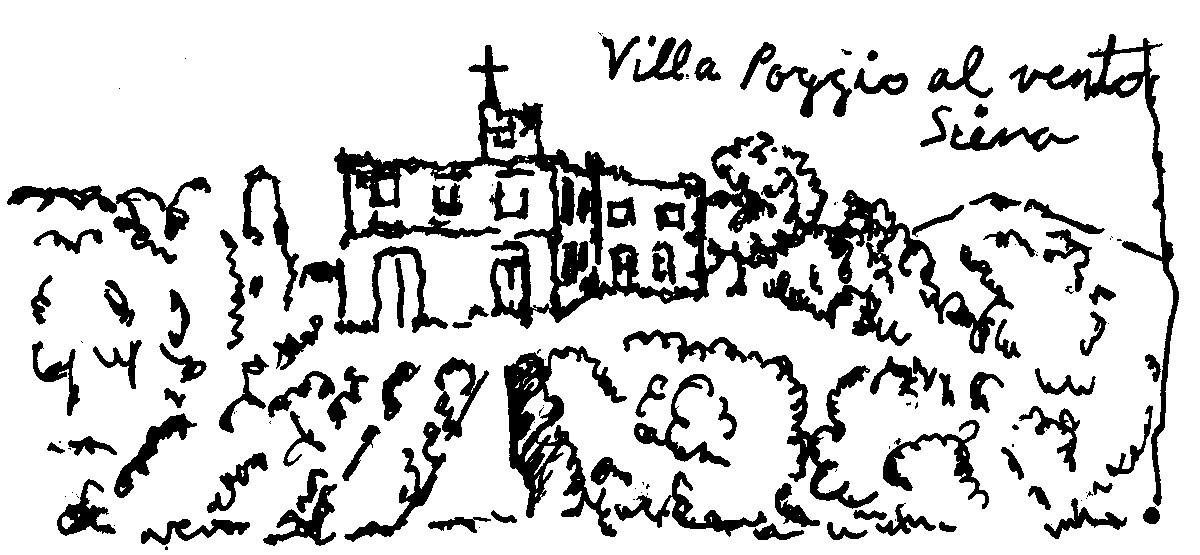
2883. EBB to Arabella Moulton-Barrett
As published in The Brownings’ Correspondence, 16, 203–209.
Villa Poggio al vento
Siena
Sept. 29—October 4– [1850] [1]
I should have written to you long since, my beloved Arabel, having promised to rain letters—but my letter to Henrietta will have set you at ease about me, [2] & I waited a little till our shifting plans were made up, and also I longed to receive your country address from yourself that I might send what I wrote straightforwardly for once. Now, I am almost despairing of your leaving London. Oh, how vexatious! Do you know I would have pushed for another answer; I wouldn’t have sate down quietly under such circumstances, with a house taken & boxes packed: and then Papa is sure to be displeased at having to pay that money, so you might as well have run the other risk. So vexatious it is! so necessary that you should have had country air & change! I am very much vexed. Only, after all, you may have gone– It is scarcely credible that with a house taken, you should make no sort of use of it, and I shall try to hope against hope as long as I can. Meantime you will have heard our history (a bit of it) from Henrietta—how we lost the Vallambrosa villa, & came to Siena & took a villa a mile & a half from the town, tiptoe on a hill commanding magnificent stares all round, a beautiful & variously undulated country, but not romantic like the Baths of Lucca, with the mountains ranged at a distance, & no water, & no forests. Though the vineyards & olivegrounds are everywhere, we are much reminded of England by some of the features of the landscape, especially by the bowery green lanes & heaps of blackberries—on each side. Also the air is very fresh—and (which is not so good though quite as English) we have seen such fogs here as I could not have believed to be in Italy—(coming from the maremma probably) but they keep at our feet as we are so high, & do us no harm. Indeed nothing has done us harm since we have been here. You never saw such a miraculous change as has past upon me! At the end of three weeks, I could walk a mile without being tired, & now at the end of the month I consider myself perfectly well, if still perhaps a shade paler than I was before my illness. I assure you I never dared hope for such a complete & rapid change– I hated going from Florence, feeling, as is natural when one is knocked down, that it was better to lie where I fell—out of spirits, in fact, with the courage as well as colour wrung out of me. Dr Harding used to keep saying “No wonder, no wonder”—but that did’nt help one up—& I scarcely saw then what could– Oh—of course I knew it was only a question of time—only one gets low & does’nt reason. Nothing could be kinder than Dr Harding’s whole bearing to us—he even wanted to come & see us the morning we set off, but we would’nt hear of it as we left Florence at seven oclock. He was imperative about our coming, though I tried to get off,—he told us “not to settle down” anywhere, .. rather to “go to Siena for ten days, & then to return to Florence, & then to go somewhere else”– Very easy to advise, thought we, & hard to put in practise, considering the practical state of the purse! Still we mean to keep more than you would think to this prospectus—we have been here a month, and tomorrow we go into Siena for a week .. not only for the sake of the change, but because I must see the churches & pictures in Siena .. the Sienese school being famous as you know, and Sodoma wonderful, says Robert, .. and in spite of my new strength I cant walk in & out, three Italian miles into the city, besides the sight-hunting– Now we calculate that it is a more œconomical thing to take an apartment in Siena, changing our place of residence, than to hire a carriage—though we pay immensely, by the way, for the apartment in Siena, through taking it only for a week .. as much as eighteen shillings. People tell us it is very dear—but Robert did not like to use much bargaining as it was only for a short time—and there are four bedrooms, just as we have here, & three sitting-rooms and the situation is one of the best in the town. Here we pay eleven shillings & five farthings the week, and you cant think what a pretty little villa it is, & how we roam about the grounds without our hats to enjoy it rurally.
The worst is that the grapes and peaches & apples & pears keep Wiedeman in a continual state of excitement– He cant be allowed (how can he?) to eat as much fruit as he chooses, and such shrieks we have every now & then!– I assure you it is heart rending. He has a way, whenever he has eaten anything he likes, of striking his breast with one hand—the child is as full of gesticulation as a little Italian– Well—there, he stands looking up at the grapes. First, he points up to them, with one finger up, in admiration, .. “How beautiful they are!” and when you assent to that, he begins striking his breast vehemently, like a Trappist in act of contrition, to express “how good they are to eat”, .. and then if you resist that & the insinuating smile into your face which accompanies it, you must be prepared for a burst of grief .. unless indeed the pigeons come down to make a diversion. We are delightfully off for animals here– There are pigeons, there are chickens, there’s an immense yellow dog (which poor Wiedeman had a great cry about on his arrival, because he wanted to hug it round the neck & kiss it on the mouth as he does by Flush, & we were afraid to let him), then there’s a pig, which he & Robert & I go to feed every day after dinner, with apples & peach-stones, & which Wiedeman is particularly fond of. He’s afraid of nothing, this child .. he wants to pat the pig’s snout—and is delighted to find himself the centre of a flock of turkies from a neighbouring farm. Also, he has made friends with all the peasants, runs into their cottages, & cant be stopped from furrowing his way into their bedrooms where he suspects them of hiding the apples. The little peasant children are shy of him, but he .. he calls after them, orders them about, examines what they have in their hands, & sews up (in his curious fashion) the holes in their clothes. He is a funny little fairy, certainly. The other day Wilson & the balia were in a cottage with him, where the cottagers were eating their black bread .. made partially of beans, but by no means, bad. Wiedeman who must do what other people do, threw away instantly a piece of cake he was eating, & insisted on having some black bread– The peasants, being much flattered at the compliment to their bread, gave him a little bit .. as much as Wilson would let him have .. and then, he pressed for more, till he had to be carried away in disgrace, crying. And there’s a child who wont touch white bread unless it is buttered, & even then, is particular as to the sort of bread! But he thought it fine to eat what the peasants were eating. I assure you he will leave a reputation in this part of the country; he has achieved great popularity. One old woman speaks of his going with tears in her eyes. The peasantry about here, are remarkable for cleanliness & industry, & live patriarchally, whole families, & sometimes two generations of families together. They are very pleasing, more so than I should have expected in Italian peasants, .. contented & joyous—eating meat generally once a week, & living for the rest on fruit, vegetables, oil, wine, & bread. Robert asked an old man if they did’nt want more animal food .. “Oh,” he said “certainly not! one gets tired of having it too often– Si stanca di questo!.” [3] Perhaps the oil, being very nutritious, may make amends for the loss of it, for they are a fine race of people, the women very handsome. Well, but we leave all these advantages tomorrow, & are full of regret, though the change will bring other good, & we must certainly see the pictures. After our week at Siena, we do talk .. if the finances, in any way, admit, of it, of going to Volterra, for a few days, before we return home—but all depends on Robert’s calculations, & we must’nt get into scrapes. A month ago we had but sixty pounds to take us to the end of the year—(you see the medical expenses were great) and this does not leave room for a superfluity of luxury & travelling about– As it is, we have enjoyed much, at a little price—& have gained much indeed .. Wiedeman’s cheeks have put on a rose-colour delightful to behold .. and his legs have grown as hard as stones—and his appetite is admirable—and this, though he has cut another double tooth & is now cutting his two eye-teeth—and though (here’s a piece of news) he has been enduring the first adversity of being weaned. Yes, we have actually weaned him– So frightened I was—because the prospect was worse with him than with your English children, who are nursed only four or six times a day, whereas he had it at every hour of the day & night, if he chose—it was a great change. Yet, through God’s mercy, neither he nor we have suffered much in the fact. First we took advantage of the new place, to amuse him, & show him this & that, & give him a quantity to eat, (as the change of air admitted of it by changing his appetite) and then, as soon the habit had been a little broken, we were so cruel as to put aloes upon the breast. Poor darling! he could’nt think what had come to his favorite diet! He made the balia get out of bed, & go to the old seats where she had used to nurse him—he thought it might be better there, perhaps .. poor darling! He cried a little, the first night it was tried,—and, the second night, he fell twice into a rage & screamed, because he thought the world was against him—but when I went into the room in the morning, he was sitting on the bed with cheeks like a rose, & playing– So the balia who was in bed too, described to me gravely what had happened to her & how all the milk was changed & grown nasty .. “tutto cangiato e divenuto [4] naughty boy”, .. so that it was impossible for poor baby to take any more of it. He looked intently into her face while she was speaking, & then to me for my sympathy– Upon which I answered .. “Then, for the future, he must have ham, & wine, and water-melons & grapes, and Mama’s cakes”, .. and he smiled brightly at that, & stretched out his arms to me, making signs that I should take him into the drawingroom at once & give him one of the macaroons kept there for him, so as to lose no time—and off I carried him, and he seemed to be quite consoled for that morning– Of course the grief recurred .. oh, he was persistent! he would’nt give it up for two or three days—but now, it is perfectly over, and I for one, feel relieved as of a burden. At a year & a half it was necessary to wean him, and, since he has begun to eat solid food to my satisfaction, I agree that it is better he should. What I feared was his being thrown out of sustenance altogether—because at one time he would eat nothing of his own will, except spunge cakes & things of that kind. He began to be better before he left Florence, but this place has much hastened the improvement, & I do hope it will last. The worst is that he has a fanciful appetite & does’nt like his soup & things strictly wholesome. But then he takes his chicken every day for dinner, without an objection, and he has milk & water & sugar at all hours of the day, (beating his breast, to show his full appreciation of it) and plenty of plain buns lightly made. As to the wine .. it is only “a taste” you know .. just to colour the water .. & you are not to confound our wine with strong port, though it is too strong for me. Madme Biondi told me that children of two & three years, were the better for a little wine & water—but certainly, even on this view of the question, he is too young & wd be better without any– One finds it hard (there’s the truth) to keep it away from him—he wd think it the worst wrong in the world. (See what a spoilt child, by Ba’s own account!) Tell me Arabel—does Minny think we are poisoning him, taking one thing with another? I shall write & ask her some day. Nevertheless if you saw him you would admit he was the picture of health, if delicately constituted .. for you may combine those two things. He can climb upon the high chairs, by himself (must’nt he be strong?) and has been amusing himself all this morning by mounting on the portmanteau & then jumping off .. the balia sitting on the floor to prevent his hurting himself. In spite of which boyish activities, he likes his doll .. hushing it to sleep when he is put to sleep himself .. and he is the vainest little creature that a girl could be, delighting in red shoes, & comforted in the deepest of his griefs, by being decorated with necklaces & bracelets & broaches—he likes even to have bracelets on his legs– The way he looks at himself in the glass & smiles, when his hat is newly trimmed with red, is ineffable. He & Robert & I have walked together by ourselves sometimes nearly half a mile from the house, .. he as good as a child could be, gathering all the flowers for me, & all the snail-shells for Robert, & insisting on our keeping to our portions, .. yes, and walking all the way. In fact, he walks far too much for his age– Sometimes he wont be carried, & Wilson & the balia have to struggle for it. The consequence of over-activity & over-excitability is that at the end of the day perhaps, he cant sleep—& his rest is broken through the night– Not that he cries—but he sleeps & wakes, sleeps & wakes. I wish he slept better.
Wednesday– Siena–
Here we are in the town of Siena—we came yesterday– You cant think how sorry we were to leave our villa, .. it was quite affecting to take the last look at the pig,—and, as to Baby, he had a good cry after our first dinner here, because we could not go back again with the apples, to feed “signor porco” [5] .. grunting, poor child, to show us what he wanted. Our rooms are very convenient on the whole (not considering the lack of tables & carpets & looking-glasses) but the town seems much colder than the country, & it will scarcely be desirable to stay longer than our week– Then, we have an idea (just an idea!) of going to Volterra for a few days, and, so, of returning home. I have been to the cathedral—it is very fine. The elaboration of parts does not detract from the general effect, .. which is miraculous almost—for nothing can be more ornate in detail—not even the Pisan great church. Then I saw a crucifixion or rather a Taking down from the cross, by Sodoma, in the church San Francesco [6] which is divine in the pathos of its expression– The virgin lies at the foot of the cross, in a deep fainting-fit, which seems <to bring> the bitterness of <de>ath, & death itself, together—you doubt whether <she> ever can recover. He is a great painter, certainly, this Sodoma– I mean to lose no time here & see as much as I can—but if it keeps on raining in the present dismal fashion, it will be difficult to see much. A Mr & Mrs Fletcher, [7] friends of Miss Dowglass, have been very kind to us here, in helping us to apartments & so on, .. & she seems a most affectionate woman, to judge by her affectionateness to me, and he, full of benevolence if not especially wise. They belong to the Newman Street churches, [8] —are quite elderly people .. and one almost wonders, with their views about ordinances, ministrations & the like, how they can bear to have lived seven years in Italy where there is neither priest nor altar, according to their own way of thinking. She takes a prayerbook & goes into the cathedral, combining in that way. Robert & they have great controversies about the priesthood, authority & the rest, and Mr Fletcher told him yesterday that really he was “almost a quaker”, .. which Robert responded to by an intimation that the holders of contrary views were “fast in bondage”. So I got up & proposed that we should have no more theology for that morning visit– Of course, it was all in good humour on all sides—they are the kindest people in the world—and apparently most pious & excellent– I told Mrs Fletcher that I should get her to instruct me more particularly in the Newman Street doctrines .. “some other morning”. The talk began yesterday by her lamentations over the crowds of church of England people who were turning R Catholics– She has a personal interest in Lord Fielding, [9] for instance.– Arabel, I wish you would write a little note for me to Mrs Jago, to say, with my best love & thanks for her kind, welcome letter, that if she should have any application from a Mr Oxenford, [10] of Mecklenburgh square, on the subject of a young boy supposed to be afflicted with spine-desease, I entreat her good offices with Mr Jago to commend the case to his benevolent interest– Mrs Fletcher has a nephew who has become suddenly a sufferer from spine symptoms—and, as I naturally spoke of Mr Jago to her, she wrote to England instantly in order to persuade her family to have recourse to his skill. I shall write soon to dear Nelly myself, but it seems best meanwhile to lose no time in apprizing her of the circumstances in question.– My own darling Arabel, how too kind & dear of you to send your work to Wiedeman & me .. & to Robert .. since you cant send to us without sending to him .. it is the same thing. Wilson is in ecstasies about the cloak because I had fallen into a fit of œconomy, and would have it that the old one should do again this winter. At the same time you make me a little vexed with you for such over-generosity– You overwhelm me, Arabel. Here’s a lock of his hair .. Wiedeman’s, I mean. [11] It curls all over his head—but you see how changed the colour is. In the sun, it glitters like gold. Will the Peytons really come? Oh Arabel,—if indeed they cd bring you! I have the extreme vanity of thinking that you wd enjoy being with us– As for me, the rapture wd be too much .. but I shd try to bear it. I do hope Trippy goes with you if you go– My dear love to her. I still maintain that she will end by hearing of Mrs Gordon– The infamy of the hesitation is bad enough– Tell me more of Alfred– I wish Surtees Cook had either of the two employments!– May God bless you, my own beloved! There’s so much more to say–
Your ever loving Ba
Write, Write.
Address, on integral page: Angleterre viâ France / Care of Miss Tripsack / (Miss Barrett) / 12. Beaumont Street / Devonshire Place / New Road / London.
Publication: EBB-AB, I, 338–344.
Manuscript: Gordon E. Moulton-Barrett.
1. Year provided by postmark.
3. “One gets tired of this!”
4. “All changed and become.”
5. “Mister pig.”
6. Murray’s describes this fourteenth-century building as “a fine and spacious church built from the designs of Angelo and Agostino da Siena,” and notes further that it “contains a masterpiece of Sodoma, the Deposition” (A Hand-Book for Travellers in Central Italy, 1850, p. 211).
7. Unidentified. However, there is a Matthew Fletcher listed in the Brownings’ first joint address book (AB-3) at 72 Newman Street.
8. The Catholic Apostolic Church was founded in 1832, primarily by Henry Drummond (1786–1860). Members first met at 14 Newman Street, hence the name EBB uses. The church was often referred to as the Irvingite church and its members as Irvingites, for Edward Irving (1792–1834), but this was a misnomer, he being neither a founder nor a church leader. Catholic Apostolic priests wore vestments, and the ceremonies were a combination of Roman Catholic, Greek, and Anglican rites.
9. Rudolph William Basil Fielding (1823–92), afterwards (1865) 8th Earl of Denbigh, was received into the Church of Rome on 28 August 1850.
10. Edward Oxenford (1791–1876), a joint stock banker specializing in Brazilian mining interests, resided at 44 Mecklenburgh Square with his wife, Emily (née Tippett, 1802–75), and seven children. John (1843–1939), their youngest son, aged 8 at this time, was presumably the child affected with a spinal complaint. Oxenford’s address in Florence is listed in AB-3 as Casa Tantini in Via Calzaioli.
11. The enclosure, preserved with this letter, is in a folded slip of paper on which EBB has written: “Siena. 1850. Wiedeman’s hair at a year & a half old. It curls so all over his head, & is of different colours in different lights.”
___________________