2965. EBB to Arabella Moulton-Barrett
As published in The Brownings’ Correspondence, 17, 132–138.
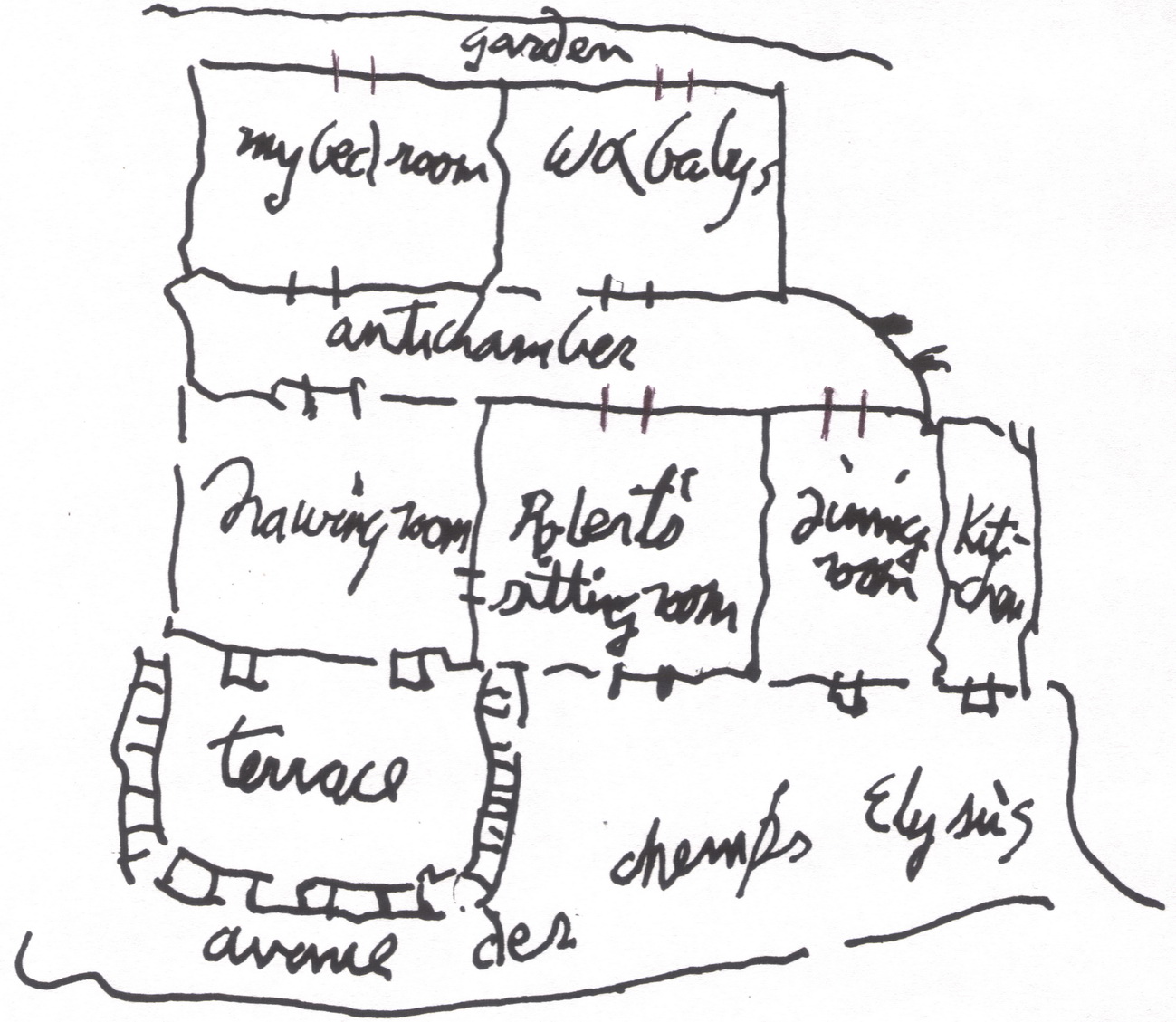
138. Avenue Champs Elysees.
Sunday, Monday, Tuesday– [12–14 October 1851] [1]
My ever dearest Arabel, The first thing I do in our new house is to answer your letter which I find in it, if indeed any legible word may be carried to you by this pale ink– My dearest, dearest Arabel, how grieved I am to hear of your rheumatism! Why what can you have done that such grievous suffering should have befallen you? stayed out in the fog at the Refuge or some other as imprudent thing, I dare say. Oh, Arabel, tell me exactly how you are & whether this strange, astonishing journey to Kinnersley has done you harm or good. It will do you good, I think, in certain respects, and I am very glad that you are about to take it—and yet I shall feel rather uneasy till I hear that you do not suffer more from the rheumatic pains in consequence of it. It seems a risk to run, setting out so soon, when you have by no means recovered—as it is plain you have not. You went to Dr Hamilton, I hope, before you left London. And do, in the country, wrap yourself up well, & dont think of such madness as going out “sketching” at this time of year– The resource of “picking mushrooms”, I wont shut you out from (will there be any better at Kinnersley?) but the “sketching” may cost me too dear, for me not to cry out against it in time. After all, the change of air & scene will do you good, I hope & pray. Write to me faithfully & very often, for your letters are too precious, to do without beyond a short breathing-time.
We are much pleased with our apartment. The situation is splendid really—and to see so much of the life & gaiety of Paris trailing between the trees, of the great avenue by lamplight yesterday evening, under our windows, kept us fixed at them when we ought to have been unpacking our boxes. Then the rooms themselves, though not very large, are bright & comfortable, carpeted throughout, & with all sorts of luxurious chairs everywhere. We have strewn our books about the drawing-room, & drawn the curtains close to keep out the sun, & opened the desk on the table—& now it looks quite artistical & as it should look– Illus.
There’s a room for a cuisiniere [2] up stairs, & we have taken a very nice-looking, cheerful person, who is to keep the apartments clean, make the beds &c, & wait, besides cooking, & to receive twenty two francs a month. Yes, and, Arabel, we went yesterday to a ready-made linen ware-house & bought two pairs of cotton sheets for her, at 3s–8d the pair– So much cheaper than any I could get in England, you will remember. They asked me 7s–6d at Moles’s, [3] & at the shop in Crawford Street, 5s—and these French ones are even made! Do you know, I had not courage to ask the price of the linen sheets: I had a sort of inward assurance that they would be cheaper here than those we got with so much pains in London. For observe, the cotton sheets are excellent—as fine as they need be. And we bought six pillow-cases of fine cotton for our own use, at a shilling each, beautifully made. Also, we bought knives & spoons & forks for common use, five pence each the spoon & fork, & you could not tell them from silver. We can use them perfectly ourselves till we get our plate over, & afterwards they will do for the kitchen. The knives were ten francs the dozen. Altogether, we thought we did very well & very unpoetically. What keeps pleasing me most is the climate. “Fires,” my dearest Arabel,!! why we could not bear such a thing. I am sitting with the windows thrown open, quite oppressed with the heat, & really Robert & I felt it a difficult matter to do our walking yesterday & the day before. The thermometers stood at seventy on the Boulevard, out of the sun. I cant help thinking it must be unusually warm weather for Paris, seeing that Florence last year by no means was as warm at this season. As to England, you cant compare an English climate with anything else in the world I do believe. It has a supremacy in badness. How people can go on breathing there, with a chance of getting out of it, fills me with wonder. You cant tell what it is, till you do get out of it, .. there’s one explanation. You dont know what it is to get free of that leaden paper-weight of low sky which presses you & creases your very soul. Robert gravely suggested the other day that the extraordinary evils of your English climate might arise from a general deficiency of drainage—& that natural philosophers may in time find out a remedy. In which case, I shall belong to the Anti-fog Law League, remember, & do my duty as a zealous female Cobden. [4]
Meanwhile, it is very pleasant here in this blaze of sunshine & lovely clear air. Did I tell you that we were on a second floor? But the staircase is very easy, & I have nothing to complain of anywhere. The garden-trees wave deliciously against the bedroom windows, and the mixture of quiet & cheerfulness is charming! Miss Haworth has sent us a letter of introduction to Lady Elgin, [5] & we mean to present it, now that we are settled, chiefly because she knows Lamartine & various of the notabilities. Also, Carlyle procures for us from Mazzini, a letter to George Sand. Poor Carlyle was in great anguish all the time he was in Paris. As a visitor to Lord Ashburton, I suppose he did’nt like to leave his host at the hotêl de Meurice, and he was distracted at the hotel, what with noise, & light—he used to get up at four in the morning & smoke, to keep himself from going mad outright from the continual want of sleep, he said. Lord & Lady Ashburton [6] seemed to have been full of attention to him—took him to Lord Normandy’s, [7] introduced him to M. Thiers, & drove him about in the carriage from one end of Paris to the other, day after day. The driving about Paris was the only thing he could bear– Everything else appeared to go sadly wrong. At dinner at Lady Sandwich[’]s [8] (when he had resigned himself to the evil of French cookery) up came M. Prosper Merimèe, “academician,” [9] and began to talk down Goëthe & Jean Paul. He bore it for twenty minutes & then rushed away to his pipe, not to cry out “Why you impertinent blasphemous scoundrel, what do you mean!” Poor Carlyle. It was very unfortunate altogether. He kept saying, “If I had but come to you that first night—”! His two last evenings he did spend with us & was most interesting. I like him very much. I never saw a writer so like his own books—that is, in society. He admired Paris after all, & said he would bring Mrs Carlyle some day & settle himself quietly, & then “keep driving about the city at the top of an omnibus.” He “thought he could get most good out of that.” This time he stayed only a week, & Robert had a letter from him yesterday, to say that he had slept ever since!– He “had’nt slept so much these seven years!–” An eight day’s sleep he had had!–
My dearest Arabel, I am very much afraid about Surtees’s disappointment—I mean about the effect it may have on him. He will be much depressed I fear, & Henrietta for his sake. As to the thing itself I have never expected much—for various reasons it seemed unlikely that he should succeed in it. How I wish he had done as Robert would certainly—have given it up upon receiving Papa’s letter. That would have been an opening to a reconciliation, perhaps. Papa wd have found it difficult to keep his position under such circumstances, at any rate. For my part, I feel despondent altogether. But dont let me write of it. [10]
Wiedeman talks of you constantly, & always remembers you in his prayers. You are “la zia”—& Sarianna Browning is “la zianna.” [11] He cant say “Arabel” anyhow. He has taken to call himself Wiedeman, which he has turned into Peninny—by an extraordinary resolution of syllables. [12] I asked him if he loved me, the other day. ‘Less,’ said he—“Peninny Mama’s boy.” He takes the easiest words out of the various languages he hears, & uses them with great impartiality. Wilson reproved him for saying “dinè” today, instead of “dinner”; but he persisted in “dinè”– “Dinner, ah..h” (nasty) he said. Then he has learnt to say ‘Ti voglio bene’ to great perfection, & to translate it by “I love you” … not quite as well pronounced—sounding indeed very much like “I wash you” as Robert accurately remarked. He is delighted with the “nuova casa,” [13] which he calls his “hom” (home) & lays immense stress on the “pateti” (alberi) [14] —to say nothing of the advantage of seeing from the windows all the troops in Paris march to & fro with music & trumpets, and the balloons go up close by, and the neighbourhood of four highly respectable Punches on every holiday. I assure you his cheeks get redder & redder, & Wilson says she never knew him eat such a dinner as he did today. Dont let me forget to tell you that by a singular good fortune, Suzanne our new servant, speaks Italian, relieving poor Wilson from a most uncomfortable condition of non-intercourse. She was in Italy some years ago for seven or eight months, & is delighted to exercise her old accomplishment.
You must understand that this letter is put into the post on tuesday. I have been scratching on day after day, & at last refused to write a word more till Robert went out to bring me some ink. If men’s ‘good deeds are writ in water,’ [15] so is the first part of this letter. Can you read it, I wonder. We like our apartment more & more. Robert, poor darling, has taken to his new room with green curtains, & sits there half in sun & half in shade, “doing” his Shelley to his heart’s content. “Monday,” he said, “was the happiest day he had had since he left England; and we never have lived in a house, he likes so well as this.”! So ‘Casa Guidi’ is slighted you see—dear Casa Guidi. I am faithful, at least. “among the faithless, faithful only found”! [16] The truth is, his room is very comfortable, and, the blaze of sunshine we have lived in since we came, is most inspiriting, taken in connection with the stir & quiet & brilliancy of the great Paris life as seen from the windows. Last night, (that is, as late as half past six) he & I were walking in the crowd, & at last standing quietly on the bridge [17] which faces the chamber of deputies, looking down into the beautiful Seine & up to the amber skies beyond, & round on the fantastic city drawn out in gas light. It was an enchanted scene altogether. The fountains, like silver mists, seemed hanging in the air by a spell– And I was there without a shawl, even. As to my cough, I have quite forgotten it; I believe it is all but gone if not utterly. Oh—and I am delighted that Robert should be so pleased: he is really pleased. Our divorce is at end, Arabel, .. I mean the divorce which London dissipations made necessary for the time. Now, we are always together again, except when he writes about Shelley in the next room. “I feel in such good spirits,” he says! Your letter relieved me in some respects, though it gave the bad news about your unwellness. We must leave everything in God’s hands—but there is a sort of lunacy which does’nt come under the doctors. As to my marriage, that was the absolutest wisdom, I maintain, & the event has proved. Some fine kinds of prudence are apt to be confounded with imprudence—but they should never be–
Write to me, my beloved Arabel—oh, let me remember to say that your combs have been comforts indeed– My hair was in splendid curl as I made tea for Mr Carlyle at Dieppe, in consequence of them, and Robert is reconciled to the occasional loss of the lank straight streamers in order to the permanent advantage. I have bought a bonnet—foolishly went to the Place Vendome where bonnets are dearer, & so had to pay eighteen francs, which I grudged rather—fifteen shillings– But it is a pretty bonnet—drawn moroon [sic] satin trimmed with moroon velvet, & Robert is tolerably satisfied with it, which is miraculous.– Arabel!—it will be miraculous also if you dont get into a scrape where you are—you dearest of non-conformists!– Certainly to “sit under” Leonard, [18] cant be the most edifying of positions. Tell me all about it, for I feel very sympathetical.
But say especially how you are. Is your grey shawl at all like the one Sarianna gave me, I wonder.
Give my best love to dear Bummy if she cares to have it—& think of me my beloved Arabel at prayer time & love-time, as
your own ever attached
Ba.
Robert’s affectionate love. I dont like to ask Sarianna to take the preserves, as she talked of wishing to take so little luggage. Send me the receipt for the pommade for the hair, as Robert likes it.
I am afraid that Wiedeman does’nt make great progress in theology. We had been talking gravely on religious questions the other day—and at last I said– “Chi è el piu buono di tutti?” [19] To which he answered without hesitation, … “Peninny[.]” Dear Mr Kenyon had the goodness to go to New Cross to enquire about us. We have written to him now.
Address: Angleterre / Miss Barrett / The Rectory / Kinnersley Castle / near Hereford.
Publication: EBB-AB, I, 413–419.
Manuscript: Berg Collection.
1. This letter is postmarked 14 October 1851, a Tuesday.
2. “Cook.”
3. Probably John Watkins Moule, a silk mercer, at 54 Baker Street, Portman Square. There are three silk mercers and ten linen-drapers listed in Crawford Street in The Post Office London Directory for 1851.
4. Richard Cobden (1804–65), reformer and statesman, was one of the leaders of the Anti-Corn Law League.
5. Elizabeth Bruce (née Oswald, 1790–1860) was the widow of Thomas Bruce (1766–1841), 7th Earl of Elgin.
6. Lady Harriet Mary Montagu (1805–57), eldest daughter of Lord and Lady Sandwich (see note 8 below), had married William Bingham Baring, 2nd Baron Ashburton, on 12 April 1823.
7. Sic, for Lord Normanby’s.
8. Mary Ann Julia Louisa Harriet Montagu (née Lowry-Corry, 1781–1862) was the widow of George John Montagu (1773–1818), 6th Earl of Sandwich. Carlyle recollected that “Lady Sandwich’s dinner was wholly in the French fashion, this was its whole result for me,—to see such a thing once. … Kickshaws, out of which I gathered a slice of undone beef, wines enough, out of which a drop of good sherry and tumbler of vin ordinaire … then to the drawing-room for coffee and talk with Thiers and Mérimée, who said, or could say, nothing notable” (Last Words, p. 181).
9. Prosper Mérimée (1803–70), French author and archeologist, best known for his novellas and short stories. A close friend of Louis Napoleon, he served as Senator during the Second Empire. He was elected a member of the Académie Française in 1844.
10. EBB’s comments here and in the last paragraph of letter 2962 would seem to indicate that Surtees Cook had sent a letter concerning his candidacy for the governorship of Wilton Gaol to Edward Moulton-Barrett. The latter evidently replied to Surtees in some negative way, possibly asking him to withdraw from the election. Doing so could then have been “an opening to a reconciliation.” EBB anticipates that Surtees will not win the post. Apparently, she had heard from Henrietta or Arabella that he had failed to gain the necessary support among the Somersetshire magistrates.
11. “Small aunt,” as opposed to “la zia,” meaning “aunt.”
12. A different explanation of the derivation of Penniny (usually spelled Penini) was offered many years later by Pen himself, as recorded by William Lyon Phelps: “When he was a child, he stuttered (he stuttered, indeed, in telling me about it), and in trying to pronounce ‘Nini,’—the name Italians give their children,—he said, ‘P-n-n-n-nini.’ English visitors called it ‘Pénnini,’ and this led to ‘Pen’” (“Robert Browning as Seen by His Son,” The Century Magazine, January 1913, p. 419).
13. “New house.”
14. “Trees.”
15. Cf. Beaumont and Fletcher, Philaster, V, 3, 82–83.
16. Cf. Milton, Paradise Lost, V, 897.
17. The Pont de la Concorde crosses the Seine between the Place de la Concorde and the Palais Bourbon, the seat of the National Assembly.
18. i.e., listen to the preaching of their cousin Leonard Edmund Graham-Clarke, the Rector of Kinnersley Parish.
19. “Who is the best of all?”
___________________