3165. EBB to Henrietta Cook
As published in The Brownings’ Correspondence, 18, 323–326.
Florence.
Jan. 27– [1853] [1]
My ever dearest Henrietta, I have a sudden opportunity of writing by the embassy’s bag (quicker than usual) & I must write to you I feel, even though my letter should be most brief in comparison with my ordinary letters, which certainly it must be. A courier goes, it seems, out of the customary times, & Mr Stuart comes to make us aware of it. There is only about half an hour to write in. But it haunts me that you say I send you few letters– Remember, dearest Henrietta, I know it is much the same thing when I write to Arabel .. & you do remember that Arabel has not two babies as you have. You are the richest of us three in that respect, & have enough to do, I dare say, in counting your monies. That I love you dearly, faithfully, unforgettingly, you know well besides, .. & we really ought (both you & I) to send most of our letters to that darling Arabel who wants them.
So glad I am this morning. Robin Hedley had bewitched Robert to go to Valambrosa today. Such a scheme. Whenever it rains in Florence in the summer even, the calculation is that it snows in the mountains, .. & I, for my part, dont believe they would have found the monastery accessible at all at this time of year. There is nothing like a road at any time. Well, the mad scheme was to set off at six in the morning & return at night—going in a carriage of course to the foot of the mountain. I said everything I could against it—but Kate, who knew nothing about the difficulties, encouraged Robin .. & Robert was rather willing than otherwise to be drawn in .. so it was settled yesterday to my vexation. In the night however the weather changed for the worse & it became impossible. So glad I am. Mr Stuart said last night the plan was a “preposterous folly,” & the path would be found impossible. But you should have heard Penini’s lecture—“I aflaid of lose monts (monks) Wobit (Robert) for you. You tate tare of lis snow on the mountains. And memember to buy Penini lese pipes,”––which were promised to blow soap bubbles, & which could’nt be left out of the more disinterested anxiety.
Dearest dear Henrietta, your letter made me joyous about you, it was such a pleasant sunshiney letter. May God be thanked that you are so happy. I have not got over my jealousy about the little girl-baby certainly, but otherwise I am in tolerable charity with you, & every little thing you can tell me is a great thing to my heart, .. so do write on about Altham’s curls & the other baby’s water-gruel, if you have begun to give such an alien thing. Yes, Henrietta, Surtees is right not to let you exhaust yourself—you did it too much before. Talking of which, I bid you beware of that swimming in your head, & remember what it betokened last time. Do you understand? A word to the very wise. Tell me how the curls go on. A little science at the beginning is suggestive to nature– Wiedeman has been used you know, from first to last, to have his hair washed every morning. Then, before it is quite dry, it is combed with the tail comb just as my hair is combed– No weather takes it out of curl. The ringlets hang smoothly & thickly. It never has been cut at the ends even—for if you once begin to cut it you must go on to cut it continually. We seldom, though sometimes, use a little pommade to it—that is all. I like what you say about the new nurse. [2] Of course she must have too much to do to have time for work now. Even Wilson scarcely makes anything except Wiedeman’s clothes, but those she makes very well, & it is an advantage to know how to cut out & put together. His frills & any embroidery on his frocks, I do myself always– He had an invitation to a luncheon party the other day at the Wills Sandfords. They are very rich people with a great establishment, & have lived for the last twenty years at Paris, because Mr Wills Sandford can live no where else though he hates the French—a curious complication of loves & hates by no means uncommon, I assure you, among the English abroad. Well—Miss Wills Sandford is a fanatical reader of mine, & they have all shown us so much attention that we have opened our hearts .. to her at least—indeed she seems really to set a price on both of us– So Penini & Wilson were invited to luncheon—that is to dinner. He behaved extremely well, .. he is’nt in the least shy now, .. he entered willingly into conversation & told them that Flush & Papa & Mama had each two names .. Flush and Tush, Papa & Wobit, Mama & Ba,—& that he himself did’nt like being called Baby but Penini. After he had dined, however, it was attempted to take Wilson from him to make her dine in the servants’ hall .. upon which poor Penini grew very red & ended by bursting into a fit of sobs. So he had to go with her & return. Afterwards he was taken to drive in the Cascine & brought home in the carriage. He told us it was an “immense party,” & there were “knives & forks & chicken & very pretty flowers.” It’s most amusing to hear that child relate his adventures, which he does everyday to us in the utmost detail. Two days since, it had been raining & we could’nt send him to his usual places of exercise, so Wilson took him into San Felice church opposite– He came back in high force. “Well. I been to church.” (‘Lurch’ he said, but I will spare you the patois this time.) “I said mine prayers. Quantity of lights and flowers. This for gentle Jesus. Boys and girls and mans sing very pretty music. Then a monk go up stairs, (meaning to the pulpit) and tell the peoples to say their prayers and hear what God says.” A capital account, I think, of service & sermon. You may not understand why he always says “Gentle Jesus”. Wilson taught him a verse of a hymn which he repeats with his prayers every morning .. the only form of words he was ever taught, for I like him to pray for what is in his head & heart, & he does it naturally. The hymn-verse is very pretty, I think–
“Gentle Jesus meek & mild
Look upon a little child.
Pity my simplicity
And suffer me to come to Thee.” [3]
So always he says Gentle Jesus, speaking of Jesus. Such a darling that child is, Henrietta. Yesterday I said, as I had him in my arms, “God bless my child” .. on which he repeated, squeezing me fervidly with his “little hands,” “God bless mine Ba”. Oh, he is very fond of calling us Robert & Ba. He always does when he means to be emphatically affectionate & coaxing. Robert has an absolute passion for him just now. Think of Robert’s always going to sit in that child’s room while Wilson is putting me to bed, for fear he should wake & cry. If he wakes & sees Robert there he is satisfied, & lets himself be sung asleep, quietly.
Yesterday a gentleman came to propose taking this house for four months from March. It is not decided yet—for we have to consider terms & much besides– Robin & Kate passed another evening here the day before yesterday, & (as we have a piano at last) we heard her sing. She sings very agreeably—but there is nothing in any way remarkable about her singing—& I was disappointed. They seem very happy indeed– I like her, & think her pretty.
Oh Henrietta, I must go. The hour strikes. Next time you have a letter it shall be longer. Couriers wait for nobody you know. Kiss the babies for me. Best love to Surtees from both of us– God bless all of you.
Your ever attached Ba–
I am very well.
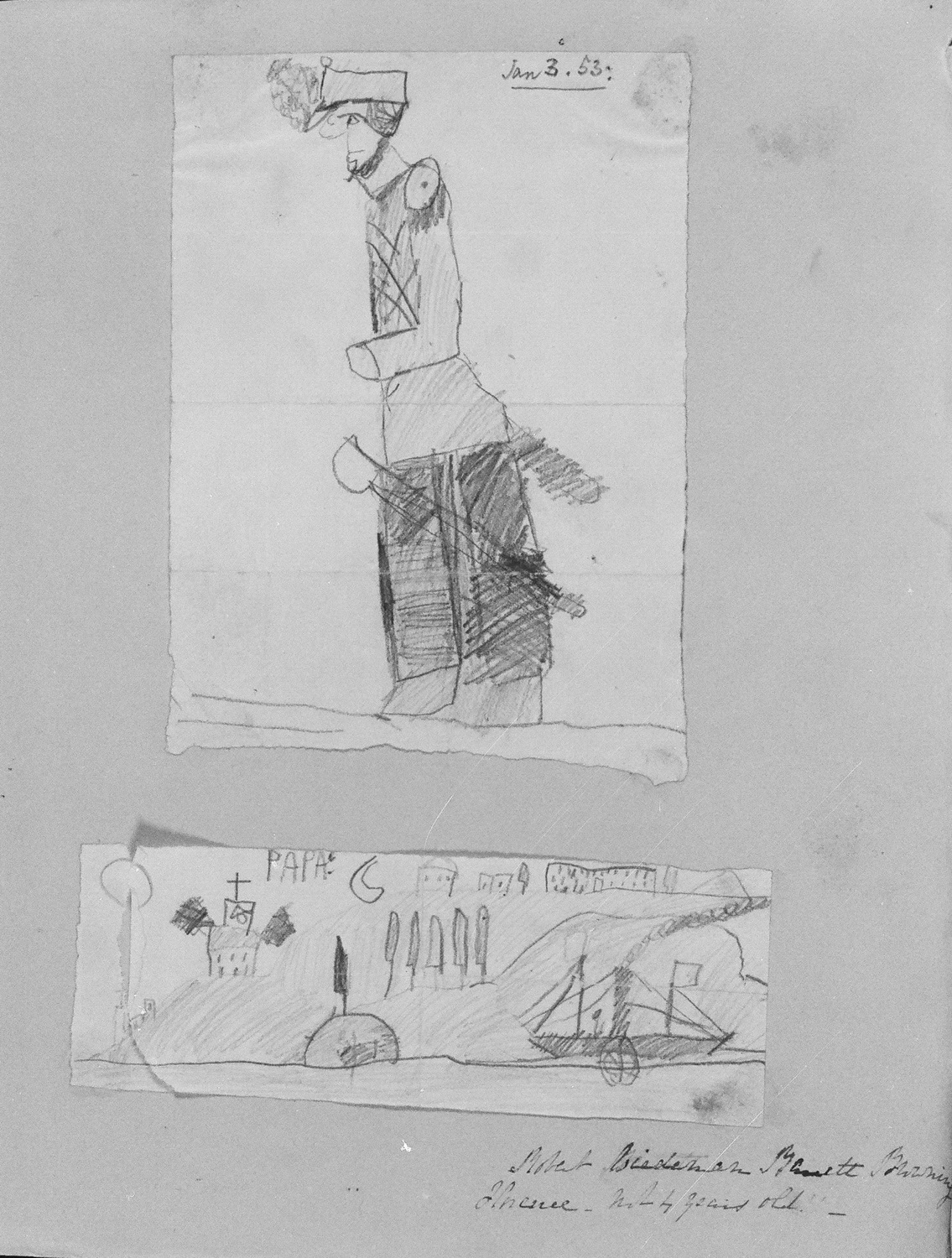
Here are drawings of Penini which Robert pushes in– Illus. [4]
Oh no, indeed .. Robert wd hang me up on a tree if I gave him lessons! Lessons—no indeed! But he learns things by instinct–
By the way, I was saying to Robert the other morning that he could’nt remember you as he did Arabel– “Yes”—he cried out, “I memember tuite well—and lity Baby too, & toys.”
I am so anxious to hear again from Wimpole Street—so anxious.
Publication: Huxley, pp. 174–176 (in part).
Manuscript: British Library.
1. Year provided by EBB’s declaring that RB would hang her “up on a tree” if she gave lessons to Pen. She wrote the same thing in letter 3163.
2. Esther King, who had been engaged by the Cooks on 13 November 1852. She was still in their service as of 29 June 1855.
3. Charles Wesley, “Gentle Jesus, meek and mild” (1814), stanza 1.
4. Henrietta pasted these drawings by Pen (see Reconstruction, K88 and K89) in her album (see Reconstruction, L205). Beneath them she wrote: “Robert Wiedeman Barrett Browning. Florence. Not 4 years old.” These drawings are reproduced facing p. 305.
___________________