3528. Robert Bulwer Lytton to EBB & RB
As published in The Brownings’ Correspondence, 21, 94–98.
Paris.
Sunday. March 4th 1855.
Hurrah! Jubilate! A letter from my dear ones at Florence my King and Queen,—and full of royal love! “Benedetto sia il gio[r]no e ’l messe e ’l’anno”! [1] and blessed be you both, with thanks of mine again, and again, for the joy you have given, the good you have done me, by this most welcomed of letters. Yesterday the winter broke—gave up the long siege of Hope & Health—those allies of life which were nigh starved out, and showed signs of retreat. This morning I woke earlier than usual with a half-sense of violets somewhere, and pleasant things at hand: The dear Spring all but looked thro’ the window at me; and by and bye came your letter, on the strength of which I have gone all day, in the spirit, rejoicing.
Your silence needed no explanation: mine, perhaps much: I hope my letter of last week will already have reached you: but here again let me say that had I known how that sickness & care had been among you, words of mine should not have been wanting to the expression of my sorrow—of my hope,—of the thousand loving and grateful thoughts of you which keep, in my heart your memories “quiet & fragrant, as their home befits.” [2] It is not the least part of the happiness which your letter has brought me to know that my dear Mrs Browning is better and stronger again, and to know how much the joy of this must be shared by those other friends of ours at Florence.
You talk of being here in May or June–
In such a whirl-i-go-round of a world as this I cant look thus far before me without growing dizzy: but I do desire beyond all things to meet you speedily again. The sight of your faces and the sound of your voices would bring me more good to body and soul than all the herbs & juices in the Pharmacopœ[i]a, and all the books from Plato to Thomas A Kempis.
I have been full of unsettled and unsettling plans for the summer—Como—Venice, the Crimea, Scotland—all castles in Spain—and the beginning of Spring, the pricking in the blood—the voice of the Turtle with “Arise and come away” [3] make one long to be miles out of sight of one’s self. But, so far as in my power lies, I shall guide my movements by yours, and lose no occasion which can bring me once more the warmth of your hand and the light of your eyes. So if you say “Paris in May or June” May and June, please God, shall find me here. In the meantime Pray let me hear oftener from you, and you shall find me not an ungrateful or a niggard correspondent.
The kindness with which you speak of my Book adds to my desire that you should soon see it. Until now I had lost almost all interest in its fate, but the chance sight of an advertisement with the words “ready in a few days” [4] makes me think that “Militia est potior—quid enim? concurritur: horæ momento, cita mors venit aut victoria læta.” [5] I certainly both hope & think you will recognize improvement.
The name I have chosen was suggested by the tradition of a certain Ann Meredith, niece or sister (or something else) of Owen Tudor’s who married into the Lytton Family. [6]
Now the next great cause for which I have to thank you—is your more than kindness to the Wilsons—my friends. My appreciation of this, & gratitude for it, is far far larger, believe me, than my power to give it utterance—thinking of all the kind things you have done and said. It was thoughtful and gracious of you to relieve that diffidence which I felt in introducing them to you, by writing to me thus warmly & generously of my friends. I well know that there is much in her wh will merit your kindest feelings and I trust that on a closer acquaintance you will not fail to see it.
I have heard from her frequently about you. Seldom, indeed, a letter without some grateful mention of you, or kindly-given scrap of news about you, which ever gives me pleasure. She complains however very much of her own shyness & timidity & fears you will give little where, she thinks, there is so little to be given in turn. Again, and again thanks to you both in their, and my own behalf.
I thoroughly understand, and most heartily agree in what Browning says as to the fault of Modern Poetry for the most part. This, is what I quarrel with in B. Norton’s Poetry. He splashes & heaps together, similies [sic] and Epithets, just as a child or a savage who had got hold of a palet [sic] & brush would do with the painter’s red and green, and blue, because the colors are attractive in themselves, but with no view to the development and harmony of a Picture. Again, if he paints you a field, he marks out—for an almost offensive prominence,—every blade of grass: just because he knows that there are blades of grass in the field, but oblivious that no body can see them all at the same time, and that, if observed too closely in particular,—the effect of the whole grass-field—in the general—is lost.
I remember that in one of his Early Picture’s the Founder of the Pre-Raffaelite School in Engd [7] —(whose name I dont like because I cant spell it) took pains to paint every wisp and fork of straw in Noah’s Ark, whereas a few judicious touches of the right color in the right place would have been (artistically) fifty times more like straw, and would not (as was the effect of the more elaborate representation) have altogether upset the Picture.
This is a vice which I have recognized and endeavoured to correct in my own poetry: and I shall write to B.N. to warn him off such a quicksand; but he wont listen, I hear, to a word from anybody.
This news of the dead Czar, takes away one’s breath. I cannot but suspect “swords, halters, poisons” [8] in the matter. There is That at work in the world just now which might well convert Atheism to Fatalism. Shall we see the end of the Vonder? [9] And when, if so; and how?
Mrs Browning says there is another life to be lived at Paris, than that which I have been neck-deep in. I know it: and more,—that every man, in every place, is responsible to God, to Man, and to himself, for the life he leads: and that the “manly and the learned Soul” is ever able “to spin its own free hours.” [10] I am ashamed of the many unmanly & unchristian like letters I have written, and of the many yet more vain and foolish thoughts I have given way to, here. All this has been the result of a feverish effort to escape from some thing in myself which I cannot define & dont understand. I would beg not to be judged by this any more than a sane man should be by a past or passing delirium, when his pulse was over a-hundred, and all his organs inflamed. I know, and will yet follow better things.
I saw Thacker[a]y here some weeks ago, and did not grow, in our one or two interviews, to like him very cordially, altho’ he was very kind & civil to me. Dickens, too, quite lately I met at dinner somewhere, and was impressed, more than at any other time before, by a something powerful and electrical about him, of vigorous intelligence & goodness. I perceive that ALEXANDER [11] .... Smith, is chanting War Songs .. Very much in the fashion of Mrs Brotherton’s greek writing as thus,
“England. France. Glory. Trumpets. Cannons.
Thunder. Smoke. Hurricanes of horse.
Volcanos of Artil[l]ery. Charge! Dash!
Splash! Crash! Smash! Hash! Fizz-Wizz.
bang. bang. bang!!!!… Glory. England. France.”
The talk here—has been of the Emperor going to the Crimea. [12] But no one, except himself—if he—knows anything about it. I have thought he might be waiting for Prussia to sign, and that when sure of his Frontier—he would be off. But this news will, probably enough, change all plans, if any have been formed. His Aides de Camp—sleep with an eye open as it were, and dare hardly take a change of linen from their Portmanteaus which are all packed up for a start at any moment.
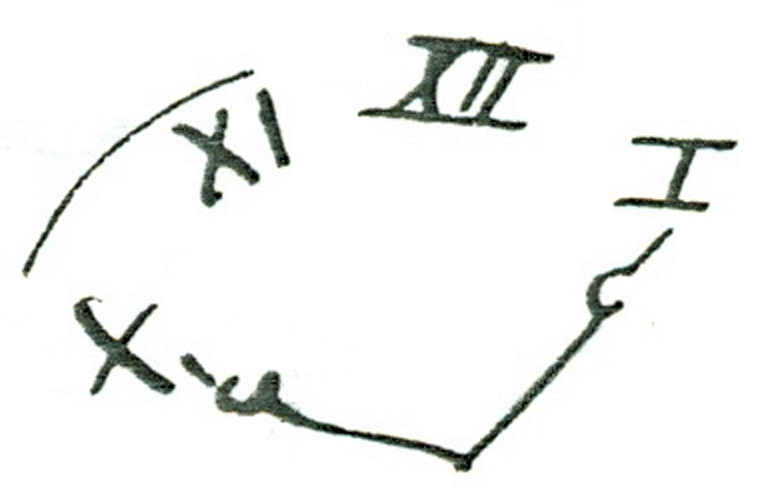
The Clock—pointing to I, Illus. says “Go to bed”[.] I have a wretched bad cold, and must obey. Therefore I gather up into as short compass as may be all that I most wish to add,
1st My love and all kind greetings to Miss Blagden.
2d The same to Fredk Tennyson, to whose kind memory I commend myself with the assurance that I shall always keep him in my own, .. and to Powers, and all other Friends as B. Norton &c.
3d My fondest and heartiest wishes for all health & happiness to yourselves, and the request that you will not lightly cease to remember how truly and affectionately I am your faithful friend,
Robert Lytton.
P.S. I have sent the letter to Miss P. [13] wh you enclosed in that to me.
Excellent good girls; and living very bravely and patiently in poverty despite the “remembrance of happier things” [14] .. they are!
Address: Affranchie / Robert Browning. Esqre / Casa Guidi. / Florence / En Toscane / Italie.
Publication: BBIS-10, pp. 103–108.
Manuscript: Armstrong Browning Library.
1. “Blessed be the day and the month and the year!” Cf. Francesco Petrarca, Rime, “In Vita di Madonna Laura,” LXI, 1 (“Benedetto sia ’l giorno e ’l mese e l’anno”).
2. Cf. RB, Paracelsus (1835), I, 6.
3. Cf. Song of Solomon 2:12–13.
4. See letter 3523, note 4. The most recent advertisement for Clytemnestra … and Other Poems appeared in The Times of 1 March 1855 (p. 14).
5. “A soldier’s life is better. Do you ask why? There is the battle clash, and in a moment of time comes speedy death or joyous victory” (Cf. Horace, Satires, I, 1, 7–8, trans. H. Rushton Fairclough).
6. Owen Tudor (ca. 1400–61) was the son of Meredydd Tudor, a cousin of Owen Glendower, but we have been unable to trace any connection to an Ann Meredith.
7. Lytton refers to John Everett Millais and his painting, “The Return of the Dove to the Ark” (1851).
8. Cf. Christopher Marlowe, Doctor Faustus, II, 2, 22. Czar Nicholas I (1796–1855) died of pneumonia on 2 March.
9. Sic. Perhaps Lytton meant “Wonder.”
10. Cf. Ben Jonson, “On Lucy Countesse of Bedford” (Epigrammes, 1616), LXXVI, 13–16.
11. The name is written in large block letters. Alexander Smith (1829–67) had published in collaboration with Sydney Dobell (1824–74) Sonnets on the War (1855). It is described in the ODNB as “an unashamedly jingoistic contribution on the Crimean War, based mainly on newspaper reports.”
12. Napoleon III had written to Lord Palmerston on 26 February 1855, declaring his intention to go to the Crimea and direct the capture of Sebastopol. In laying out his military plans, the Emperor wrote: “Strike quickly, and Sebastopol will be ours before May 1. … You will tell me, perhaps, that I might trust some general with this mission. Now, not only would such a general not have the same moral influence, but time would be wasted, as it always has been, in memorandums between Canrobert and Raglan, between Lord Raglan and Omar Pasha” (Blanchard Jerrold, The Life of Napoleon III, 1874–82, 4, 62). Lord Clarendon met the Emperor in early March “to talk the matter over. The British statesman found all the persons who surrounded the Emperor—his aides-de-camp as well as his advisors—opposed to the journey to the Crimea” (4, 62–63). During his state visit to England the following month, Queen Victoria, Prince Albert, and Palmerston all counselled him against the venture. In the face of such opposition, the Emperor changed his mind.
13. Marguerite Power (see letter 3355, note 3). “Good girls” refers to her and her two sisters: Ellen Power (b. ca. 1823) and Helen Elizabeth (1836–92). A fourth sister, Louisa Charlotte (1831–1919), had married in 1849 Robert Bennison in Hobart Town (now Hobart), Tasmania.
14. Cf. Tennyson, “Locksley Hall” (1842), line 76.
___________________