4751. Frederick Tennyson to EBB
As published in The Brownings’ Correspondence, 28, 165–174.
Roseville House. Roseville St
St. Helier. Jersey.
Sep. 29/60
My dear Mrs Browning /
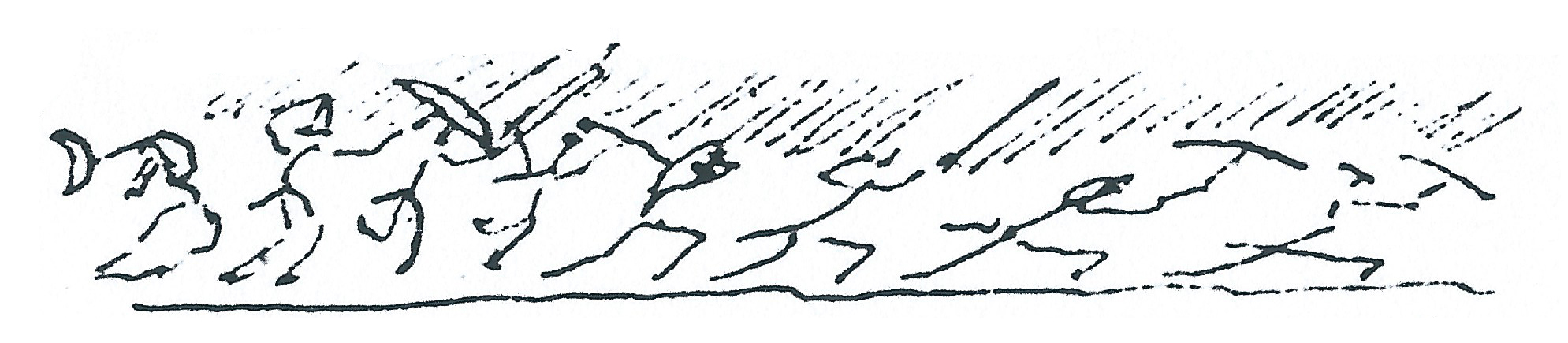
It is now so many months, which seem years, since I smoked any pipe in your presence, or enjoyed the light of your countenance, that I am fain to hold a brief confabulation with you by way of the post—a sorry alternative but I [sic] only available one– First, can you inform me in what way I have offended Miss Blagden to whom some time since I wrote a very loving letter as I thought, enquiring particularly as to your whereabouts this summer—but she neither deigned to answer me or otherwise to communicate the desired information– After waiting I know not how long for her reply I got your address at last through Mrs Alexander– [1] That Miss. B. got my letter is certain for the Alexanders acknowledged the receipt of a note to them enclosed in the same– It appears to me incivility can no further go not to say unkindness—but her motives are a secret to me—at any rate my conscience does not reproach me. — Well—here have I been located in this hyperborean island just one year and maugre hurricanes (of which we have had exactly 120!) gloom and almost continual rain. I must say I have contrived to enjoy a better state of mind and body than was my lot during the last ten years of my sojourn in ‘the pleasant land[.]’ [2] Such a season as we have had has not been experienced since 16– Twelve consecutive months of tempest! The climate has been that of the Second Day before the creation of the Firmament to divide the waters from the waters– [3] The hurricane of the first of june parched all the vegetation of the island like the breath of a furnace, the salt in the sea wind acting like fire or frost– The winters however are milder here than in any part of the North of Italy– The Isoch[e]imenal Line of 40 degrees of temperature describes an immense arc in these waters the apex of which is somewhere in the N. of Ireland it then passes down right through Jersey while the I. of Wight close by has a different & much colder climate– The Island itself is a very pretty emerald cut into pastoral valleys the trimmest of gardens & orchards dotted with decent villas and gray old granite granges—and indented with many quiet murmurous bays—to which you wind under coverture of boughs—and where you may watch the distant waters in continual conflict with the snouted crags that form an iron girdle about us and falling back in inaudible foam: there are also wondrous caverns out of the gloom of which you may look on the yellow sands lying in light, and the blue sea here often as blue under a clear sky as the Mediterranean itself– But under a gale from N.W. the mountains of water that roll in show the difference between that and the Atlantic– As an evidence of the mildness of the climate the standard figtrees grow here as large as in Italy & bear good fruit—and I have seen a delicate fern which is not found they say elsewhere north of Madeira– It must be confessed however that this Summer to me who have been spoiled by 10 months out of the 12 of golden skies has been wo[e]fully weary– The rain it raineth every day [4] —& gray day succeeds to gray day like cloud on cloud, and the glimpses of sunshine are as dark lanterns which throw out a momentary gleam on tower or headland or human face (not divine here) and being instantly withdrawn serve only to make the darkness visible– [5] But I believe this summer ‘rara avis in terris nigroque &c[’] [6] has been universally bad—except in America—bad even in India– An old gentleman who had been observing the sun through his telescope assured me that it was covered with spots this year which may possibly account for the weather if each spot is equal to the withdrawal of some 50,000 miles of solar radiance– But this season contrasts so strongly with that of 59 when the heat was as oppressive & the skies as unclouded as those of Italy that I do not despair of a brighter future– Of one thing I am certain—that for Invalids the winter of Jersey must be as superior to that of Florence as the absence of mountains in the immediate vicinity carrying frozen snow on their heads for eight months of every year—with an air that closes the pores, and rasps the nerves day and night can make it. Poor Maria was at first much disconcerted by the never ending still beginning [7] showers—she had no idea that she was moving from the Zone of Autumnal rains to that of Constant Precipitation Illus.
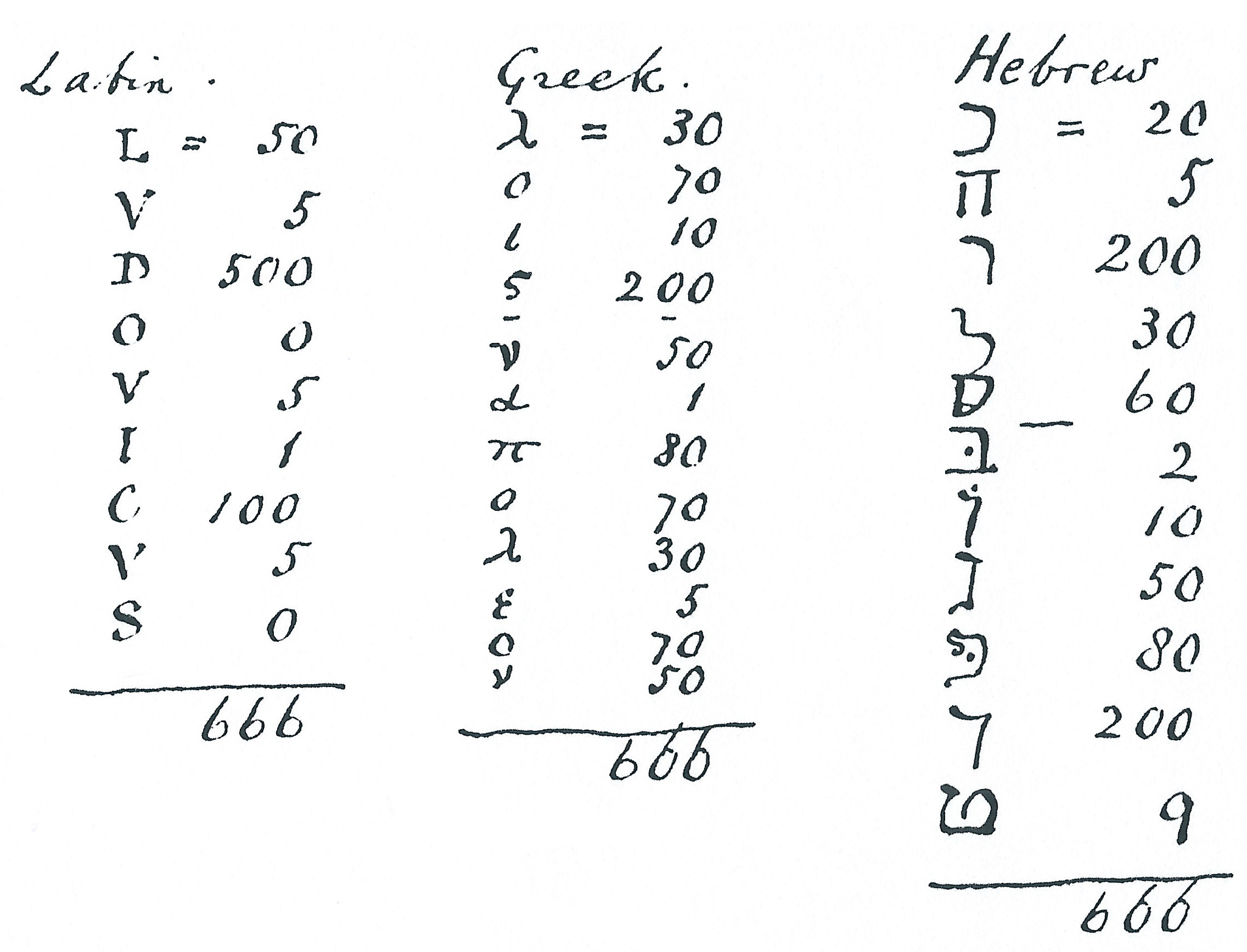
I have succeeded in getting here as pleasant a home in a garden as a man need desire to have where if I am rather less than semi-attached to my neighbours at any rate I am rather more than semidetached from them– However I have succeeded in making acquaintance with some very good primitive people here– The Authorities here are a faint imitation of the American Congress—but the other day they were sticklicking & fisticuffing one another in a public room. The next [day] all the papers reported the creditable fact. It seems to me that your ‘petit roi d’Yvetot’ [8] should be the mildest of mild old gentlemen with a long white waistcoat—shoe buckles—and the pinkest of courtesy. If not the sooner his Kingdom is removed from him the better. Now he does not here either set an example of good behaviour in his own person or organize any means for securing it in the persons of others—for we have no Police here or none worth mentioning[.] Consequently houses are broken into repeatedly and the safety of the lieges depends I think, as much upon the general drunkenness of the ill-disposed which renders them incapable of planning much mischief as upon any preventive provisions– We have had Victor Hugo here this summer he came to attend a Garibaldi meeting and made a grand oration[.] [9] He seems still to be in great vigour & though I could see his face but imperfectly from the opposite side of the room his voice is clear & lion-like– “Messieurs he said, Garibaldi prendra Palerme, apres Palerme, Messine, apres Messine Naples, apres Naples, Rome! apres Rome, Venise, apres Venise TOUT!’[’] [10] It will give you some idea of the people of this place when I tell you that one of the orators a Dr Dickson [11] with exquisite refinement & in V. Hugo’s presence said ‘I am aware that a great gun is coming after me, nevertheless & apropos to Garibaldi there is a man to whom the very best of Lyrics is due– Oh! that you had written an ode to him the true Patriot, the great Liberator, and noble heart—and not glorified the Arch-thimblerigger [12] & ‘gloomy sporting man[.]’ [13] Talk of your Hannibals, Cæsars, Napoleon & here is Gideon—or rather Samson wielding the jawbone of an ass [14] and tormented with no thirst in the shape of selfseeking, or personal ambition which he may wish to quench out of it—a grand heroic man who if he perishes in his mighty struggle will it is to be hoped bring down their house upon the heads of the Philistines. [15] Here is a man to immortalize poets if they should contrive to put a distich or two into mens mouth coupled with his name. As for your L. Napoleon if he were not at all times more anxious for pudding than for praise—though he may do his best to amalgamate them—would he have broken off short and left the selfsacrificing & the undisciplined to carry out his own project—to the imminent danger of its annihilation? But let us hope the best– The ungenerous London Press has given you no credit for the pure ideality which led you to apotheosize the Man who with many here passes for the ‘Beast from the Sea’ [16] and with the most for A Beast[.] You have been figuring in Periodicals as the Imperialist Poetess! [17] Probably you will not be shaken in your opinion by anything I can say—but I confess that few things have appeared to me more strange—not to say startling—than the discovery that a certain Mr Savile has lately made– [18] You are aware that the French Emperor’s name in its entirety is Charles Louis, Napoleon Bonaparte– Now the number 666 [19] or rather different numbers forming a total of 666 turned into corresponding numeral letters of the Latin, Greek & Hebrew languages (recollect the Inscription on the Cross) bring out this name in its completeness. Judge for yourself– Illus.
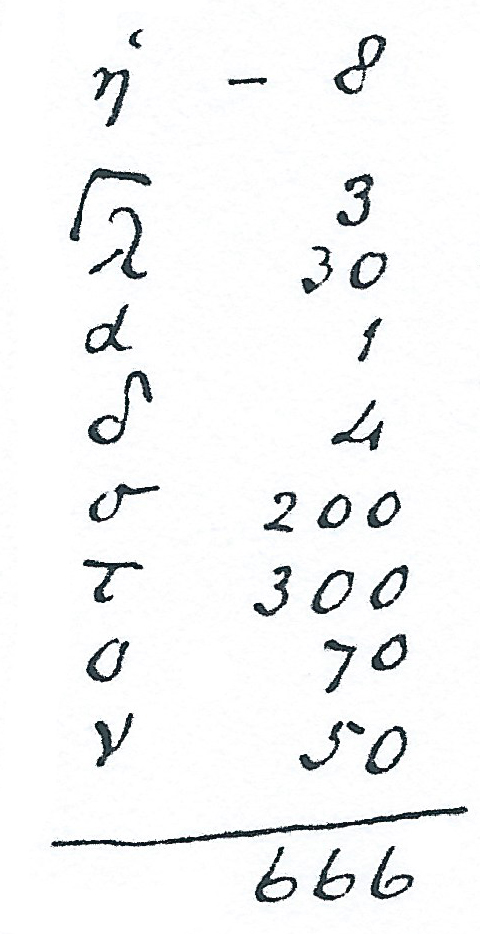
Which we are told is the ‘Number of a MAN!’ [20] Now if he should turn out to be THE BEAST recollect that you with All the World have ‘wondered after him[.]’ [21] “Is this a man like the rest, this miracle’[’] [22] &c again. “Nay, but He, this Wonder &c[.”] [23] It may be some consolation for you to learn that the Chancellor of the Exchequer’s name [24] also furnishes the mystical number—but only approximately. The Greek spelling of course cannot represent the mute terminal e—so that the ἡ, feminine article if you will, may be conceived to represent the English masculine He—Lord Stanley [25] too, I am afraid is a case of the Beast in Greek Numerals, Illus. and no doubt all over the world similar cases might be discovered if one were to take the trouble to look for them—but surely we are not to look anywhere except among crowned heads of great Empires– To say the least of it, the thing has a very queer look– And now that ‘Partant pour la Syrie’ [26] played on all barrel-organs turns out to have been a prophesy as I always believed it to be—what if he should retain the footing in Palestine which he has so easily obtained– [27] They say he is a Jew himself. What if at last he should sell their country to the Jews (& perhaps sell them in so doing)[?] Think what grand new hunting establishments, what unimaginable Trianons, [28] what gorgeous Pleasure Domes he might decree [29] after that grand haul– And would not the unconverted Israelites take him for their Messiah? Would he not accept the offer? and if he did what then? Aye—what then! If it is one of my weaknesses to believe that the Bible speaks the truth in plain language unless there be a very good reason for not doing so—I have so many that you will not perceive it among the rest– Now the Apocalypse, though a symbolical Book, is not entirely so. There are numbers of expressions that can only be taken literally—and ‘the name of a Man’ surely can mean nothing but the name of a man—or what in earth or heaven can it possibly mean? Swedenborg who was undoubtedly one of the greatest wonders that ever lived is nowhere so wonderful as in his comment on the Revelation where he volatilizes the mystical into the more mystical [30] —like gas generated out of steam—& never seems to have considered that passions lead to actions, principles to material results—in short the Subjective to the Objective—and as the foreshadowing of human actions in this world was the burthen of the Old Testament Prophesies—so doubtless it is of the New—or how could Prophesy ever be a ‘sure word’ ‘a light shining in a dark place’? [31] Now to suppose that the name of a Man does not really mean the name of an individual but something else—would be to fall exactly into Swedenborg’s error—666 being one symbol, [‘]the Name of a Man’ would be another—of something incomprehensible—and therefore neither a light, nor a word– As to Mr Gladstone seeing that he publickly kissed the hand of a Greek, idolatrous Archbishop at Athens, [32] thus irretrievably disgracing himself[,] how can we be certain that the convertibility of his name into 666 may not signify that he has if not the ‘mark of the Beast’ at least ‘the number of his name[’]?
But whether L. Napoleon be The Beast or not I wonder at nothing he has done– I only wonder what he is going to do next, and under which of the hats of the ‘Gloomy Sporting man’ the pea will be found. [33] The threatened league of Austria, Prussia, & Russia, seems to have disconcerted him for the nonce, & to have drawn from him renewed pacific declarations– The ‘Rôle militaire’ of France is ended we are told—to begin again as soon as convenient. Rôle seems to me an unconsciously well-chosen term than which nothing could better express the pretentious disinterestedness meaning Savoy and I think I see the confirmation of this insincerity in the bitter refusal with which he met the Swiss demand for a neutral ground of two hours march– [34] ‘Not an inch of ground, not a man’ was the answer– I am happy to say however that the roll of war here is by no means on the decrease notwithstanding– They talk of arming the Merchant Marine, & increasing the Army to 400,000 men so that we shall be able I trust to give a good account of him and the ‘Libyans & Æthiopians at his steps[.]’ [35] You know what I think of the Spiritual Manifestations– Well the subject has been taken up in Thackerays Magazine ‘The Cornhill’ in a sober philosophical Article which offering no explanatory hypothesis draws attention to the evidence in favour of these phenomena being positive facts of a new order– The Editor in a note vouches for the honour & truthfulness of the writer who he says has been a friend of his for 25 years. [36] This in connexion with the tone of the paper which to me has a strong smack of his style of conversation half persuades me that it was written by White of Bonchurch in the I. of Wight, [37] whom probably you know. However this may be, it may be likely I think to revive attention to the matter appearing as it does in the least extramundane of sublunary periodicals at this late hour when all interest in it is well nigh exhausted– Very improperly too I think & for the same reason that I think it a most evil feature of the times in which we live that the Grand Master of all Juggling is himself not merely turned into a joke but positively ignored– Whether or not these phenomena are actually the σημεια [38] which we are told are to precede one whose coming is after the working of Satan, [39] remains to be seen– Meanwhile it may lead to a comparison in devout minds with another class of phenomena which have lately been agitating the Protestant World—I mean the Revivals—I see the testimony in favour of the reality & divine origin of this movement bears the names of many men of high mind and high position and among the Clergy Bishops and learned theologians. Now if these Authorities are not themselves possessed by a spirit of strong delusion [40] —and they do not appear to me to be exactly the class of people likely to be carried away by extravagance of fanaticism—this movement is the true complement of the other and the proper answer to those who imagine that the Holy Spirit would commence operations in the middle of the 19th Century by inspiring and translating furniture—or laboriously spelling out the names of Smith & Jones &c and thereby so astounding those important individuals—as to convert them—but to what? Why to the doctrines of Karnec. [41] Professor Hunt [42] &c i e revived Voltairianism and farragos of blasphemous lies—both Antichristian & Antiscriptural. The fruits of these revivals (others there may have been during the Xn Æra though none so marked & so great) are unmistakeable—a sudden & total change of life in hundreds of individuals steeped to the lips in every species of corruption—without any recorded cases of relapse at least none that have come to my knowledge—and supposing there have been cases unrecorded. The great majority of those so changed are evidences in their own persons of effects proceeding from causes as much superior to those resulting in mere displays of suspended gravitation, spectral chirography, [43] and metaphysical music as the Soul is to the Body–
I should very much like to have your opinion of Alfred’s ‘Idylls of the King[.]’ I maintain that it beats anything he has written as a connected Poem—and so the public seems to think– It has had a great success & I think fully deserved– Vivien and Guinevere are particularly fine– As for our friend Lytton’s Lucile it promises I think to be the most evanescent of human productions– I cannot describe to you the nausea I feel at being jerked along by his unmeaning rhythm—as unpleasant in its motion through the Sentimental—as a Tuscan calessino or Neapolitan corricolo [44] through a valley of vines—but it is as bad as seasickness to wobble along through the stale passions and vices of aristocrats—turning corners of fetid immorality praised with the faintest of condemnation—for instance—“his vice by extreme perseverance became (almost!) criminal[.]” [45] This of an habitual Seducer! truly the moral side of this young gentleman’s psychical poligon [sic] may be pretty correctly measured by such sentences– Parker [46] said to me not long ago, ‘they (the Bulwers) are a bad set[.]’ I have little doubt of it–
I was grieved to hear of the death of Mrs Jameson knowing the regard you had for her & having met her occasionally myself—every old departed face leaves a fresh wrinkle on one’s own. I hear poor Mrs Norton was brought nigh to death by her grief for the loss of her son Fletcher– [47] Brin [48] was living this time last year at Dinan in Brittany close by here & my family met him in their way to Jersey. Last year I visited Alfred for the first time at his Greenery in the I. of Wight. [49] It is a charming spot & he ought to be well satisfied that his lines have fallen & are uttered in such pleasant places as much like Paradise as any British locality can be during the waving of the fiery sword– [50] I trust you have enjoyed a better summer at Siena than we have had here & that you have not since I last saw you suffered in health, & that this letter will find you still at the Villa Amberti. [51] (is that the name of it?) Do not use me as Miss Blagden has done but send me some token, however brief, that I am not forgotten as I have not forgotten you– I hold you to be among the best friends I have, and assuredly those in Italy of whom I retain the most cordial recollections– Maria sends her kindest remembrances to you both & believe me ever yours, most sincerely
F Tennyson
P S. I hope I have not pained you by my random strictures on L. Napoleon– Perhaps I ought not to have said what I have– I fear I may have been somewhat influenced by looking at him through the distorting lens of disappointed avarice– I feel personally embittered against the fellow. I consider that he has robbed [me] of at least £2000. Do not laugh– This is how he did it– Last year in my way from Pisa to Livorno I met a Sardinian General Officer in a railway carriage who assured me it was his firm belief that the Emperor after finishing with Italy, would attack England– This he told [me] he had from headquarters. I mentioned this to many in London, & thought they treated the intelligence with a very unjustifiable indifference– But there arose shortly afterwards a fresh Invasion panic– I need not tell you how Money markets are affected by such a condition of things– Now I had about 160 hundred Pound Shares in the Manchester & Sheffield Railway, which for many years had been quoted at a very low figure indeed—and I felt certain that if I did not dispose of them immediately, I should have to do so eventually at a much greater disadvantage or perhaps realise nothing at all. In that case I should have been greatly damaged myself and several of my brothers would have been completely ruined– I sold them then at £38 and thereabouts– But since then they have risen £10 per share and are still rising– This is my destiny no doubt, as it has always been– But ‘Circumstance the Unspiritual God, and Miscreator’ [52] takes in my mind the form of the French Emperor and I must therefore beg you to be lenient to the results of this hallucination, if it be one–
Address: Mrs Browning / Villa Amberti [sic] / Porta Camollia / Siena / Italy.
Publication: None traced.
Manuscript: Armstrong Browning Library.
1. Lucia Gray Alexander (née Swett, 1814–1916), wealthy heiress, of Boston. In 1853 she and her artist husband, Francis Alexander (1800–80), settled in Florence with their daughter, Esther Frances “Francesca” (1837–1917), artist and compiler of Italian folk songs. The Alexanders, like Isa Blagden, resided at Bellosguardo.
2. Psalm 106:24.
3. Cf. Genesis 1:6.
4. Twelfth Night, V, 1, 392.
5. From Milton’s description of hell in Paradise Lost, I, 63: “No light, but rather darkness visible.”
6. Juvenal, Satires, 6, 165: “Rara avis in terris nigroque simillima cycno” (“A rare bird on this earth, exactly like a black swan”), trans. Susanna Morton Braund.
7. Dryden, “Alexander’s Feast” (1697), line 101.
8. “Little king of Yvetot.” Yvetot is a small town in Normandy, where ruling lords “bore the title of king from the 15th till the middle of the 16th century, their petty monarchy being popularized in one of Béranger’s songs [‘Le Roi d’Yvetot’]” (EB). Tennyson may have in mind the bailiff of Jersey (the island’s chief civil officer), who at this time was Jean Hammond (1801–80). He served in that capacity from 1858 until his death.
9. Victor Hugo, living in exile on the Isle of Guernsey (see letter 3981, note 3), was invited to the Isle of Jersey to give a speech to help raise funds for Garibaldi’s army of volunteers. It was delivered on 14 June 1860 in St. Helier, and a translation was printed in The Daily News of 19 June. Hugo began by describing the atrocities carried out by the Neapolitan government on its own people: “The Kingdom of Naples … has but a single institution—the police. Every district has its cudgelling commission. … This government has, in addition, the instrument of the inquisition—torture. Yes, torture! A sbiro [‘policeman’] … binds the accused with the head between the legs until he confesses. Another sbiro … fixes him upon an iron grating, beneath which he lights a fire. This is called the Burning Chair. Another sbiro … has invented an instrument into which the arm or the leg of the victim is introduced; a screw is turned, and the limb is crushed” (p. 6).
10. “Garibaldi will take Palermo, after Palermo, Messina, after Messina Naples, after Naples, Rome! After Rome, Venice, after Venice, everything.” The translation of this part of Hugo’s speech, as printed in The Daily News of 19 June, reads as follows: “The whole of this adventure is epic; it is brilliant, formidable, and charming like an attack of bees. Behold those radiant stages of his [Garibaldi’s] march, and I predict to you that not one of them shall disappoint him in the infallible fortunes of the future. After Marsala—Palermo; after Palermo—Messina; after Messina—Naples; after Naples—Rome; after Rome—Venice; after Venice—All” (p. 6).
11. Joseph Dickson, M.D. (1819–74), general practitioner in St. Helier’s, Jersey.
12. Dickson refers facetiously to Hugo’s Napoleon le petit (1852), which is anything but a glorification (see letter 3139, note 4).
13. A term applied to Napoleon III by the British press. The Derby Mercury, for example, declared: “Governments of every hue, from that of Vienna to that of Brussels, seem to be at one in the conviction that so long as ‘the gloomy sporting-man’ wields the power of 800,000 bayonets, and dreams of himself as the heir of all his uncle’s conquests, so long there will be no repose or security for Europe” (25 July 1860, p. 2). The OED defines sporting-man as “a sportsman of an inferior type or one who is interested in sport from purely mercenary motives.”
14. See Judges 15:15–16.
15. See Judges 16:29–30.
16. Cf. Revelation 13:1.
17. A reference to a review of Poems Before Congress published in The Saturday Review of 31 March 1860 (see letter 4645, note 4).
18. Bourchier Wrey Savile (1817–88), Anglican clergyman and theologian, published his “discovery” in a pamphlet entitled “Come Out,” or “Go Out:” an Explication of Revelation XVIII. 4. According to the Douay Version (1860): “If we variously write the names of the present Emperor of the French, in the three languages which told the world the death of the Saviour of men, we find in the Latin tongue, Louis, i.e. Ludovicus—in the Greek tongue Louis Napoleon, and in the Hebrew tongue Charles Bonaparte, each one equals the number 666” (p. 17).
19. The number appears in Revelation 13:18: “Here is wisdom. Let him that hath understanding count the number of the beast: for it is the number of a man; and his number is Six hundred threescore and six.”
20. Revelation 13:18.
21. “Napoleon III in Italy,” lines 315–316.
22. Cf. Revelation 13:3.
23. “Napoleon III in Italy,” line 330.
24. William Ewart Gladstone.
25. Edward Henry Stanley (1826–93); see letter 3601, note 7.
26. “Departing for Syria” (1809), a song with words by Alexandre de Laborde (1773–1842) and music by Hortense Bonaparte (née de Beauharnais, 1783–1837), step-daughter of Napoleon I and mother of Napoleon III. During the Second Empire, the song became the de facto national anthem.
27. Following clashes between Druse and Maronite (Christian) factions in the spring of 1860, culminating in massacres of the latter, the great powers in conjunction with the Ottoman Empire authorized the sending of 12,000 European troops to occupy Lebanon (then part of Syria) for a period of six months to protect the Maronites and restore order. “France was to furnish half this number immediately, with the other Powers agreeing to provide further troops as necessary” (Simon Chesterman, Just War or Just Peace?, Oxford, 2001, p. 32). The French arrived in August “but found that the disturbances had subsided and that order had been restored by the Ottoman authorities” (p. 32).
28. The Grand Trianon, a villa on the grounds of Versailles, built by Louis XIV “after the designs of J.H. Mansard” (Galignani’s New Paris Guide, 1861, 575).
29. Cf. Coleridge, “Kubla Khan,” line 2.
30. Presumably, Tennyson has in mind a passage from Emanuel Swedenborg’s The Apocalypse Revealed (1766).
31. Cf. II Peter 1:19.
32. Tennyson refers to Gladstone’s diplomatic mission to the Ionian Islands in the winter of 1858–59 (see letter 4346, note 16). We have been unable to confirm the incident mentioned here, but on the island of Zante on 15 December 1858, according to The Morning Post, a Greek Orthodox Archbishop “put out his hand, it appears, to present a petition for annexation with Greece. Mr. Gladstone kissed the hand of the Prelate with reverence, expressing the respect he entertained for the office and calling of the Bishop” (1 January 1859, p. 4). However, Gladstone “went on to say that as to a union with Greece, the thing was a simple impossibility” (p. 4).
33. An allusion to thimblerig, “a swindling game usually played with three thimbles … and a pea which was ostensibly placed under one of them” (OED).
34. While part of Piedmont (Kingdom of Sardinia), Savoy’s northern districts, Chablais and Faucigny, were allowed to be neutral (with security provided by the Swiss) and allowed to maintain a free trade relationship with Switzerland. When Savoy was transferred to France in the spring of 1860, Switzerland worried that the French would end these concessions. However, in a dispatch to Lord Cowley dated 9 May 1860, Lord John Russell enumerated the “securities for Switzerland” that France was willing to provide: “1. Territory. 2. Armaments. 3. Trade. On the first head, I understand the French Government to be willing to … place in the hands of Switzerland any point now in the possession of Savoy necessary to the defence of the Passes leading from Savoy into Switzerland … Under the head of ‘armaments,’— 1. An engagement on the part of France to erect no fortifications within that part of Savoy rendered neutral by the Treaties of 1815. 2. The renewal by France of an old engagement on the part of Savoy not to have armed boats on the Lake of Geneva. Thirdly, under the head of ‘trade,’ France would consent to the extension of what is called the ‘commercial zone,’ by which a part of the neutral districts are exempted from the payment of Customs duties, and in which, therefore, a free trade is carried on” (Correspondence Relating to the Affairs of Italy, Savoy, & Switzerland, British Parliamentary Papers, 1860, pp. 242–243).
35. Cf. Daniel 11:43.
37. James White (1803–62); see letter 3384, note 9.
38. “Signs.”
39. Cf. II Thessalonians 2:9.
40. Cf. II Thessalonians 2:11.
41. i.e., Allan Kardec (1804–69); see letter 4559, note 4.
42. Unidentified.
43. Automatic writing.
44. “Two-wheel carriage,” the Tuscan version being smaller.
45. Tennyson has in mind the following passage in Lucile (1860), I, VI, 2, 21–27: “Both he and Lord Alfred had been / Men of pleasure: but men’s pleasant vices, which, seen / In Alfred, appear’d, from the light languid mood / Of soft unconcern with which these were pursued, / As amiable foibles, by strange involution, / In Eugène, from their earnest, intense prosecution, / Appear’d almost criminal.”
46. Probably John William Parker (1792–1870), who had published Tennyson’s volume of poetry Days and Hours (1854).
47. Fletcher Cavendish Norton (1829–59), eldest son of Caroline Norton (née Sheridan, 1808–77), died of consumption in Paris on 13 October 1859.
48. Thomas Brinsley Norton (1831–77), younger brother of Fletcher.
49. Farringford.
50. Cf. Genesis 3:24.
51. Sic, for Villa Alberti.
52. Cf. Byron, Childe Harold’s Pilgrimage, IV, CXXV, 6–7.
___________________